
What Is an Erne in Pickleball? The Legal Kitchen Bypass
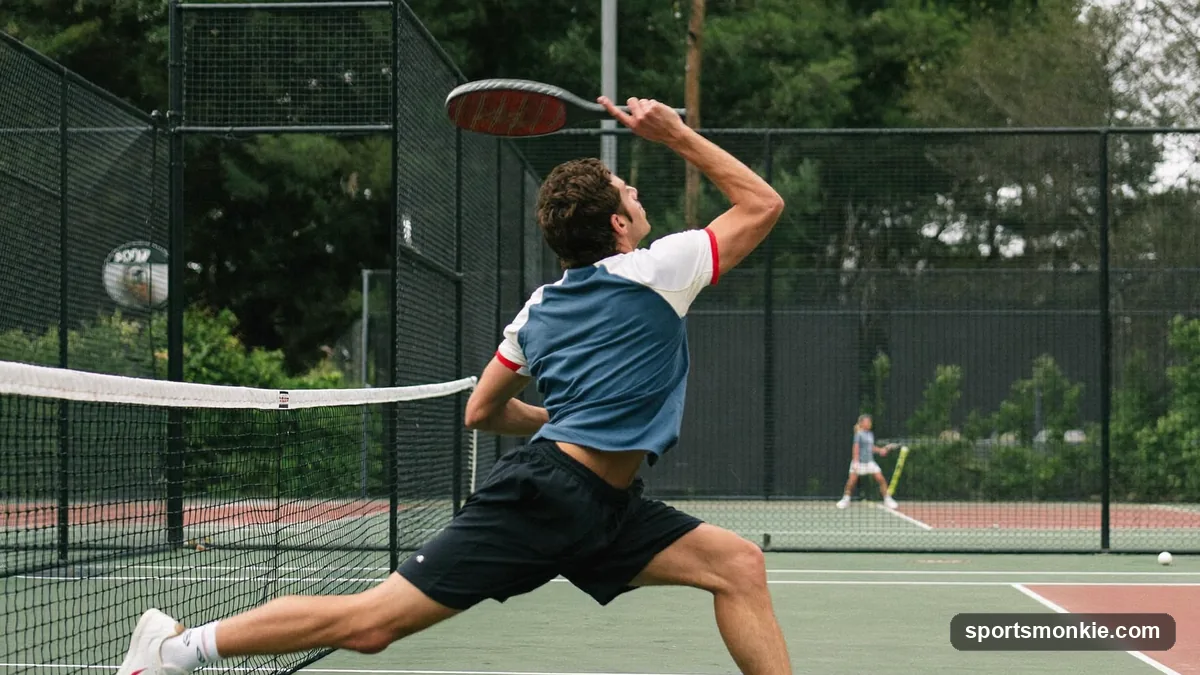
An erne is an advanced shot where you volley a ball right at the net while keeping your feet entirely outside the kitchen — either by jumping over the corner of the non-volley zone or by running around it — and landing in the narrow in-bounds strip beside the kitchen. Because you never touch the non-volley zone during the volley, it is perfectly legal, and it lets you attack a ball at the net that would otherwise be an untouchable dink. It is named after Erne Perry, the player who popularized it.
It looks like cheating the first time you see it — someone appears to leap into the forbidden zone and smack a volley. They do not. The whole trick is landing beside the kitchen, not in it.
Why the erne is legal
The non-volley zone rule says only one thing: you cannot volley while touching the kitchen or its line. It says nothing about volleying at the net from somewhere else.
There is a small patch of legal, in-bounds court right beside the kitchen, between the zone and the sideline. If you can get your feet there — outside the kitchen but still hard against the net — you can legally volley a ball out of the air from a spot most opponents assume is off-limits. The erne exploits exactly that gap in most players’ mental map of the court. Your feet stay out of the zone the entire time; the shot is clean.
How to hit an erne
There are two routes into the position:
- Read the dink early. The erne works against a predictable dink aimed wide, toward your sideline. You have to see it coming.
- Choose your path. Either jump — taking off from outside the kitchen, over the corner of the zone, and landing beside it near the sideline — or run around the back edge of the kitchen and plant beside it.
- Land outside the kitchen, in bounds. Your feet must come down in that strip beside the zone, never touching the kitchen or its line, and inside the sideline.
- Volley it down and away. From that net-height position you can hit sharply into the open court, usually cross-court into the space your movement just left open on the other side.
- Recover fast. An erne commits you to one side of the net. If it does not win the point outright, you are exposed, so it has to count.
Timing is everything. Move too early and a smart opponent redirects the dink to the middle you just abandoned; move too late and you clip the kitchen for a fault.
The erne vs the ATP
The erne is often mentioned alongside the ATP, and they get confused because both are legal shots that seem to break a rule. They are different.
| Erne | ATP (around the post) | |
|---|---|---|
| What it is | Volley at the net with feet outside the kitchen | Shot hit around the outside of the net post |
| Goes over or around | Over the net, from beside the kitchen | Around the post, can be below net height |
| Set up by | A wide dink you can attack at the net | A sharp, wide-angled ball pulling you off court |
| Legal? | Yes, if you never touch the kitchen | Yes, and there is no minimum height |
The ATP has no height requirement at all — because it passes around the post rather than over the net, it can travel well below net level and still be good, which surprises people who assume every shot must clear the net.
Should you learn it?
Not yet, for most players. The erne is a high-risk, high-reward poach that rewards precise footwork and punishes a split-second mistake with either a kitchen fault or a wide-open court. It sits near the top of the skill ladder, above the shots that actually win most rec games.
Build the foundation first — a reliable dink and a consistent third-shot drop will raise your level far more than a flashy erne ever will. Learn to defend the erne (keep your dinks to the middle and at the feet) before you try to hit one, and add it once your kitchen-line game is genuinely solid.
If you found this useful, our breakdown of Around the Post Shot in Pickleball (ATP) covers related ground.
Frequently asked questions
Is the erne a legal shot in pickleball?+
Yes, the erne is legal, as long as you do not touch the non-volley zone or its line while volleying, and your feet land in-bounds outside the kitchen beside the sideline. You may jump from outside the kitchen, over the corner, and land beside it, or run around the zone entirely. Touching the kitchen at any point during the volley makes it a fault.
How is an erne different from a normal kitchen fault?+
Both happen right at the net, but an erne keeps your feet entirely outside the non-volley zone — in the small in-bounds area beside the kitchen — so the volley is legal. A kitchen fault is when you volley while touching the zone. The erne is essentially the legal way to volley at the net without ever being in the kitchen.
Can you jump over the kitchen to hit an erne?+
Yes, provided you take off from outside the kitchen and land outside it, beside the sideline, without your feet or momentum touching the zone or its line. Jumping over the corner of the kitchen is a common way to set one up. If any part of the landing clips the kitchen, it is a fault.
What is an ATP in pickleball?+
ATP stands for 'around the post' — a shot hit around the outside of the net post, below the height of the net, rather than over it. It is legal, and there is no minimum height, so an ATP can pass well below net level. It happens on wide-angled balls that pull you off the court, and unlike the erne it is about going around the post, not around the kitchen.
How do you defend against an erne?+
Aim your dinks and drops to the middle or at the opponent's feet rather than wide to the sideline, since a wide, predictable dink is what an erne poacher feasts on. Keep the ball low and vary placement so your opponent cannot commit early to jumping around the kitchen. A well-disguised dink to the body removes the erne opportunity.
Is the erne a beginner shot?+
No. The erne is an advanced, high-risk shot that demands precise footwork, timing and court awareness, and a mistimed one either faults in the kitchen or leaves your court wide open. Beginners are far better served mastering the dink, the third-shot drop and reliable kitchen-line volleys before attempting it.
Sources
Play & tools
Free browser games and tools — no account, no download.
- Play today's Sports Connections — Today's Sports Connections — daily hints, answers, and play the grid.
- Play Guess the NFL Player — A new mystery NFL player every day. Eight guesses, with a clue on each — plus free unlimited mode.
- Explore all our games →
Related racket sports guides
View all →
Non-Volley Zone Rules in Pickleball: The Complete Reference
The full non-volley zone rulebook: what's allowed, every common kitchen fault, the momentum rule, and the edge cases players argue about most.
Pickleball Faults Explained: The Full List of Common Faults
A fault ends the rally in pickleball. Here's the full list — kitchen volleys, serve faults, out of bounds, two-bounce violations and net touches.
Pickleball Spin Serve: What's Legal and How to Add Spin
The pickleball spin serve explained: the pre-release hand spin is banned, but legal paddle spin is allowed. How to add safe spin the right way.
Third-Shot Drop in Pickleball: Why It Wins Points
The third-shot drop is a soft arc from the baseline into the opponent's kitchen that lets the serving team advance to the net. Here's how to hit it.
What Is a Dink in Pickleball? The Soft Shot Explained
A dink is a soft pickleball shot that arcs just over the net into the opponent's kitchen, too low to attack. Here's why it's used and how to hit one.
How to Hold a Pickleball Paddle: Grips and Grip Pressure
How to hold a pickleball paddle: the continental and eastern grips, the neutral ready grip, and how much grip pressure to use for control.