
Pickleball Faults Explained: The Full List of Common Faults
On this page6
A fault is any rules violation that stops play and ends the rally. When the receiving side faults, the serving side scores a point; when the serving side faults, it loses the serve. That is the whole consequence — under traditional side-out scoring, a fault by the servers never hands the receivers a point directly, only the serve.
Most faults fall into a handful of buckets. Here is the complete working list, grouped so you can see the patterns rather than memorize twenty separate rules.
The full list of common faults
| Fault | What it means |
|---|---|
| Non-volley-zone (kitchen) volley | Volleying while standing in the kitchen, touching its line, or letting momentum carry you in after a volley |
| Serve fault | Serve lands out, in the wrong box, in the kitchen or on its line, fails to clear the net, or is hit with an illegal motion |
| Foot fault on serve | A foot touches the baseline or its extensions, or leaves the correct area, at the moment of contact |
| Ball out of bounds | The ball lands outside the court boundary lines |
| Ball into the net | A shot fails to clear the net |
| Two-bounce violation | Volleying the serve or the return before the required bounce on each side |
| Double bounce on your side | Letting the ball bounce twice on your own side before returning it |
| Ball hits a player | A live ball strikes you, your clothing or anything you carry (except paddle and hand below the wrist) |
| Net touch | You, your paddle or your clothing touch the net or posts while the ball is live |
| Reaching over the net | Making contact with the ball before it has crossed to your side |
Kitchen faults: the most common of all
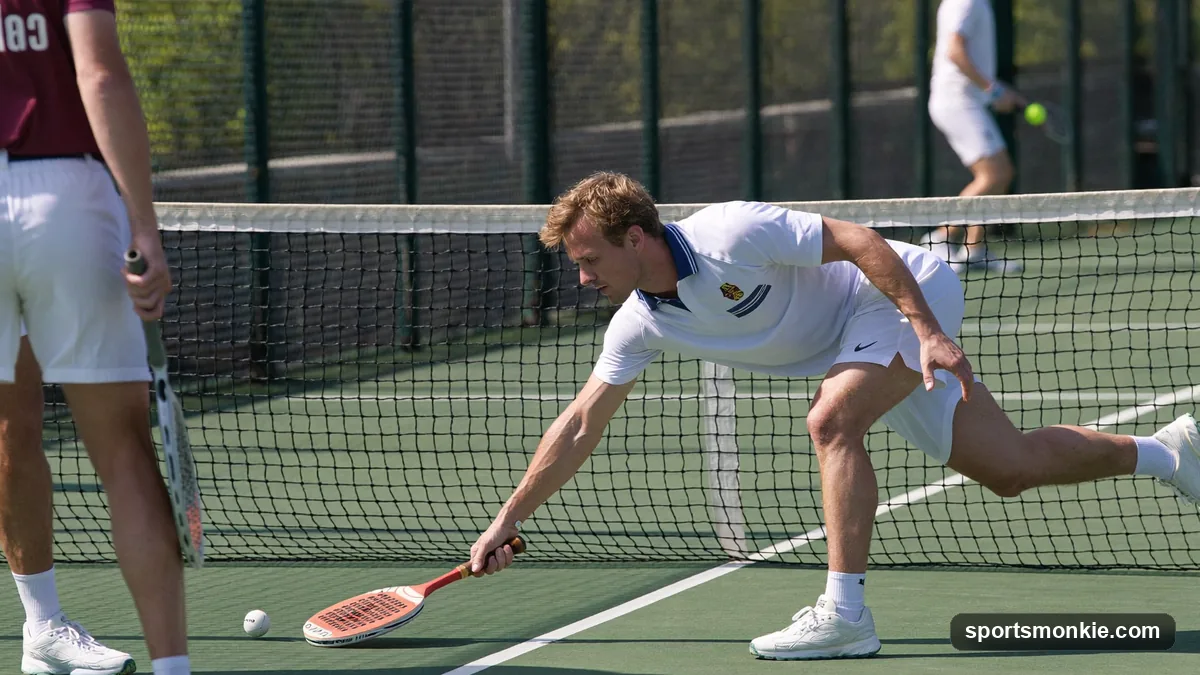
The non-volley zone, or kitchen, produces more faults than anything else in rec play, and almost none of them are about simply standing in the zone — you are allowed to stand there whenever the ball has bounced. The faults come from volleys:
- Volleying with a foot in the kitchen or on its line.
- Volleying, then having your momentum carry you into the zone — a fault even though you struck the ball from outside.
- Touching the line with your paddle drop or a fingertip during a volley.
The momentum rule is the sneaky one: you must fully re-establish your feet outside the kitchen before your next volley.
Serve faults
Serving is tightly regulated, so it is a rich source of faults. A serve is a fault if it lands out, lands in the wrong service court, clips the kitchen or its line, or fails to clear the net. It is also a fault if the motion is illegal — a volley serve must be underhand, below the waist, with the paddle head below the wrist. Foot placement matters too: a foot touching the baseline or its extensions at contact is a foot fault. Our pickleball serving rules guide breaks the legal serve down in full.
Since 2021 there is no service let, so a serve that ticks the net and lands in the correct box is live, not a fault.
Boundary and bounce faults
A ball landing outside the lines is out and a fault against whoever hit it. Every boundary line counts as in — a ball catching the edge of a line is good — with the single exception of the kitchen line on a serve, which must be cleared entirely.
The bounce faults are the two-bounce family. Volleying the serve or the return before it has bounced breaks the two-bounce rule. And letting the ball bounce twice on your own side before you return it ends the rally against you.
Contact and net faults
Two more end rallies fast. If the live ball hits you or your clothing — anywhere except the paddle and your hand below the wrist — it is a fault, even out of bounds, because the ball is treated as if it would have landed in. And touching the net or its posts with your body, paddle or clothing while the ball is live is a fault, as is reaching across the net to hit a ball before it has crossed to your side.
The pattern to remember
Faults sound like a long list, but they reduce to five habits: keep your feet legal on the serve, respect the kitchen on volleys, let the required bounces happen, keep the ball inside the lines, and stay off the net. Get those five automatic and you will rarely give away a cheap point. New to the sport? Our pickleball rules for beginners walks through the same rules from scratch, so you learn what to do rather than just what not to do.
Frequently asked questions
What happens when you commit a fault in pickleball?+
The rally ends immediately. If the receiving side commits the fault, the serving side scores a point. If the serving side commits it, they lose the serve — either to their partner (in doubles) or, on a side-out, to the opponents. Under traditional side-out scoring a fault never gives the receiving side a point directly.
Is it a fault if the ball hits you in pickleball?+
Yes. If a live ball hits you or anything you are wearing or carrying (other than the paddle and your hand below the wrist), it is a fault against you — even if you are standing well out of bounds, because a ball striking you is treated as if it would have landed in. The exception is a ball that has already bounced or is clearly dead.
Is touching the net a fault in pickleball?+
Yes. If you, your paddle or your clothing touch the net or the net posts while the ball is in play, it is a fault. It is also a fault to reach over the net to hit a ball before it has crossed to your side, with narrow exceptions for a ball that has bounced back over the net on its own.
Does the ball landing on the line count as in or out?+
A ball touching any line is in — with one exception: on the serve, a ball landing on the kitchen (non-volley-zone) line is a fault. So every boundary line counts as good except the kitchen line for a serve, which must clear the kitchen entirely to be legal.
Is it a fault to hit the ball before it crosses the net?+
Yes. You cannot reach across the plane of the net to strike a ball that is still on the opponent's side; you must wait until it crosses. Your paddle may follow through over the net after a legal contact on your side, but making contact before the ball crosses is a fault.
What is the most common fault in pickleball?+
Kitchen (non-volley-zone) faults are the most frequent in rec play — usually momentum carrying a player into the zone after a volley, or touching the line while volleying. Serve foot faults and hitting the ball into the net are close behind. Nearly all of them are habit errors that disappear with practice, not misunderstandings of the rules.
Sources
Play & tools
Free browser games and tools — no account, no download.
- Play today's Sports Connections — Today's Sports Connections — daily hints, answers, and play the grid.
- Play Guess the NFL Player — A new mystery NFL player every day. Eight guesses, with a clue on each — plus free unlimited mode.
- Explore all our games →
Related racket sports guides
View all →
Non-Volley Zone Rules in Pickleball: The Complete Reference
The full non-volley zone rulebook: what's allowed, every common kitchen fault, the momentum rule, and the edge cases players argue about most.
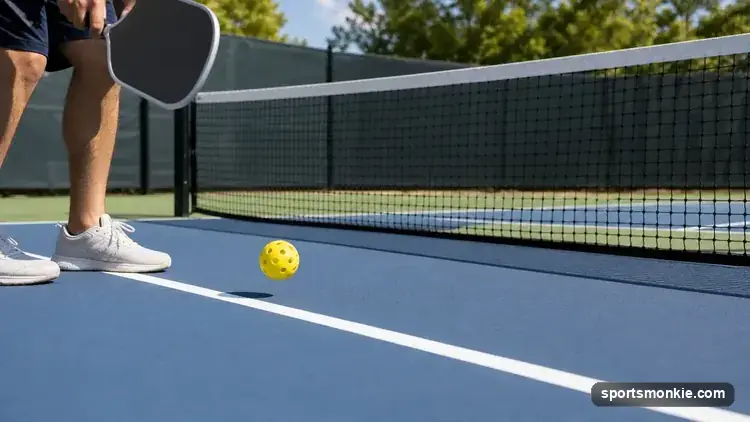
What Is the Kitchen in Pickleball? The Non-Volley Zone Rule
The kitchen is pickleball's 7-foot non-volley zone at the net where you can't hit the ball out of the air. Here's the rule and the faults that catch beginners.
The Double-Bounce Rule in Pickleball, Explained Simply
The double-bounce (two-bounce) rule means the ball must bounce once on each side before anyone can volley. Here's why it exists and the faults it causes.
Is There a Let in Pickleball? No — the Net Serve Is Live
There is no let serve in pickleball. Since 2021 a serve that clips the net and lands in is live and played on. Here's what changed and why.
Pickleball Line Call Rules: What's In, What's Out, Who Calls
Every line is in except the kitchen line on a serve. Players call their own end and give the benefit of the doubt. Here's how line calls work.
Pickleball Scoring Explained: How Points Actually Work
Only the serving side scores in traditional pickleball. Games go to 11, win by 2. Here's how side-out scoring works and how to call the score.