
Pickleball Line Call Rules: What's In, What's Out, Who Calls
On this page5
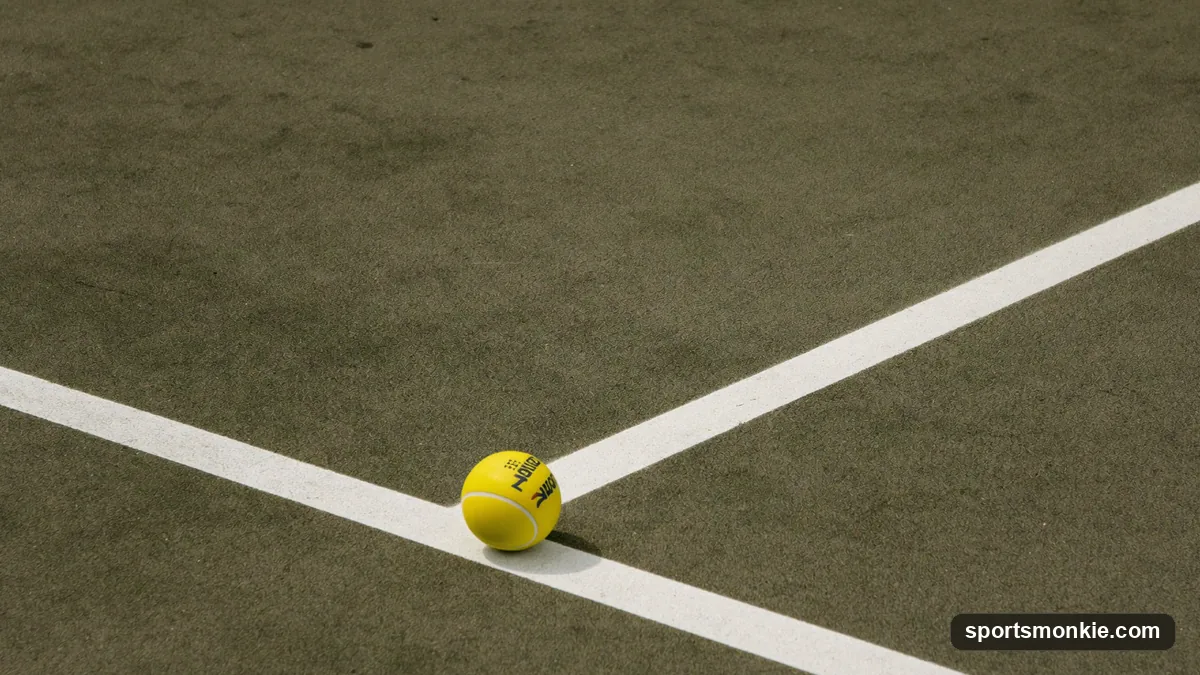
In pickleball every line is in — a ball touching any boundary counts as good — with one exception: on the serve, a ball that lands on the non-volley-zone (kitchen) line is a fault. In recreational play with no referee, you call the lines on your own side of the net, and any ball you cannot clearly see as out gets called in.
Those three ideas — lines are in, you call your own end, doubt goes to the opponent — settle almost every line dispute you will ever have. Here is each one in full.
Lines are in — except the kitchen line on a serve
A ball catching the edge of a line is in. Baseline, sideline, centreline: touch it by a millimetre and it is good. There is no “mostly out” — any contact with the line is a live, in ball.
The lone exception is the serve. A serve must clear the non-volley zone completely, so a serve landing in the kitchen or on the kitchen line is a fault. During a rally that same kitchen line plays as in like every other line. It is a serving restriction, not a property of the line itself.
| Ball lands on… | Serve | Rally |
|---|---|---|
| Baseline | In | In |
| Sideline | In | In |
| Centreline | In | In |
| Non-volley-zone (kitchen) line | Fault | In |
Who calls the lines
In rec play there is no referee, so the players are the officials. You call the lines on your own side of the net — the end nearest you — because that is where you have the clearest view. You do not make calls on your opponent’s end; that is their responsibility.
This split of duty is why honesty is the whole system. Each side polices its own court, so the game only works if everyone calls fairly against themselves. A ball that lands near your baseline is your call to make, in or out.
The benefit of the doubt
The most important line rule is not about geometry — it is about certainty. If you are not sure a ball was out, you must call it in. Doubt always goes to the opponent.
You are only allowed to call a ball out if you clearly saw a gap between the ball and the line. “It looked long,” “I think it was out,” or “it was probably out” are all in. This standard is deliberately strict because you are ruling on your own point, and the sport leans hard on players not talking themselves into favourable calls.
Timing: call it promptly or play it
An out call has to be prompt and audible. Make it immediately — before or right as you would strike the ball — and loudly or with a clear hand signal so your opponent knows. If you return the ball first and then decide it was out, the call does not stand: by playing it, you played it as in.
This stops the worst habit in casual pickleball, where a player hits a weak return, sees they are in trouble, and only then claims the incoming ball was long. Once you have played it, it was in.
When you can’t agree
With no referee and a genuine disagreement, the calling team’s call usually stands, since they own their end. But if neither side is sure and it is truly contested, the accepted fix is to replay the point rather than argue it. Replaying a rare 50-50 costs nothing; a reputation for bad calls costs you every future game with that group.
Clean line-calling and clean fault-calling go together — many “out” disputes are really about whether a shot was a fault at all. If you are still learning the boundaries alongside the serve and the bounce rules, the pickleball rules for beginners guide puts line calls in context with the rest of the basics.
Keep it simple on court: if you did not clearly see it out, it is in — and once you have hit it back, the moment to call it has passed.
Frequently asked questions
Is the line in or out in pickleball?+
Every boundary line is in. A ball touching the baseline, sideline or centreline — even by a hair — is a good ball. The one exception is the kitchen line on a serve: a serve landing on that line is a fault. So during rallies all lines are in, and only the serve treats the non-volley-zone line as out.
Who makes the line calls in recreational pickleball?+
Players call the lines on their own side of the net, the end closest to them, because they have the best view of where the ball lands. You do not call balls on the opponent's side. If a team genuinely cannot agree and there is no referee, the point is normally replayed rather than argued.
What is the benefit of the doubt rule in pickleball?+
If you are not certain a ball landed out, you must call it in. Any doubt goes to your opponent, not to you. You cannot call a ball out because it 'looked' out or you 'think' it might have been — you must have clearly seen space between the ball and the line. When in doubt, it is in.
Can you call the ball out after you hit it back?+
No. Once you return the ball and play continues, you have effectively played it as in and cannot go back and call it out. Out calls must be made promptly — immediately and before or right as you would have played the ball — and clearly enough that your opponent hears or sees it. A late call does not stand.
Why is the kitchen line out on the serve but in during rallies?+
The serve must land beyond the non-volley zone, so the kitchen and its line are all off-limits for a serve — clip that line and it is a fault. During a rally there is no such restriction, so the kitchen line, like every other line, plays as in. It is purely a serving rule, not a general line rule.
What happens if there is no referee and players disagree on a call?+
In unofficiated rec play the calling team's call generally stands, because they own the lines on their side. If both sides genuinely cannot agree and neither is sure, the standard resolution is to replay the point rather than let it become an argument. Consistent honesty matters more than winning one point.
Sources
Play & tools
Free browser games and tools — no account, no download.
- Play today's Sports Connections — Today's Sports Connections — daily hints, answers, and play the grid.
- Play Guess the NFL Player — A new mystery NFL player every day. Eight guesses, with a clue on each — plus free unlimited mode.
- Explore all our games →
Related racket sports guides
View all →
Rally Scoring in Pickleball: How It Works vs Side-Out
In rally scoring every rally is a point, so games move faster — usually to 15 or 21. Here's how it differs from traditional side-out scoring.
The Double-Bounce Rule in Pickleball, Explained Simply
The double-bounce (two-bounce) rule means the ball must bounce once on each side before anyone can volley. Here's why it exists and the faults it causes.
Is There a Let in Pickleball? No — the Net Serve Is Live
There is no let serve in pickleball. Since 2021 a serve that clips the net and lands in is live and played on. Here's what changed and why.
Non-Volley Zone Rules in Pickleball: The Complete Reference
The full non-volley zone rulebook: what's allowed, every common kitchen fault, the momentum rule, and the edge cases players argue about most.
Pickleball Faults Explained: The Full List of Common Faults
A fault ends the rally in pickleball. Here's the full list — kitchen volleys, serve faults, out of bounds, two-bounce violations and net touches.
Pickleball Scoring Explained: How Points Actually Work
Only the serving side scores in traditional pickleball. Games go to 11, win by 2. Here's how side-out scoring works and how to call the score.