
Pickleball Ready Position: Paddle Up, Balanced, Prepared
On this page5
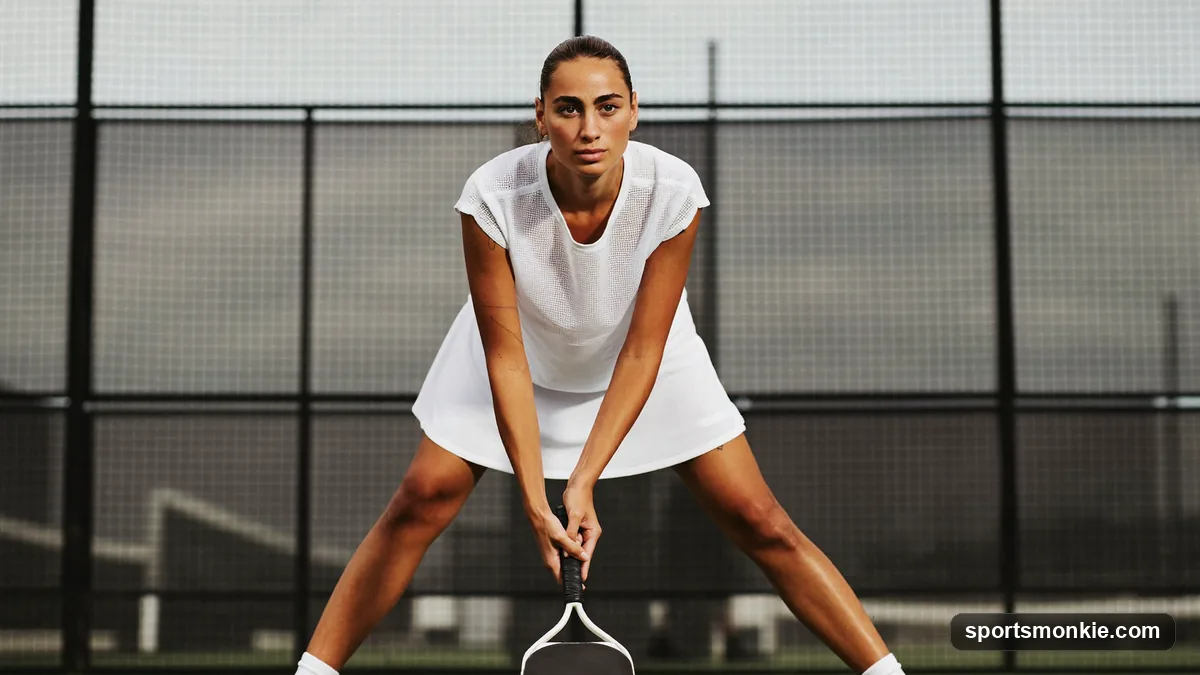
The pickleball ready position is paddle up in front of your body at about chest height, knees bent, weight on the balls of your feet, and a neutral continental grip so either wing is instantly available. It matters most at the kitchen line, where balls arrive in a fraction of a second and a paddle held low leaves you late. Keep the paddle high and centred and you cut your reaction distance to every ball — reset to this position after every shot, because a dropped paddle is the most common reason players get handcuffed at the net.
What the ready position looks like
- Paddle up and in front, around chest height, tip pointing up and slightly forward — not hanging at your side or resting at your waist.
- Neutral continental grip, the same one you use for most shots, so a forehand or backhand needs no grip change. (If grips are new to you, start with how to hold a paddle.)
- Knees bent, weight forward on the balls of your feet, ready to push off. Standing tall and flat-footed is slow.
- Paddle centred, angled slightly toward the backhand, because that is the side that is harder to reach in time and the side opponents aim at.
That is the entire stance. It is simple, which is why it is so often neglected — players know it and still let the paddle drift down between shots.
Why paddle height is the whole point
At the kitchen line, a speed-up reaches you almost instantly. A paddle held down at your waist has to travel up and out to meet it, and that extra travel is exactly the time you do not have. A paddle already up and centred is halfway to every reply before the ball is even hit.
This is why quick-handed net players are often not faster than anyone else — they simply start with the paddle in a position that makes them look fast. Fix your paddle height and you gain reaction speed without gaining a single step of quickness.
Protect your backhand
A subtle mistake is holding the paddle ready for a forehand, which quietly surrenders the backhand. Under time pressure the backhand is the harder side to deploy, so it is the side smart opponents attack. Angling the ready paddle slightly toward the backhand keeps both wings available and defends your weaker side — the same logic that makes a strong backhand volley worth drilling.
Reset after every shot
The ready position is not a one-time setup; it is where you return between every ball. The instant you finish a shot, bring the paddle back up and centred and re-square your feet, rather than admiring the shot or leaving the paddle where the swing ended. This reset is the twin of good footwork — feet and paddle both recover to neutral together. Players who hit a lovely shot and then get handcuffed on the next one almost always failed to reset the paddle.
Adjust the height to your reaction time
| Court position | Paddle height | Why |
|---|---|---|
| Kitchen line | High, chest height | Fast exchanges, no time to react from low |
| Transition zone | Up and ready | Vulnerable mid-court, expect a speed-up |
| Baseline | Slightly lower is fine | Balls take longer to arrive |
Keep the balanced base the same everywhere — knees bent, weight forward — and let the paddle height rise as you get closer to the net. Groove the reset into every volley drill you do, and the ready position stops being something you think about and becomes the default your body returns to on its own. That is when the fast hands finally show up.
Frequently asked questions
What is the ready position in pickleball?+
It is the balanced, prepared stance you return to between shots: paddle up in front of your body around chest height, knees bent, weight forward on the balls of your feet, and a neutral grip. From it you can move or swing in any direction without wasted motion. It is most important at the kitchen line, where fast exchanges leave no time to get ready from scratch.
How high should you hold your paddle in pickleball?+
Around chest height, up and in front of you, especially at the net. A high, ready paddle shortens the distance it has to travel to meet a fast ball, which is the difference between blocking a speed-up and getting handcuffed. Paddles held low at the waist are the most common reason players are late on quick balls at the kitchen line.
Why does paddle position matter so much at the net?+
Because balls at the kitchen line arrive in a fraction of a second, and a paddle held low has to travel too far, too fast to reach them. A paddle already up and centred is halfway to every reply. Good net players are not necessarily quicker — they simply start with the paddle in a position that makes them look quick.
Should the paddle favour the forehand or backhand in ready position?+
Neutral, angled slightly toward the backhand for many players, because the backhand is harder to get to under time pressure and is the side opponents attack. Holding a forehand-ready paddle quietly concedes your backhand. A centred, slightly backhand-leaning paddle keeps both wings available and protects your weaker side at the net.
How do I reset to ready position after a shot?+
The instant you finish a shot, bring the paddle back up and centred and re-square your feet, rather than watching the ball or leaving the paddle where the swing ended. This reset is a habit you build with reps. Failing to recover the paddle is why players who hit a good shot then get wrong-footed or handcuffed on the very next ball.
Is the ready position the same everywhere on the court?+
The core is the same — balanced, knees bent, paddle up — but the paddle height rises the closer you are to the net. At the kitchen line, keep it high at chest height for fast exchanges; at the baseline you can carry it a little lower since balls take longer to arrive. Adjust the height to how much reaction time you have.
Sources
Play & tools
Free browser games and tools — no account, no download.
- Play today's Sports Connections — Today's Sports Connections — daily hints, answers, and play the grid.
- Play Guess the NFL Player — A new mystery NFL player every day. Eight guesses, with a clue on each — plus free unlimited mode.
- Explore all our games →
Related racket sports guides
View all →
Pickleball Volley Technique: Punch, Block and Reset
Pickleball volley technique: the punch volley, the block and reset, and how to volley at the kitchen line without faulting in the non-volley zone.
How to Hold a Pickleball Paddle: Grips and Grip Pressure
How to hold a pickleball paddle: the continental and eastern grips, the neutral ready grip, and how much grip pressure to use for control.
How to Play Pickleball Singles: Strategy and Court Coverage
Pickleball singles strategy: where to serve, how to cover the court, when to attack, and why it rewards fitness and placement over doubles touch.
How to Serve in Pickleball: Technique for a Consistent Serve
A step-by-step pickleball serve technique: grip, ball drop or toss, contact point below the waist, and follow-through for a deep, reliable serve.
Pickleball Backhand Technique: One-Handed vs Two-Handed
Pickleball backhand technique: one-handed vs two-handed, plus how to hit the backhand dink, drive and volley with control and depth.
Pickleball Drills: The Practice List That Fixes Your Game
The best pickleball drills for dinking, the third shot, serve and return, volleys and footwork — a practical list with reps and what each one fixes.