
How to Shoot a Basketball: Perfect Form Step by Step
On this page6
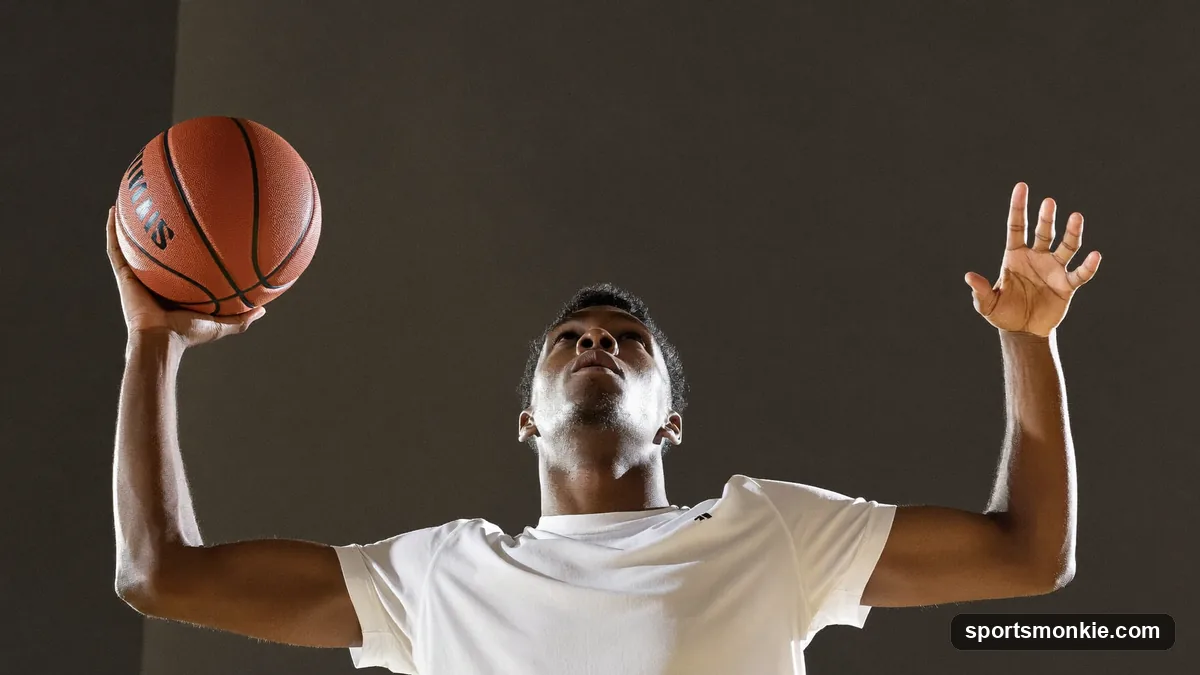
To shoot a basketball, square your feet to the rim, cradle the ball on the fingerpads of your shooting hand with your guide hand resting on the side, and line your elbow up under the ball. Dip into a knee bend, then push up in one fluid motion, releasing off your index and middle fingers with a high arc and a snapped-down follow-through. Get those four moving parts synced and the ball will fall the same way every time.
Shooting looks like magic when a knockdown shooter does it, but it is really just a stack of small, teachable mechanics repeated identically. This guide walks you through every link in the chain, from your feet to your fingertips, and points you toward the drills and details that fix the most common misses.
Start With Your Base: Stance and Balance
Every good shot is built from the ground up. Set your feet about shoulder-width apart and point your toes at the rim, or use a slight stagger with your shooting-side foot a couple inches ahead. Your weight should sit on the balls of your feet, knees soft and bent, hips loaded like a spring.
Balance is the “B” in BEEF for a reason: if your base is off, nothing above it can be consistent. Land where you took off. If you drift forward, backward, or fade sideways, you are stealing power and accuracy from the shot. Beginners should catch the ball already low in an athletic stance so they are not wasting motion. For a full breakdown of body position, footwork, and how the pieces connect, study basketball shooting form alongside this guide.
Grip the Ball the Right Way
How you hold the ball decides how it comes off your hand. Spread the fingers of your shooting hand comfortably wide and rest the ball on your fingerpads, not your palm. You want a small gap of daylight between your palm and the ball so it rolls off your fingers cleanly.
Your guide hand goes on the side of the ball, thumb relaxed, doing exactly one job: keeping the ball steady until release. It should never push, flick, or add spin. A thumb flick from the guide hand is the single most common cause of left-right misses.
Line the seams up the same way each time if it helps your consistency, and check that your shooting-hand index finger sits roughly on the ball’s midline so backspin comes off straight.
Align the Elbow and Load the Shot
This is where accuracy is won or lost. Bring the ball up into your shooting pocket, somewhere between your chest and your shoulder on the shooting side. Your shooting elbow should be tucked in and stacked under the ball, forming roughly a 90-degree angle, with your forearm close to vertical.
If your elbow flares out to the side (the classic “chicken wing”), the ball will drift off line no matter how good your touch is. A quick self-check: from your shooting pocket, you should be able to see the rim just over or beside the ball, with your wrist cocked back so there are wrinkles in it.
Keep your eyes locked on your target the entire time. Pick one spot, the middle of the rim or just over the front edge, and do not follow the ball’s flight. Want a deeper progression of fixes for this phase? The jump shot technique guide breaks the loading motion down frame by frame.
The Release: One Motion, Up and Through
A great shot is one smooth motion, not a series of stops. As your legs extend, your arm extends with them so the energy flows from your feet, through your core, and out your fingertips. Think “low to high” and finish tall.
At the top, snap your wrist so your fingers point down at the rim and the ball rolls off your index and middle fingers. That snap creates the soft backspin that gives you a shooter’s touch and friendly bounces. Release the ball on the way up, near the peak of your jump, so your body adds power rather than fighting gravity.
Here is the sequence to groove until it is automatic:
| Step | Cue | Common mistake |
|---|---|---|
| 1. Load | Knees bent, ball in pocket | Standing too straight |
| 2. Lift | Legs and arm extend together | Arm shoots before legs |
| 3. Release | Ball rolls off index & middle fingers | Palming the ball |
| 4. Snap | Wrist flicks down, backspin | Stiff, flat wrist |
| 5. Hold | Follow-through frozen | Dropping the hand early |
Follow-Through and Arc
Do not drop your hand the instant the ball leaves it. Freeze your follow-through with your arm extended and your fingers hanging down toward the rim, the “gooseneck” or “reaching into the cookie jar” finish. Holding it forces the rest of your mechanics to stay clean and gives you instant feedback on your release.
Aim for an arc of roughly 45 to 50 degrees. A well-arced shot sees a bigger opening in the hoop and turns rim-grazers into makes, while a flat line-drive shot has almost no margin. You should watch the ball rise clearly above the rim before it drops. Guards and shorter players generally want arc on the higher end of that range.
Groove all of this with reps. A steady diet of basketball shooting drills, starting with close-range form shooting and working outward, is how the motion becomes muscle memory. If your overall stroke needs an audit, the tips in how to shoot a basketball better target the habits that quietly cost you points.
Practice Progression and Fixing Misses
Do not start at the three-point line. Begin one to three feet from the hoop with one-hand form shooting, no guide hand, and swish ten in a row before you step back. This is where the correct feel gets wired in. On the NBA court the three-point line sits 23 feet 9 inches out (22 feet in the corners), while high school and most rec lines are 19 feet 9 inches, so build to your line gradually rather than forcing distance.
Use your misses as a diagnostic:
- Short or long usually means a touch or leg-power issue, not alignment. Fix your arc and use your legs.
- Left or right points to alignment: elbow flare, guide-hand thumb, or feet not squared.
- No backspin or flat rotation means you are palming the ball or not snapping the wrist.
- Falling away means your base is off; land where you jumped.
Once your set shot is reliable, layer in the rest of your scoring toolkit. Learn to finish at the basket with a clean layup, get comfortable creating space off the bounce with sound dribbling fundamentals, and understand the full menu of types of shots in basketball so you know which release fits each situation. From there, dedicated work on three-point shooting and a repeatable free-throw technique turns solid mechanics into real scoring.
Shooting a basketball well is not about talent. It is about building one clean, repeatable motion and then running enough quality reps that it holds up under pressure. Nail your base, stack your elbow, arc it up, and hold that follow-through, and the makes will follow.
Frequently asked questions
What is the BEEF method in basketball shooting?+
BEEF is a four-part checklist for a repeatable jump shot: Balance (feet shoulder-width, squared to the rim), Eyes (locked on the back of the rim or the front of the hoop), Elbow (bent to about 90 degrees and tucked under the ball, not flared out), and Follow-through (snap the wrist and hold your fingers pointing down at the rim). Running through B-E-E-F before each rep builds muscle memory and exposes exactly which link in the chain is breaking down.
Where should you aim when shooting a basketball?+
Aim at a single point and commit to it every shot. Most coaches teach aiming for the middle of the rim or just over the front of the rim, since a slightly long miss still has a chance to bank or roll in. Backboard shooters target the near top corner of the square on bank shots. Pick one target, keep your eyes on it through the release, and do not track the ball's flight until it leaves your hand.
What is the correct arc for a basketball shot?+
A release angle of about 45 to 50 degrees gives the ball the largest margin for error as it drops through the hoop. Too flat (under 40 degrees) shrinks the opening the ball sees and turns near-makes into rim-outs; too high wastes energy and hurts your range. Shorter players and guards often benefit from arc on the higher end. You should see the ball peak clearly above the rim before it comes down, not fire on a line drive.
Why do I keep missing left or right instead of short or long?+
Left-right misses almost always come from alignment, not touch. Check that your shooting elbow is directly under the ball rather than flared out, that your guide (off) hand is only steadying the side and comes off before release, and that your feet and shoulders are squared to the rim. A thumb flick from the guide hand is the most common hidden cause. Film yourself from straight on to see which one is pushing the ball off line.
How do I shoot a basketball farther without losing form?+
Range comes from your legs and core, not from heaving with your arm. Bend deeper into your stance, then drive up through your ankles, knees, and hips so the ball is already moving upward before your arm finishes extending. Keep the same clean release and high follow-through. Step back a foot at a time in practice and only extend your range once you can make shots with your normal arc and rotation, never by shot-putting the ball.
How long does it take to improve your basketball shot?+
Noticeable gains in form usually appear within two to four weeks of daily focused practice, but rewiring an ingrained habit and making it automatic under pressure typically takes several months. Consistency beats volume: 150 to 300 quality reps a day with correct mechanics, close to the basket first, will reshape your shot faster than thousands of rushed, sloppy attempts. Track your makes from set spots each week to see real progress.
Sources
Play & tools
Free browser games and tools — no account, no download.
- Play 82-0 — Draft five, one per position, and see if your lineup can go a flawless NBA season.
- Play Era Ball — Draft an all-time NBA roster from a single era, then simulate a season and chase a perfect run.
- Play 32-0 — Draft five college basketball legends, one per position, and chase a perfect 32-0 national title.
- Explore all our games →
- Get the printable bracket — Download and print a blank tournament bracket to fill out by hand.
- Open the TS% calculator — Calculate TS% from points, field goal attempts and free throw attempts — scoring efficiency in one number.
- Explore all our free sports tools →
Related basketball guides
View all →
Proper Basketball Shooting Form: A Step-by-Step Guide
Master proper basketball shooting form with clear cues for your feet, elbow alignment, guide hand, and wrist snap, plus how to build a repeatable one-motion shot.
How to Shoot a Basketball Better: Fix Flat Shots Fast
Learn how to shoot a basketball better by fixing flat shots, tightening footwork off the catch, and building a practice routine that makes your jumper repeatable.
How to Do a Crossover Dribble: Step-by-Step Guide
Learn how to do a crossover dribble that actually breaks defenders: the low hard bounce, the setup that sells, ball protection, and how to score off it.
How to Dribble a Basketball: Control, Speed, Weak Hand
Learn how to dribble a basketball with fingertip control, a low hard bounce, and eyes up. Step-by-step cues plus weak-hand drills to build a real handle.
How to Shoot a Three-Pointer: Range, Power & Footwork
Learn how to shoot a three-pointer with a legs-driven stroke, clean footwork behind the line, and a range-building plan that keeps your form the same at 24 feet.
Hack Squat Form: How to Use the Machine Safely, Step by Step
Hack squat form means feet mid-platform and shoulder-width, back and shoulders flat against the pads, knees tracking over the toes, and a controlled drop to thighs-parallel — here are the cues, depth, and mistakes.