
How to Dribble a Basketball: Control, Speed, Weak Hand
On this page6
To dribble a basketball, push the ball into the floor with your fingertips and finger pads, not your palm, using a loose wrist so the ball comes right back to your hand. Keep the bounce low and hard, stay in an athletic stance with your knees bent, and keep your eyes up so you can see the floor. The single biggest thing separating a real handle from a shaky one is weak-hand volume: dribble your off hand as often as your strong hand.
Grip and Hand: Use Fingertips, Never the Palm
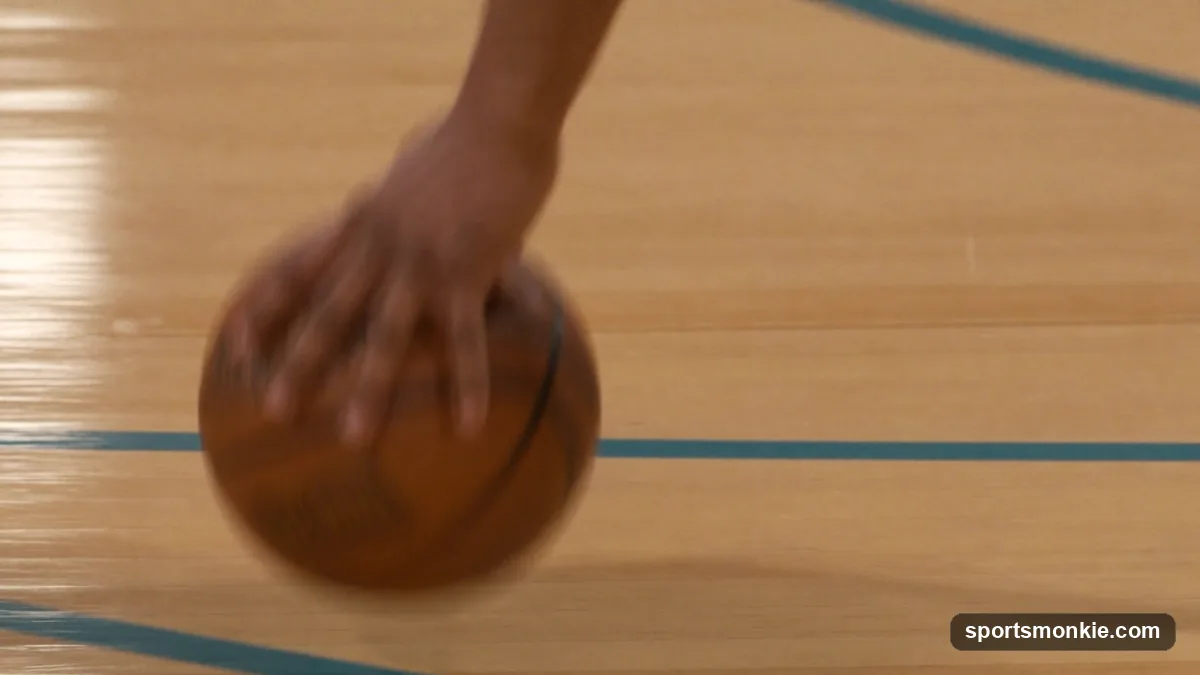
The foundation of every dribble is contact. Spread your fingers comfortably wide and let the ball touch your fingertips and the pads at the base of your fingers. Your palm should never rest on the ball. When the palm slaps the ball you get a loud, dead bounce you cannot steer, and you also risk carrying violations because your hand drifts under the ball.
Think of your hand as a spring, not a paddle. You are not slapping the ball down; you are pushing it and receiving it. On the way back up, let the ball sink slightly into your fingers before you push again. That soft catch-and-push is what gives good handlers their quiet, controlled bounce.
A quick self-check: after a few dribbles, look at where the ball met your hand. If your palm feels the impact, you are slapping. If only your fingers are working, you are on the right track. This same fingertip touch carries over to your basketball shooting form, where the ball should also ride on the pads and fingertips rather than the palm.
Get Low: Stance, Bounce Height, and Power
Your body sets up the dribble before your hand ever touches the ball. Stand in an athletic stance: feet a little wider than shoulder width, knees bent, hips back, chest up, weight on the balls of your feet. This is the same base you use for a defensive slide or a jump shot, so it should start to feel like home.
Bounce height is about control and protection:
| Situation | Dribble height | Why |
|---|---|---|
| Open floor, no pressure | Waist height | Easy control, ready to move |
| Defender guarding you | Knee height or lower | Less air time, harder to steal |
| Protecting in traffic | Below the knee, hard pounds | Ball stays close and quick |
Power comes from a firm, downward push, not from raising the ball high. A common mistake is dribbling gently and letting the ball float up near the chest, which hands a defender an easy steal. Pound the ball into the floor so it snaps back fast and spends as little time in the air as possible.
Keep your dribbling hand roughly above the ball and slightly to the outside of your body so the ball bounces up beside your hip, not in front of your feet where you can kick it.
Keep Your Eyes Up
A handler who stares at the ball is playing blind. You cannot see an open teammate, a help defender rotating over, or a fast-break lane if your chin is down. Training your eyes up is a deliberate skill, not something that just happens.
Build it in stages:
- Dribble in place and read text, numbers, or a clock across the room out loud.
- Dribble while walking around the house or gym without looking down.
- Have a partner hold up fingers and call out the count while you dribble.
- Dribble through cones or chairs with your head up, feeling the ball rather than watching it.
The goal is to make the bounce automatic so your attention is free for the game. This translates directly to finishing plays, because a layup started with your head up gives you time to read the defender and pick the right hand.
Master Both Hands
Nothing exposes a weak handle faster than a defender forcing you to your off hand. If you can only go one direction, good defenders will take that direction away and trap you. The fix is unglamorous: dribble your weak hand as much as your strong hand, every single day.
Use everyday moments. Bounce the ball with your off hand while walking the driveway, watching TV, or waiting for a friend at the gym. Volume beats variety here. A player who logs a few thousand honest weak-hand dribbles a week will pass one chasing fancy moves.
Core two-hand and weak-hand work to rotate through:
- Stationary pound dribbles: Hard, low pounds in place, 30 seconds each hand.
- Crossovers in place: Push the ball hip to hip; this feeds directly into a real crossover dribble once you can go game speed.
- Figure eight: Weave the ball between your legs in a figure-eight pattern, leading with the weak hand.
- Two-ball dribbling: Dribble a ball in each hand, together then alternating, to force the weak hand to keep up.
For a full progression, work through a set of basketball dribbling drills three or four times a week, always giving the weak hand equal or extra reps.
Move With the Ball: Speed and Change of Direction
Dribbling in place is only the setup. In a game you dribble on the move, so you need to connect your handle to your feet. When you push the ball ahead to cover ground, angle the dribble out in front of you and let a slightly higher bounce carry you into a run; this is the speed dribble on a fast break.
To change direction, get the ball low and quick, then push it across your body sharply on a crossover, or protect it with a hesitation before exploding past your defender. Whatever the move, the rules of contact do not change: fingertips, firm push, eyes up. Keep your body between the defender and the ball, using your off arm and shoulder as a shield without pushing off.
Two footwork points matter. First, sync your dribble with your steps so you are not traveling; the ball should hit the floor as your feet move, and once you pick up your dribble you must pass or shoot. Second, protect the ball with a low, hard bounce whenever a defender closes in, then attack the gap the moment it opens.
Common Dribbling Mistakes and Fixes
Most struggling handlers share the same handful of flaws. Here is what to watch for:
- Slapping with the palm: Spread the fingers and push through the pads instead.
- Dribbling too high: Bend your knees and pound the ball to waist height or lower.
- Head down: Force your chin up using the eyes-up progressions above.
- Neglecting the weak hand: Give it equal or extra reps until it feels normal.
- Bouncing the ball in front of your feet: Keep it beside your hip so you do not kick it.
- Standing straight up: Stay in an athletic stance the whole time you have the ball.
Fix these one at a time. Pick a single flaw, drill it for a week until the correction feels automatic, then move to the next. Handle work compounds, and the same body control you build here supports everything else in your game, from scoring off the dribble to running the offense. Put in daily reps with clean fundamentals and your handle will hold up under real pressure.
Frequently asked questions
Why should you dribble with your fingertips and not your palm?+
Your fingertips and the pads at the base of your fingers give you touch, feel, and quick control, while your palm just slaps the ball and kills your timing. Slapping with the palm produces a loud, inconsistent bounce you cannot steer. Spreading your fingers and pushing through the pads lets you change speed and direction instantly, which is why every strong ball handler keeps the palm off the ball.
How high should you dribble a basketball?+
Keep the ball at waist height or lower for control dribbles, and drop it to knee height or below when a defender is pressuring you. A low, hard dribble spends less time in the air, so there is less chance for a defender to swipe it. When you push the ball up to your chest, you hand the defender an easy steal. Bend your knees to get low rather than bending only at the waist.
How do I keep my eyes up while dribbling?+
Start by dribbling in place while reading text or numbers across the room, then progress to dribbling as you walk without looking down. The bounce should become automatic through repetition, so your eyes are free to scan the floor. Coaches drill this because a handler who stares at the ball cannot see open teammates, help defenders, or the rim. Trust your feel and force your chin up.
How can I improve my weak hand dribbling fast?+
Dribble your weak hand for at least as many reps as your strong hand, and spend everyday moments, like walking to the mailbox, bouncing the ball weak-handed. Do stationary control dribbles, low pound dribbles, and figure-eight drills leading with the weak hand. Within a few weeks of daily reps the weak hand starts to feel natural. The fastest gains come from volume, not fancy moves, so pile up honest repetitions.
What is a double dribble and how do I avoid it?+
A double dribble is called when you dribble with two hands at once, or when you stop your dribble by catching the ball and then start dribbling again. To avoid it, keep only one hand on top of the ball and never let your palm slide underneath it. Once you pick up your dribble, you must pass or shoot. Staying under control and keeping your hand on top of the ball prevents both versions of the violation.
How long does it take to get good at dribbling?+
Noticeable control improves within two to three weeks of daily 15 to 20 minute sessions, and a genuinely reliable handle takes several months of consistent work. Progress depends on reps, not talent, so a player who dribbles every day passes one who practices twice a week. Focus on clean fundamentals first: fingertip control, low bounce, and weak-hand volume. Speed and moves come naturally once the base is solid.
Sources
Play & tools
Free browser games and tools — no account, no download.
- Play 82-0 — Draft five, one per position, and see if your lineup can go a flawless NBA season.
- Play Era Ball — Draft an all-time NBA roster from a single era, then simulate a season and chase a perfect run.
- Play 32-0 — Draft five college basketball legends, one per position, and chase a perfect 32-0 national title.
- Explore all our games →
- Get the printable bracket — Download and print a blank tournament bracket to fill out by hand.
- Open the TS% calculator — Calculate TS% from points, field goal attempts and free throw attempts — scoring efficiency in one number.
- Explore all our free sports tools →
Related basketball guides
View all →
How to Do a Crossover Dribble: Step-by-Step Guide
Learn how to do a crossover dribble that actually breaks defenders: the low hard bounce, the setup that sells, ball protection, and how to score off it.
Proper Basketball Shooting Form: A Step-by-Step Guide
Master proper basketball shooting form with clear cues for your feet, elbow alignment, guide hand, and wrist snap, plus how to build a repeatable one-motion shot.
Double Dribble Rule in Basketball, Explained
The double dribble rule bans dribbling with two hands or dribbling again after you stop. Learn the two ways it happens, the penalty, and carry vs. double dribble.
How to Do a Layup: Footwork, Steps & Off-Hand Finish
Learn how to do a layup step by step: the one-two footwork, correct takeoff foot, off-hand finishes, and how to use the backboard box to score at the rim.
How to Shoot a Basketball Better: Fix Flat Shots Fast
Learn how to shoot a basketball better by fixing flat shots, tightening footwork off the catch, and building a practice routine that makes your jumper repeatable.
How to Shoot a Basketball: Perfect Form Step by Step
Learn how to shoot a basketball with perfect form: master BEEF, balanced stance, a straight-up release, 45-degree arc, and follow-through to make more shots.