
How to Shoot a Three-Pointer: Range, Power & Footwork
On this page7
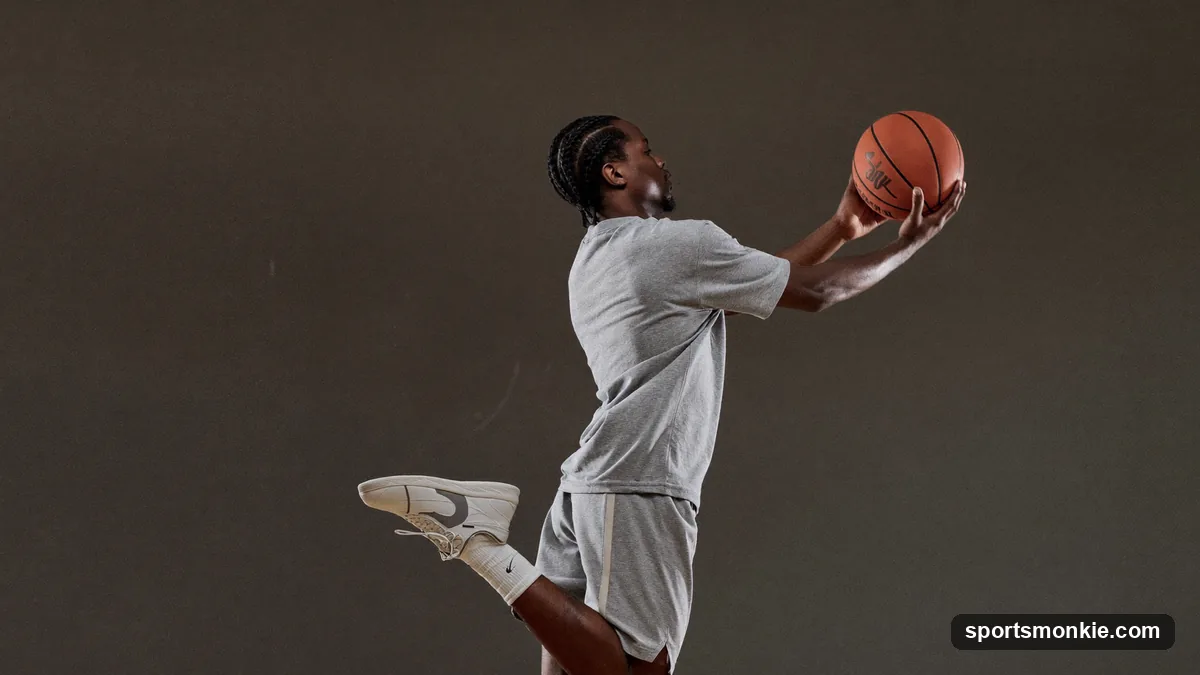
To shoot a three-pointer, you drive the shot with your legs, set your feet behind the line before you catch, and keep the exact same stroke you use from mid-range. The distance is not conquered by pushing harder with your arms. It is conquered by better rhythm, a deeper knee bend, and footwork that gets you set early. Do that, and 24 feet feels the same as 15.
Power Comes From Your Legs, Not Your Arms
The single biggest mistake beyond the arc is trying to muscle the ball there. When you reach for range with your arms, your elbow flares, your wrist stiffens, and your shot goes flat. Every extra foot then requires more arm effort, and your touch disappears.
Instead, treat your legs as the engine. Your knees, hips, and calves generate the force, while your upper body simply guides and releases. A good rule: your arms should feel like they are doing the same amount of work at 24 feet as they do at 15. The difference is entirely in how much your legs load and drive.
This is why building a clean base matters so much. If you have not locked in your fundamentals, start with our guide to basketball shooting form and the full how to shoot a basketball breakdown before you push your range out.
Set Your Feet Behind the Line First
You cannot shoot a good three if you are worried about stepping on the line. Great shooters know exactly where the arc is without looking down. Build that awareness in practice so it becomes automatic in games.
Key footwork cues:
- Land or arrive with feet already behind the line. Give yourself six to twelve inches of cushion so a small drift never turns into a two-pointer.
- Point your feet slightly toward the rim, with your shooting-side foot a touch ahead (the “1-2” or hop-into-the-shot stance).
- Feet shoulder-width apart. Too narrow and you lose balance; too wide and you lose lift.
- Toes, knees, and shoulders aligned toward the basket so your energy travels straight.
On a catch-and-shoot three, prep your feet before the pass arrives. The best shooters are set and loaded a split second before the ball hits their hands, which is what makes their release look effortless. This same footwork discipline shows up in a clean jump shot technique.
Load and Release: The One-Motion Stroke
Distance shooting works best as one fluid motion, not a two-part “catch, then shoot.” Here is the sequence, start to finish:
- Dip the ball as you catch, lowering it to a pocket near your hip or waist. This dip loads your legs and creates rhythm.
- Bend your knees into a comfortable athletic crouch. Deeper than a mid-range shot, but never a full squat.
- Rise and lift together. As your legs extend upward, your shooting arm carries the ball up in one smooth path.
- Release on the way up, before the top of your jump, so leg power flows into the ball.
- Snap your wrist and follow through, fingers pointing down at the rim, elbow finishing above your eye.
The timing point most players miss is number four. If you jump, hang, and then push the ball with your arms at the peak, you have cut your legs out of the shot entirely. Release early enough that your upward momentum is still helping.
The Court Dimensions You Must Know
Your range target depends on which line you are shooting behind. The arc is not the same everywhere, and the corners are always closer than the top.
| Level | Top of the arc | Corner three |
|---|---|---|
| NBA | 23 ft 9 in | 22 ft 0 in |
| WNBA | 22 ft 1.75 in | 21 ft 8 in |
| NCAA (men & women) | 22 ft 1.75 in | 21 ft 8 in |
| FIBA / international | 22 ft 1.7 in | 21 ft 8 in |
| High school (NFHS) | 19 ft 9 in | 19 ft 9 in (uniform-ish, shorter in corners) |
The takeaway: the corner three is the shortest and most efficient shot on the floor, roughly a foot and a half closer than the top of the key in the NBA. If you are still stretching your range, the corners are where you should get comfortable first. Note too that a made three counts as three points only if both feet are behind the line at release; landing on the line after a legal launch is fine.
Build Range the Right Way
Range is earned, not forced. The proven method is to move back gradually while keeping your percentage honest.
The 8-of-10 rule: pick a spot inside the arc. Shoot until you make eight of ten with clean, one-motion form and a balanced landing. Only then step back one foot. Repeat. If your percentage collapses, you have found your true range ceiling, so stay there and strengthen your legs before pushing further.
A weekly range progression might look like:
- Week 1: Free-throw-line extended and elbows. Groove the stroke.
- Week 2: Mid-range to the arc, five spots.
- Week 3: Corners and wings at the three-point line.
- Week 4: Top of the key and a step behind (“NBA range” reps).
Off-court strength accelerates everything. Squats, lunges, calf raises, and jump training add the leg power that makes 24 feet feel routine. Pair your shooting sessions with structured basketball shooting drills so every rep is game-speed rather than a lazy warm-up flick.
Keep Your Arc High and Consistent
A flat shot has a tiny margin for error because the rim looks like a thin slot. A higher arc turns the rim into a wider target and lets the ball land softer, so more rattles drop.
Aim for a release angle around 45 to 52 degrees. A common self-check: on a made shot, the ball should clearly rise above the top of the backboard square from your view before dropping. If your threes are line drives that clang hard off the back rim, add loft by finishing higher with your fingertips and thinking “up and out,” not “flat and forward.”
Consistency of arc comes from consistency of everything before it. The same dip, the same leg drive, and the same release point every single time is what separates a streaky shooter from a knockdown one.
Drills to Groove Your Three
Use these three staples every session:
- Beat the Pro: shoot from five arc spots. You get one point per make; the “pro” gets two per miss. Race to eleven. This forces game pressure.
- Catch-and-shoot with a pass: have a partner or rebounder feed you so you practice setting your feet before the catch, exactly like a game.
- Form-to-range ladder: start at ten feet, make three in a row, step back a foot, repeat out past the arc. Rebuilds rhythm on tired legs.
To finish, tie your outside game to the rest of your skill set. A defender who respects your three has to close out hard, which opens driving lanes, so sharpen your handle with the crossover dribble and know your full menu of scoring options in our guide to the types of shots in basketball. If you are tracking whether the added range is actually efficient, check the same scoring line with the true shooting percentage calculator. Shooting range is a weapon, but it is most dangerous when paired with everything else you can do on the floor.
Frequently asked questions
How do I get more range on my three-pointer?+
Range comes from your legs and rhythm, not from throwing the ball harder with your arms. Add a slightly deeper knee bend, sync your dip with your gather, and release the ball as your legs extend so the whole body pushes it. Move back one foot at a time, and only after you can hit eight of ten with clean form. Chucking flat, arm-heavy shots to reach the line builds bad habits fast.
How far is the three-point line?+
In the NBA, the arc is 23 feet 9 inches at the top and 22 feet straight out in the corners. The NCAA men's and women's line is 22 feet 1.75 inches, and the FIBA/international line is 22 feet 1.7 inches. High school (NFHS) uses 19 feet 9 inches. Corners are always shorter than the top of the key, which is why corner threes are the most efficient shot on the floor.
Should I jump forward when shooting a three?+
No. Jump straight up and land in nearly the same spot, an inch or two forward at most. Drifting forward, backward, or sideways changes your release point and kills consistency. A balanced vertical jump lets your legs deliver full power to the shot and keeps your eyes level on the rim. If you feel yourself lunging toward the basket to reach, your feet are too far back or your legs are underpowered.
Why do my threes come up short?+
Short threes almost always mean your legs aren't in the shot. If you shoot with your arms alone, you lose power the moment you step behind the arc. Fix it by dipping the ball to load your knees, then releasing as your legs drive upward. A flat arc, around 40 degrees or less, also robs you of soft distance. Aim for a 45-to-52-degree arc so the ball carries and lands softer.
How many threes should I make in practice each day?+
Quality reps beat volume. Aim for 150 to 250 game-speed threes a day, tracked by makes from five spots around the arc: both corners, both wings, and the top. Chart your percentages so you know your real range. Elite shooters treat every rep like it counts, using the same footwork and follow-through, rather than launching hundreds of sloppy shots that just groove mistakes.
Can I shoot a three-pointer off the dribble?+
Yes, but it is harder because you must gather your feet and load your legs in one motion. Practice a controlled pull-up: on your last dribble, sweep the ball into your shot pocket as you plant your feet and dip. Keep the same one-motion rhythm you use on catch-and-shoot threes. Master stationary catch-and-shoot range first, since off-the-dribble threes demand more balance and leg strength to reach the line.
Sources
Play & tools
Free browser games and tools — no account, no download.
- Play 82-0 — Draft five, one per position, and see if your lineup can go a flawless NBA season.
- Play Era Ball — Draft an all-time NBA roster from a single era, then simulate a season and chase a perfect run.
- Play 32-0 — Draft five college basketball legends, one per position, and chase a perfect 32-0 national title.
- Explore all our games →
- Get the printable bracket — Download and print a blank tournament bracket to fill out by hand.
- Open the TS% calculator — Calculate TS% from points, field goal attempts and free throw attempts — scoring efficiency in one number.
- Explore all our free sports tools →
Related basketball guides
View all →
Proper Basketball Shooting Form: A Step-by-Step Guide
Master proper basketball shooting form with clear cues for your feet, elbow alignment, guide hand, and wrist snap, plus how to build a repeatable one-motion shot.
How to Do a Layup: Footwork, Steps & Off-Hand Finish
Learn how to do a layup step by step: the one-two footwork, correct takeoff foot, off-hand finishes, and how to use the backboard box to score at the rim.
How to Shoot a Basketball Better: Fix Flat Shots Fast
Learn how to shoot a basketball better by fixing flat shots, tightening footwork off the catch, and building a practice routine that makes your jumper repeatable.
How to Shoot a Basketball: Perfect Form Step by Step
Learn how to shoot a basketball with perfect form: master BEEF, balanced stance, a straight-up release, 45-degree arc, and follow-through to make more shots.
Jump Shot Technique: Elevation, Set Point, Release
Master jump shot technique with real coaching cues for footwork, set point, elevation, and releasing at the peak—for both catch-and-shoot and off-the-dribble shots.
How to Shoot a Soccer Ball: Technique, Power & Accuracy
To shoot a soccer ball with power and accuracy, plant your standing foot beside the ball, strike through the laces, and follow through to your target.