
Greatest All-Rounders in Cricket History, Ranked
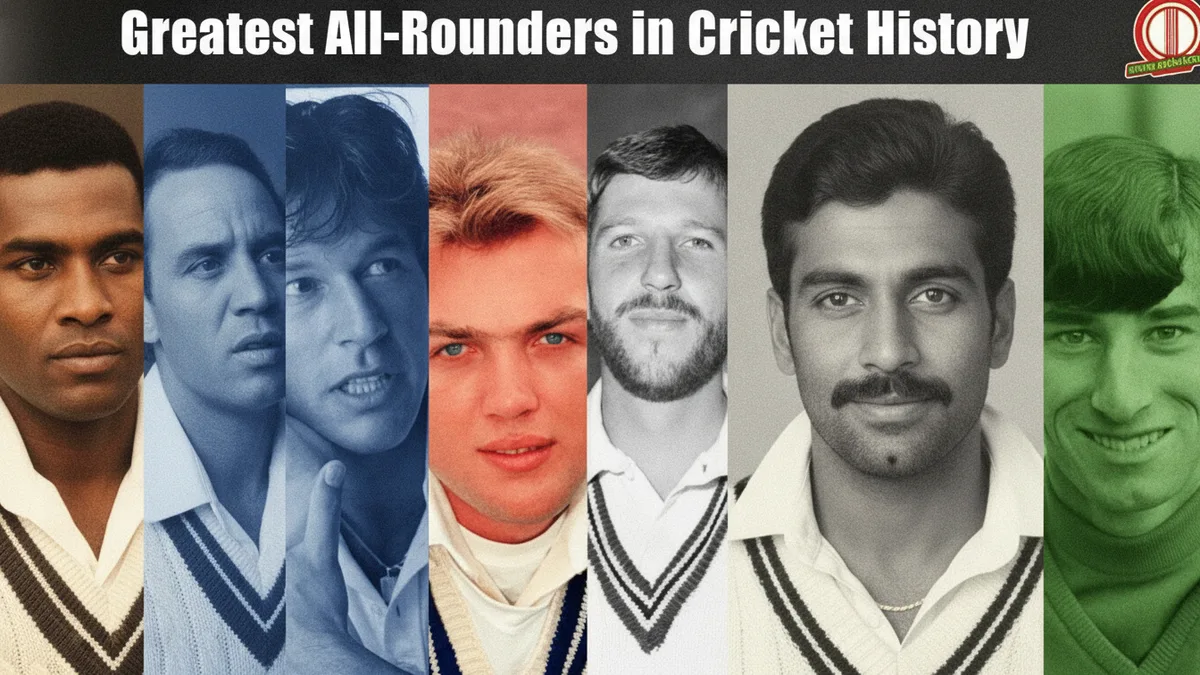
On this page17
- 01The greatest cricket all-rounders at a glance
- 02Garfield Sobers
- 03Imran Khan
- 04Kapil Dev
- 05Ian Botham
- 06Richard Hadlee
- 07Jacques Kallis
- 08Ben Stokes
- 09Shakib Al Hasan
- 10Ravindra Jadeja
- 11Wasim Akram
- 12Keith Miller
- 13Andrew Flintoff
- 14How We Ranked Them
- 15The Two-Discipline Bar
- 16Test Career Numbers at a Glance
- 17Era Caveats Worth Knowing
Placement rewards players who would have earned a Test spot on batting alone or bowling alone, then delivered both for a full career. We weighed combined output, peak match-winning impact, and how rare each player's skill mix was over era-based reputation.
The greatest cricket all-rounders at a glance
| Rank | Player | Strongest all-round case |
|---|---|---|
| 1 | Garfield Sobers | 8,032 Test runs plus three bowling styles |
| 2 | Imran Khan | 362 Test wickets and 1992 World Cup captain |
| 3 | Kapil Dev | 5,248 runs, 434 wickets and 1983 World Cup |
| 4 | Ian Botham | 5,200 runs, 383 wickets and 1981 Ashes |
| 5 | Richard Hadlee | First to 400 Test wickets |
| 6 | Jacques Kallis | 13,289 Test runs and 292 wickets |
- The complete cricketer
Garfield Sobers
Sobers is the only player on this list who bowled three genuinely different styles at Test level: left-arm orthodox spin, left-arm wrist spin, and left-arm pace, chosen by conditions and match state. That alone would rank him among bowling all-rounders; the batting is what makes him untouchable. His 8,032 Test runs came at an average above 57, a figure most specialist top-order batters never reach, and his 365 not out stood as the highest individual Test score for 36 years until Brian Lara passed it in 1994.
He ranks above Kallis, who has larger raw numbers, because no other cricketer has ever combined top-order batting with three distinct bowling disciplines plus close-catching of that quality. Versatility, not volume, wins the top spot.
Team: West Indies · Era: 1954–1974 · Test runs: 8,032 (avg 57+) · Wickets: 235 · Defining feat: 365* record held 36 years
- Captain and strike bowler
Imran Khan
Imran was a genuine fast bowler first, taking 362 Test wickets at an average under 23, then built a top-order batting game that finished on 3,807 Test runs. Late in his career he was arguably Pakistan's best batter and best bowler on the same team sheet, a double almost no captain manages while also leading the side.
He ranks ahead of Kapil Dev because of that peak batting average and the leadership that delivered Pakistan's only World Cup, in 1992, after which he retired. His all-round credentials feed directly into his standing among the most successful cricket captains.
Team: Pakistan · Era: 1971–1992 · Test runs: 3,807 · Wickets: 362 (avg <23) · Defining feat: 1992 World Cup-winning captain
- World Cup spearhead
Kapil Dev
Kapil retired with 434 Test wickets, a world record at the time, alongside 5,248 Test runs. He remains the only Indian to combine 5,000-plus Test runs with 400-plus Test wickets, and he stayed the attack's leader while doing it rather than easing into a batting role.
His unbeaten 175 against Zimbabwe in the 1983 World Cup rescued a collapsing innings, and he captained that India side to the title, the sport's first major global upset. He edges Botham for the way he carried a weaker bowling attack for over a decade.
Team: India · Era: 1978–1994 · Test runs: 5,248 · Wickets: 434 · Defining feat: 1983 World Cup-winning captain
- The series-turner
Ian Botham
Botham's 1981 Ashes, still called "Botham's Ashes," is the reference point for a single player bending a series: a match-turning 149 not out at Headingley after England followed on, then a five-wicket burst, then more at Old Trafford. Across his career he scored 5,200 Test runs and took 383 wickets.
He was also an elite slip fielder, a third skill that raw batting-and-bowling totals miss. He sits just below Kapil because his bowling average climbed sharply in the back half of his career as fitness faded.
Team: England · Era: 1977–1992 · Test runs: 5,200 · Wickets: 383 · Defining feat: 1981 'Botham's Ashes'
- Record-setting seamer
Richard Hadlee
Hadlee was the first bowler in history to reach 400 Test wickets, finishing with 431 at an average of 22.29, the lowest of the 1980s quartet. He carried the New Zealand attack almost single-handedly, and the team's Test results dipped sharply once he retired.
His 3,124 Test runs and two centuries kept him a genuine all-rounder rather than a bowler who batted. He ranks below the top four mainly because his batting, while real, never reached their top-order weight.
Team: New Zealand · Era: 1973–1990 · Test runs: 3,124 · Wickets: 431 (avg 22.29) · Defining feat: first to 400 Test wickets
- The statistical case
Jacques Kallis
No all-rounder has produced more combined output. Kallis finished with 13,289 Test runs and 292 wickets across an 18-year career, plus more than 200 catches, more Test runs than any batter in history except Sachin Tendulkar. Looked at coldly, that is the strongest numerical argument for greatest all-rounder ever.
He ranks sixth rather than first because his bowling, though skilled, was a genuine second string rather than a strike weapon, and his understated style meant the wickets came in support rather than in spells that won matches. He belongs on any list of the greatest cricketers of all time.
Team: South Africa · Era: 1995–2013 · Test runs: 13,289 · Wickets: 292 · Defining feat: most combined runs-plus-wickets of any all-rounder
- Modern benchmark
Ben Stokes
Stokes is the defining Test all-rounder of his generation, and in 2026 he passed 7,000 Test runs and 200 wickets, joining only Sobers and Kallis in that club. His unbeaten 135 to win the 2019 Headingley Ashes Test, after England had followed on, is the modern equal of Botham's 1981 heroics.
He ranks below the all-time group only because his bowling workload has been managed around injuries, but as England's captain since 2022 he has also reshaped how the side plays Test cricket. On current output he is still climbing this list.
Team: England · Era: 2011–present · Test runs: 7,000+ · Wickets: 200+ · Defining feat: 2019 Headingley 135*
- Cross-format great
Shakib Al Hasan
Shakib spent long stretches ranked the world's number-one all-rounder in ODI cricket by the ICC and is the most statistically complete cricketer any newer Test nation has produced, with well over 700 international wickets across formats paired with a top-order batting game that anchored Bangladesh for nearly two decades.
He ranks here on the strength of that 18-year body of work; his international future has been clouded since 2024 by off-field and political complications that have kept him out of the Bangladesh side. The résumé, not any recent form, earns the placement.
Team: Bangladesh · Era: 2007–2024 · Test runs: 4,600+ · Wickets: 240+ · Defining feat: long-running world No. 1 ODI all-rounder
- Turns matches both ways
Ravindra Jadeja
Jadeja became only the fourth cricketer to reach 4,000 Test runs and 300 Test wickets, pairing economical, wicket-taking left-arm spin with a batting record that has kept climbing into his thirties. He is also widely rated the best fielder in the world at any position, the extra skill that lifts him past several bigger-name bowlers.
His numbers undersell how often he swings a match with bat and ball in the same innings, especially at home; during the drawn 2025 tour of England he strung together five straight fifties. He is named among the best spin bowlers in current cricket and, thanks to his sword-twirl celebration, among the cricketers with moustaches most linked to the modern game.
Team: India · Era: 2009–present · Test runs: 4,000+ · Wickets: 300+ · Defining feat: 4th to the 4,000-run, 300-wicket double
- Bowling all-rounder
Wasim Akram
Wasim Akram is filed among the greatest fast bowlers first, 414 Test wickets and the finest exponent of reverse swing the game has seen, but the bat earns him a place here. He scored 2,898 Test runs, including an unbeaten 257 batting down the order against Zimbabwe in 1996, one of the highest scores ever made from a lower-order position.
He ranks below the genuine dual threats because he was chosen for his bowling, not his batting, but few strike bowlers of his class could also be trusted to bat at No. 7 and turn a game. He features in any account of the most wickets in cricket.
Team: Pakistan · Era: 1984–2003 · Test runs: 2,898 · Wickets: 414 · Defining feat: 257* from the lower order, 1996
- Pre-Sobers standard
Keith Miller
Miller flew as a fighter pilot in the Second World War before Test cricket, and brought the same nervelessness to the game: 2,958 Test runs at an average near 37 and 170 wickets at a strike rate that made him one of the most dangerous new-ball bowlers of his time.
He formed a fearsome opening attack with Ray Lindwall while batting in Australia's top six through the late 1940s and 1950s. Contemporaries regularly called him the finest all-rounder they had seen, a title Sobers inherited when he arrived.
Team: Australia · Era: 1946–1956 · Test runs: 2,958 (avg ~37) · Wickets: 170 · Defining feat: new-ball partner to Ray Lindwall
- Short, brilliant peak
Andrew Flintoff
Flintoff's 2005 Ashes, where his spells at Edgbaston and Trent Bridge swung the series to England, is one of the most celebrated campaigns by any English all-rounder. He finished with 3,845 Test runs and 226 wickets, totals that undersell a roughly three-year stretch when he was as dominant as anyone in the game.
He ranks last here because persistent knee and ankle injuries cut that peak short; the career numbers hint at a player who, kept fit, could have pushed the group above him. Impact was elite, longevity was not.
Team: England · Era: 1998–2009 · Test runs: 3,845 · Wickets: 226 · Defining feat: 2005 Ashes match-winner
Reader interaction
Build your ranking
Drag the names into the order you think is right — or use the arrows — then submit to see how your list compares with everyone else's.
- Garfield Sobers
- Imran Khan
- Kapil Dev
- Ian Botham
- Richard Hadlee
- Jacques Kallis
- Ben Stokes
- Shakib Al Hasan
- Ravindra Jadeja
- Wasim Akram
- Keith Miller
- Andrew Flintoff
Audience ranking
How everyone ranked them
Built from reader rankings using position-based points.
The ranked cards above are the list. The sections below explain how the order was built and give the context that makes the ranking make sense, rather than repeating each player’s write-up.
How We Ranked Them
Three things decided placement, weighted together. First, career-long output in both disciplines, because an all-rounder’s value is cumulative and shows up over hundreds of innings. Second, peak dominance and match-winning impact, the ability to bend a Test or a series with bat and ball in the same game. Third, and the tie-breaker, how rare the skill mix was, which is why Sobers clears Kallis despite smaller totals.
Sobers and Kallis top the all-time reckoning because they cleared every bar simultaneously and for the longest. The 1980s quartet of Imran, Kapil, Botham, and Hadlee are grouped tightly because they were true contemporaries whose rivalry is inseparable from the case for each. Modern names, Stokes, Shakib, and Jadeja, are ranked on their current bodies of work, with active totals noted as still growing.
The Two-Discipline Bar
The distinction that matters is between a genuine all-rounder and a specialist who contributes in the other discipline. A batting all-rounder is picked mainly to bat but bowls usefully; a bowling all-rounder is picked mainly to bowl but adds real lower-order runs. A true all-rounder would be selected in either role on its own. Wasim Akram sits near the bowling end of that spectrum and Kallis near the batting end, which is part of why neither tops the list despite huge numbers.
Test Career Numbers at a Glance
Totals are Test-career figures; active players’ lines are rounded and will keep climbing.
| Rank | Player | Country | Era | Test runs | Test wickets |
|---|---|---|---|---|---|
| 1 | Garfield Sobers | West Indies | 1954–1974 | 8,032 | 235 |
| 2 | Imran Khan | Pakistan | 1971–1992 | 3,807 | 362 |
| 3 | Kapil Dev | India | 1978–1994 | 5,248 | 434 |
| 4 | Ian Botham | England | 1977–1992 | 5,200 | 383 |
| 5 | Richard Hadlee | New Zealand | 1973–1990 | 3,124 | 431 |
| 6 | Jacques Kallis | South Africa | 1995–2013 | 13,289 | 292 |
| 7 | Ben Stokes | England | 2011–present | 7,000+ | 200+ |
| 8 | Shakib Al Hasan | Bangladesh | 2007–2024 | 4,600+ | 240+ |
| 9 | Ravindra Jadeja | India | 2009–present | 4,000+ | 300+ |
| 10 | Wasim Akram | Pakistan | 1984–2003 | 2,898 | 414 |
| 11 | Keith Miller | Australia | 1946–1956 | 2,958 | 170 |
| 12 | Andrew Flintoff | England | 1998–2009 | 3,845 | 226 |
Era Caveats Worth Knowing
Cross-era comparison has limits. Pitches, workloads, and schedules changed enormously between Keith Miller’s uncovered wickets in the 1940s and the year-round grind of the modern game. Bowling averages under 23, common among the 1980s quartet, are harder to reach now against better batting equipment and flatter pitches. Conversely, modern all-rounders accumulate bigger raw totals simply because there is far more cricket to play. The ranking accounts for this by leaning on rarity and peak impact, not just career tallies, so a shorter career at a higher level can outrank a longer one of accumulation.
Frequently asked questions
What actually counts as a genuine all-rounder?+
A genuine all-rounder is good enough at both batting and bowling to earn a Test place on either skill alone. That is a high bar, and it separates the players on this list from the far more common 'bits and pieces' cricketer who bats a bit and bowls a bit but would not be picked for either discipline by itself. Every name here cleared both bars in Test cricket.
Does this ranking cover Tests only, or white-ball cricket too?+
The ranking is built on Test cricket, the format where all-round value is hardest to fake and the record stretches back nearly a century. Several of these players, notably Shakib Al Hasan and Ben Stokes, are also elite white-ball all-rounders, and that breadth is noted. But comparing eras fairly means leaning on the longest, most comparable dataset, which is the Test record.
Why is Sobers ranked above Kallis when Kallis has bigger numbers?+
Kallis has the larger combined output, more than 13,000 Test runs and nearly 300 wickets, and that gives him the strongest statistical case. Sobers ranks higher because he offered rarer versatility: top-order batting plus three distinct bowling styles, from pace to two kinds of spin, that let him lead an attack in any conditions. The top spot rewards that range over raw volume.
Who were the 1980s 'big four' all-rounders?+
Imran Khan of Pakistan, Kapil Dev of India, Ian Botham of England, and Richard Hadlee of New Zealand were near-exact contemporaries, each capable of winning Tests with bat and ball. Their overlapping careers and constant statistical comparison made the 1980s the richest era for all-round cricket. This list ranks them close together because their head-to-head rivalry is part of the case for each.
Is Ben Stokes the best all-rounder in cricket right now?+
In Test cricket, yes, by consensus. Stokes passed 7,000 Test runs and 200 wickets in 2026, a mark only Sobers and Kallis had reached before him, and he has repeatedly won matches with both bat and ball. Ravindra Jadeja is the other leading active contender, especially at home for India, but Stokes's peak match-winning weight sits a rung above.
Why isn't a great batter like Sachin Tendulkar on the list?+
Tendulkar is among the greatest batters ever and bowled useful part-time spin, but he was never close to being picked for his bowling, so he is not an all-rounder in the sense used here. The list requires genuine dual selection value. A player has to be good enough with the ball to lead or support an attack, not just fill a few overs when the frontline bowlers tire.
Sources
Play & tools
Free browser games and tools — no account, no download.
- Play today's Sports Connections — Today's Sports Connections — daily hints, answers, and play the grid.
- Play Guess the NFL Player — A new mystery NFL player every day. Eight guesses, with a clue on each — plus free unlimited mode.
- Explore all our games →
Related cricket guides
View all →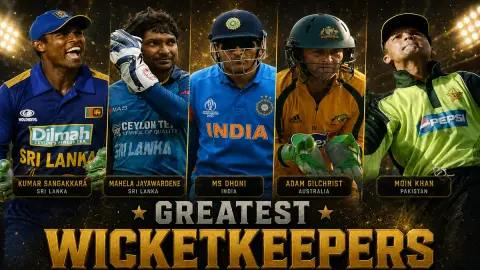
Greatest Wicketkeepers in Cricket History, Ranked
The 13 greatest wicketkeepers in cricket history, ranked and named — Gilchrist, Dhoni, Sangakkara, Boucher, Healy, Knott and more, with their dismissal records.
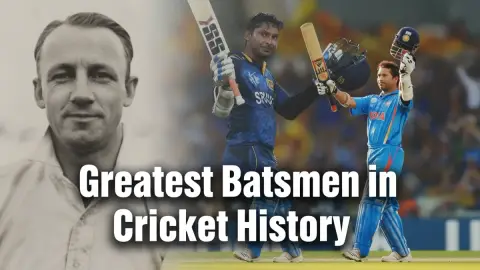
Greatest Batsmen in Cricket History, Ranked
The 12 greatest batsmen in cricket history ranked — Bradman, Tendulkar, Lara, Richards, Sobers, Kohli and more, with the averages, runs and records behind each name.
Best Cricket Coaches Ever: 12 Greatest Ranked (2026)
John Buchanan leads our best cricket coaches ranking. See the all-time top 12 plus the 2026 cases for Gautam Gambhir, Andrew McDonald and Gary Kirsten.

Most Successful Cricket Teams in History: The All-Time Rankings
Every major cricket nation ranked by ICC titles: Australia's 10 trophies, the West Indies dynasty, India's seven, and South Africa's 2025 WTC breakthrough.
Best Fielders in Cricket History: Ranked
Jonty Rhodes still tops most lists of cricket's greatest fielders. Here is the full ranking, what the catching records actually prove, and how much a great fielder is worth in runs.

Longest Six in Cricket History: Shahid Afridi's Disputed 153m Claim, Ranked
Shahid Afridi's 153–160m six at the Wanderers in 2013 is the most-cited longest six in cricket history, but independent remeasurement puts it closer to 100–120m. Every major claim from 1856 to 2026, ranked and fact-checked.