
Greatest Wicketkeepers in Cricket History, Ranked
On this page17
- 01Greatest wicketkeepers in cricket history at a glance
- 02Adam Gilchrist
- 03Mark Boucher
- 04MS Dhoni
- 05Kumar Sangakkara
- 06Ian Healy
- 07Rodney Marsh
- 08Alan Knott
- 09Godfrey Evans
- 10Jeff Dujon
- 11Quinton de Kock
- 12Jos Buttler
- 13Rishabh Pant
- 14BJ Watling
- 15How we ranked them
- 16Record holders at a glance
- 17What actually makes a keeper great
Ranked by weighing four things at once: dismissal totals relative to matches kept, batting value (which counts far more since Gilchrist), influence on how the position is played, and reliability across a full career. Raw dismissal counts are read against each keeper's era, not compared blindly across generations.
Greatest wicketkeepers in cricket history at a glance
| Rank | Wicketkeeper | Signature record | Strongest ranking argument |
|---|---|---|---|
| 1 | Adam Gilchrist | 17 Test hundreds | Redefined the wicketkeeper-batter role |
| 2 | Mark Boucher | 555 Test dismissals | Unmatched career keeping volume in Tests |
| 3 | MS Dhoni | 195 international stumpings | Elite keeping, finishing and captaincy value |
| 4 | Kumar Sangakkara | 482 ODI dismissals | Record ODI dismissals plus exceptional batting |
| 5 | Ian Healy | 395 Test dismissals | Benchmark glovework against elite spin and pace |
| 6 | Rodney Marsh | 355 Test dismissals | Set the career record during his era |
- Redefined the role
Adam Gilchrist
Gilchrist earns the top spot because he changed what selectors ask of a keeper. He scored 5,570 Test runs at 47.60 from 96 matches and hit 17 Test hundreds — the most by any wicketkeeper — while batting at number seven and opening in ODIs, numbers that would have made him a first-choice specialist batsman on their own.
He ranks above Boucher, whose glovework totals are higher, because the batting reset the position for everyone after him. His keeping was Test-standard too: 416 Test dismissals (379 catches, 37 stumpings) for a dominant Australia side. For where he sits among the game's broader greats, see our greatest cricketers of all time ranking.
Team: Australia · Era: 1996–2008 · Bat: 5,570 Test runs at 47.60 · Defining feat: 17 Test hundreds, most by a keeper
- Career leader
Mark Boucher
Boucher holds the outright Test record for dismissals by a keeper: 555 in 147 matches, a mark no one else has approached. He passed Ian Healy's 395 in Karachi in October 2007 and is the only keeper in Test history past 500 catches.
He sits behind Gilchrist rather than ahead despite the bigger glovework numbers because his batting, while useful, never reshaped the role the way Gilchrist's did. Longevity and near-total reliability behind the stumps are his case — he kept wicket in Tests more successfully than anyone who has played the game.
Team: South Africa · Era: 1997–2012 · Record: 555 Test dismissals (all-time) · Milestone: only keeper past 500 Test catches
- Limited-overs great
MS Dhoni
Dhoni owns the record that best captures fast hands: 195 international stumpings, the most by any keeper, often completed and appealed before the batsman knew the foot had lifted. He finished with 829 international dismissals in all, third-most in history behind Boucher and Gilchrist.
He ranks above Sangakkara on keeping craft in the shortest formats and on match impact — as keeper-captain he won every major ICC white-ball title India competed for during his peak. His finishing with the bat set the template studied by the best finishers in cricket today.
Team: India · Era: 2004–2019 · Record: 195 stumpings (all-time) · Total: 829 international dismissals
- Keeper-batsman
Kumar Sangakkara
Sangakkara is the batting benchmark on this list: a Test average of 57.40, the best of anyone with 10,000-plus runs. As a keeper he took 678 dismissals, including a world-record 482 in ODIs (383 catches, 99 stumpings) that still stands.
He ranks just behind Dhoni because he gave up the gloves for a chunk of his career to prolong his batting, so his keeping body of work is shorter than a full-time gloveman's. What lifts him this high is the rare double — elite ODI keeping records plus one of the finest batting records the game has produced.
Team: Sri Lanka · Era: 2000–2015 · Record: 482 ODI dismissals (all-time) · Bat: Test average 57.40
- Purest gloveman
Ian Healy
Healy is the reference point for standing up to a world-class spinner. His keeping to Shane Warne — reading drift and turn that beat the batsman — is still taught as the ideal, and he finished with 395 dismissals from 119 Tests.
He broke Rodney Marsh's world record of 355 in Rawalpindi in October 1998, and his mark stood until Boucher passed it in 2007. He ranks above Marsh, the man he overtook, because he did it across a slightly longer and more scrutinised era and set the modern standard for pure keeping technique before Gilchrist took his place.
Team: Australia · Era: 1988–1999 · Held Test record: 1998–2007 · Signature: keeping to Shane Warne's leg-spin
- Record-setter of his day
Rodney Marsh
Marsh set the Test dismissals record of 355 that Healy would later break, keeping across 96 Tests to Dennis Lillee and Australia's fearsome late-1970s attack. "Caught Marsh, bowled Lillee" became the most repeated dismissal line in Australian cricket for a reason — the partnership accounted for 95 Test wickets together.
He ranks below Healy, who broke his record and kept to an even sharper spin threat, but above the England and West Indies keepers beneath him on volume and on the trust his bowlers placed in him. His name is still shorthand in Australia for durability behind the stumps.
Team: Australia · Era: 1970–1984 · Record: 355 Test dismissals (world record at retirement) · Partnership: 95 Test wickets with Lillee
- England's most prolific
Alan Knott
Knott took 269 dismissals from 95 Tests (250 catches, 19 stumpings) — a world record at his retirement and still England's most prolific keeping career. Coaches cite his quick footwork, soft hands and mid-flight adjustments as close to a textbook model.
He ranks above Godfrey Evans, England's other great keeper below him, on both dismissal volume and batting: Knott scored 4,389 Test runs as a genuinely useful lower-order bat, hinting at the dual role Gilchrist would later perfect.
Team: England · Era: 1967–1981 · Record: 269 dismissals (England's most) · Bat: 4,389 Test runs
- Pre-TV pioneer
Godfrey Evans
Evans was the first keeper in history to reach 200 Test dismissals, finishing with 219 (173 catches, 46 stumpings) across 91 Tests from 1946 to 1959. Wisden called him "arguably the best wicket-keeper the game has ever seen."
He ranks below Knott, England's later record-holder, on raw numbers, but the context lifts him well up an all-time list: he did it without the protective gear, covered pitches or television replays that later keepers had, standing up energetically on unpredictable surfaces where a fumble was rarely his fault.
Team: England · Era: 1946–1959 · Milestone: first keeper to 200 Test dismissals · Honor: Wisden Cricketer of the Year, 1951
- West Indies record
Jeff Dujon
Dujon kept elegantly to the most feared fast-bowling attack cricket has assembled, across 81 Tests from 1981 to 1991. He finished with 272 dismissals (267 catches, 5 stumpings) — almost all off pace, a West Indies record that stood for decades.
He ranks around the middle because his glovework, though outstanding, came with few stumpings and modest keeping variety — he rarely had to stand up to spin. What he did do, standing back to Marshall, Garner, Holding and Roberts, he did as well as anyone, and he chipped in valuable lower-order runs for a side that seldom needed them.
Team: West Indies · Era: 1981–1991 · Record: 272 dismissals (West Indies' most) · Note: kept to the great WI pace quartet
- Modern complete keeper
Quinton de Kock
De Kock is the most complete keeper-batsman currently active. He retired from Tests at 29 with 232 dismissals from 54 matches at a batting average of 38.82 — well above what most specialist keepers post — and has passed 6,770 ODI runs with 21 centuries.
He ranks ahead of the two younger names below him on a longer, more decorated white-ball body of work, including a return from ODI retirement in 2025 to keep adding runs and dismissals. His pull toward attacking top-order batting mirrors the modern keeper-batsman mould Gilchrist created.
Team: South Africa · Era: 2012–present · Bat: 6,770+ ODI runs, 21 centuries · Test line: 232 dismissals at 38.82 average
- White-ball finisher
Jos Buttler
Buttler is the defining white-ball keeper of his generation, winning the 2019 ODI World Cup as gloveman and captaining England to the 2022 T20 World Cup. He holds the record for most catches by a keeper in a single ODI innings, six.
He ranks below de Kock because his Test keeping never settled and much of his best batting came without the gloves, but across limited-overs cricket his clean hands and explosive finishing made him England's first-choice keeper for over a decade, even after he stepped down as captain in 2025.
Team: England · Era: 2011–present · Titles: 2019 ODI & 2022 T20 World Cups · Record: 6 catches in an ODI innings
- Modern match-turner
Rishabh Pant
Pant reached 2,500 Test runs faster than any Indian keeper — quicker than Dhoni — and has since built to eight Test hundreds, many of them counter-attacking innings that flipped matches. In June 2025 he became the first Indian keeper to score centuries in both innings of a Test, at Headingley.
He ranks just above Watling on ceiling and on the volume of match-defining batting he already owns, though his keeping consistency is still maturing. As of 2026 he remains India's first-choice gloveman across formats after returning from a serious 2022 car crash.
Team: India · Era: 2017–present · Bat: 8 Test hundreds · Feat: first Indian keeper with twin Test centuries (Headingley, 2025)
- Quiet foundation
BJ Watling
Watling was the understated backbone of New Zealand's climb to the top of Test cricket, keeping from 2009 to 2021 and retiring with a batting average that rivalled many specialist batsmen. He rarely made highlight reels the way flashier keepers did.
He closes the list because his value was steadiness rather than record-setting numbers, but it paid off in the biggest match of all: New Zealand won the inaugural ICC World Test Championship final in June 2021, which turned out to be Watling's last Test.
Team: New Zealand · Era: 2009–2021 · Peak: 2021 World Test Championship title · Note: WTC final was his final Test
Reader interaction
Build your ranking
Drag the names into the order you think is right — or use the arrows — then submit to see how your list compares with everyone else's.
- Adam Gilchrist
- Mark Boucher
- MS Dhoni
- Kumar Sangakkara
- Ian Healy
- Rodney Marsh
- Alan Knott
- Godfrey Evans
- Jeff Dujon
- Quinton de Kock
- Jos Buttler
- Rishabh Pant
- BJ Watling
Audience ranking
How everyone ranked them
Built from reader rankings using position-based points.
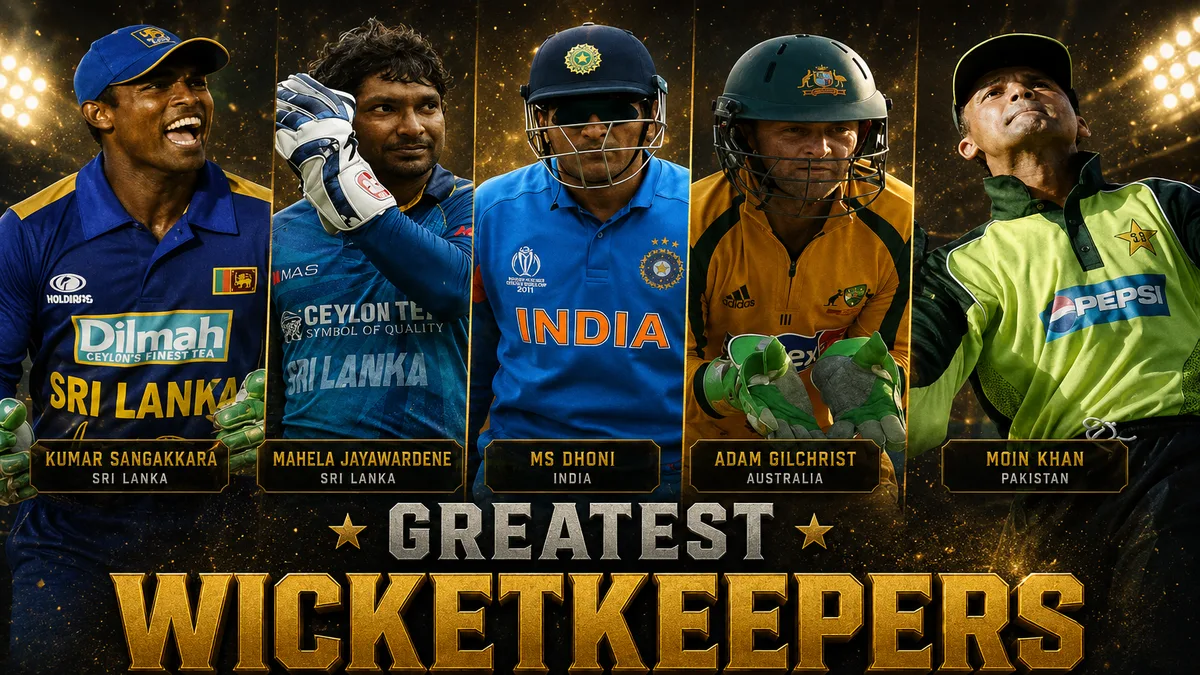
For most of Test cricket’s history, a keeper who could bat a bit was a bonus, not a requirement. Then Adam Gilchrist walked in at number seven and scored like an opener, and selectors everywhere had to rethink what the position was for. The cards above rank the 13 keepers most consistently named among the greatest; the sections below explain how we weighed them and how to read dismissal records fairly.
How we ranked them
This list weighs four things together rather than any single number: career dismissal totals relative to matches kept, batting contribution (worth far more since Gilchrist’s era), influence on how the position is played, and reliability sustained across a full career rather than one standout series.
Comparing a keeper from the 1950s to one from the 2010s runs into real problems. Pitches, protective gear, over rates and even the laws around keeping have all changed, and earlier keepers often worked on uncovered pitches with unpredictable bounce and no television replays to help umpires. Judging each keeper against their own era, rather than by raw statistical comparison, gives the fairer picture — which is why Godfrey Evans and Alan Knott sit high despite lower totals than modern names.
Record holders at a glance
The all-time ranking blends many qualities, but individual records are cleaner to state. These are the current benchmarks for the position across formats.
| Category | Holder | Mark |
|---|---|---|
| Most Test dismissals | Mark Boucher | 555 |
| Most international dismissals | Mark Boucher | 998 |
| Most ODI dismissals | Kumar Sangakkara | 482 |
| Most international stumpings | MS Dhoni | 195 |
| Most catches, one ODI innings | Jos Buttler | 6 |
| Most Test runs by a keeper | Adam Gilchrist | 5,570 |
What actually makes a keeper great
Elite footwork and soft hands standing up to spin, the reflexes to take pace standing back, and the concentration to hold both across long days in the field are the base requirements. Since Gilchrist, a genuine batting threat lower in the order has become close to mandatory for a first-choice international keeper.
Money and squad context shape the modern role too. For how today’s cricketers are paid across formats, see our highest-paid cricketers breakdown, and for the fielding disciplines a keeper directs from behind the stumps, see fielding positions in cricket.
Frequently asked questions
Who has the most dismissals across all international cricket, not just Tests?+
Counting Tests, ODIs and T20Is together, Mark Boucher leads with 998 international dismissals, followed by Adam Gilchrist on 905 and MS Dhoni on 829. The order differs from the Test-only list because Dhoni and Gilchrist played huge volumes of white-ball cricket, while Boucher's total is spread across all three formats over a long career. Kumar Sangakkara sits just behind that group.
Why did some great keepers give up the gloves mid-career?+
Keeping is physically punishing over long days, and both Kumar Sangakkara and Quinton de Kock stepped away from it to prolong their careers or protect their batting output. Sangakkara handed over the gloves in Tests to keep playing as a specialist batsman, and de Kock retired from Test cricket at 29 while continuing in white-ball formats. The trade-off is fewer dismissals but more years and higher batting returns.
What separates keeping to spin from keeping to fast bowling?+
Standing up to a spinner demands soft hands, fine footwork and the ability to read drift and turn late — the skill that made Ian Healy's keeping to Shane Warne a coaching reference. Standing back to genuine pace is about reflexes and reading edges at speed, as Jeff Dujon did to the West Indies quartet. Great all-round keepers, like Dhoni with his stumpings, master both, which is rarer than it sounds.
Are wicketkeeper-captains judged by a different standard?+
Keeping and captaining at once is a heavy dual load, so the best keeper-captains get extra credit for it. MS Dhoni ran India's field placings and bowling changes while completing his record stumpings, and Jos Buttler and Rishabh Pant have both led their sides from behind the stumps. It cuts both ways: captaincy can drain a keeper's batting or glovework, so sustained excellence at both lifts a player up an all-time list.
Does the ranking include Twenty20 internationals?+
T20I dismissals count toward a keeper's overall international totals, but they rarely swing an all-time ranking on their own. The format is short, chances behind the stumps are fewer per game, and stumpings off spin are the main keeping event. It matters most for modern names like Buttler, de Kock and Pant, whose reputations are built partly on white-ball cricket, and far less for era-defining Test keepers like Marsh, Knott and Evans.
Who is the best active wicketkeeper as of 2026?+
Among current players, Quinton de Kock and Rishabh Pant have the strongest cases. De Kock offers the more complete and decorated white-ball record after returning from ODI retirement in 2025, while Pant is the bigger match-winner with the bat in Tests, holding eight hundreds and India's first-choice keeping role across formats. Which you prefer depends on whether you weight all-format consistency or Test-match impact more heavily.
Sources
Play & tools
Free browser games and tools — no account, no download.
- Play today's Sports Connections — Today's Sports Connections — daily hints, answers, and play the grid.
- Play Guess the NFL Player — A new mystery NFL player every day. Eight guesses, with a clue on each — plus free unlimited mode.
- Explore all our games →
Related cricket guides
View all →
Greatest All-Rounders in Cricket History, Ranked
The 12 greatest all-rounders in cricket history, ranked from Garfield Sobers to Ben Stokes, each with the Test batting and bowling numbers that back the case.
Greatest Batsmen in Cricket History, Ranked
The 12 greatest batsmen in cricket history ranked — Bradman, Tendulkar, Lara, Richards, Sobers, Kohli and more, with the averages, runs and records behind each name.
Best Cricket Coaches Ever: 12 Greatest Ranked (2026)
John Buchanan leads our best cricket coaches ranking. See the all-time top 12 plus the 2026 cases for Gautam Gambhir, Andrew McDonald and Gary Kirsten.

Most Successful Cricket Teams in History: The All-Time Rankings
Every major cricket nation ranked by ICC titles: Australia's 10 trophies, the West Indies dynasty, India's seven, and South Africa's 2025 WTC breakthrough.
Best Fielders in Cricket History: Ranked
Jonty Rhodes still tops most lists of cricket's greatest fielders. Here is the full ranking, what the catching records actually prove, and how much a great fielder is worth in runs.

Longest Six in Cricket History: Shahid Afridi's Disputed 153m Claim, Ranked
Shahid Afridi's 153–160m six at the Wanderers in 2013 is the most-cited longest six in cricket history, but independent remeasurement puts it closer to 100–120m. Every major claim from 1856 to 2026, ranked and fact-checked.