
Overhead Shot in Tennis: How to Hit the Smash (Complete Guide)
On this page6
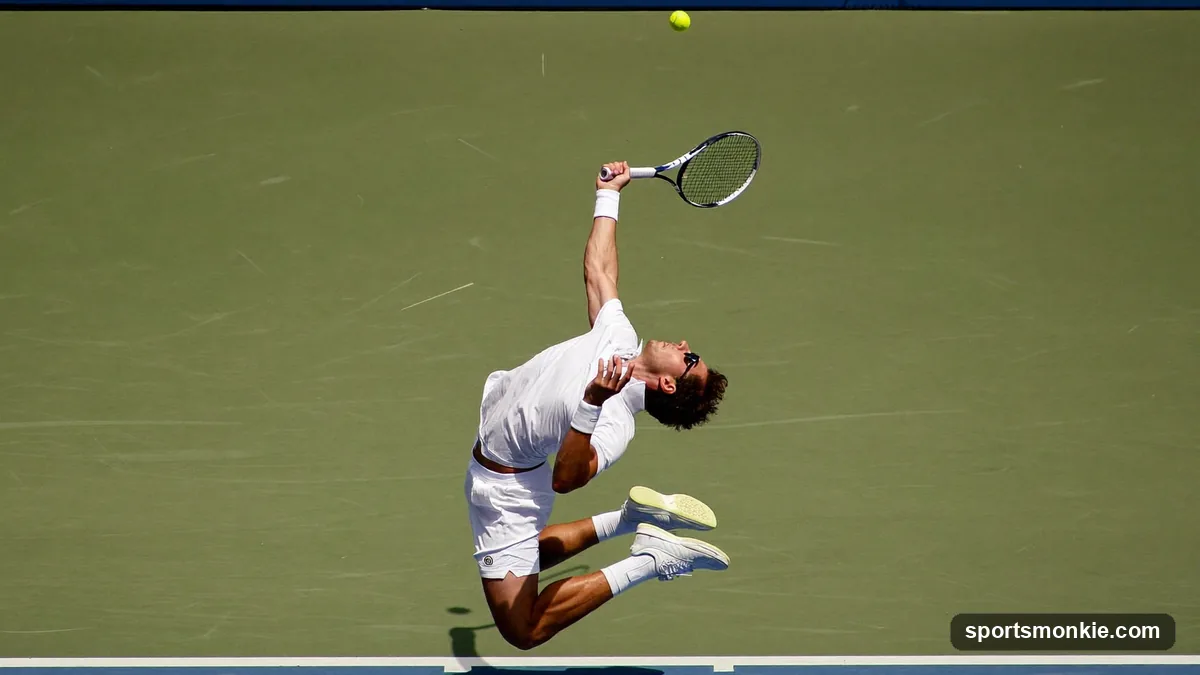
The overhead shot in tennis — usually called the smash — is a serve-like stroke hit above the head, most often used to punish a lob that lands short or fails to clear the player deep enough. It is one of the types of tennis shots every serious player needs, because it converts an opponent’s defensive lob straight into a point-ending weapon.
What Is the Overhead Shot in Tennis?
A smash is a shot hit above the hitter’s head with a swinging motion nearly identical to a serve. Coaches and commentators use “overhead” and “smash” interchangeably. The shot exists almost entirely as a response to the lob: when an opponent lifts the ball high to buy time or push a net-rusher back, a well-placed overhead lets the attacking player step forward and end the rally with a steep, hard-angled shot the opponent has little chance of returning.
Because the overhead shares its mechanics with the serve — same continental grip, same throwing action, same “up and over” swing path — players who have a reliable serve already have a head start on the smash. The main differences are the shortened backswing (there’s no ball toss to time) and the footwork needed to track a moving target instead of a stationary one.
Overhead Technique: Step by Step
The overhead follows a repeatable sequence that mirrors service motion but compresses the preparation phase:
- Turn immediately. As soon as you read the lob, rotate your body so your non-hitting shoulder faces the net — the same sideways stance used on serve.
- Track with your off arm. Point your non-racket arm up at the ball. This isn’t decorative; it keeps your head and shoulders aligned with the ball’s flight and helps time the swing.
- Load the racket. Bring the racket up and behind your head into a “back-scratch” position, much like the trophy pose on a serve, but with less exaggerated loading.
- Strike in front, and down. Contact the ball slightly in front of your body, at full extension, hitting down and through it rather than up and out.
- Follow through across the body. Let the racket continue its arc across your torso, shifting your weight into your front foot as you finish.
The downward strike angle is what separates the overhead from the serve: because you’re hitting from closer to the net with the ball already elevated, gravity and a compact, aggressive swing path let you drive the ball steeply into the opponent’s court.
Footwork: Getting Under the Ball
Technique alone won’t save a mistimed overhead — footwork determines whether you’re balanced enough to execute it. The positioning here has more in common with a volley in tennis than with a serve, since both shots are typically played from inside the baseline with forward momentum built in.
Key footwork principles:
- Use side-steps and cross-steps, not a flat-footed shuffle, to adjust distance quickly under a falling ball.
- Never backpedal while facing the net. Turning sideways and shuffling back keeps you balanced; running backward while looking up invites mistimed contact and falls.
- Set your feet shoulder-width apart before the swing for a stable base, whether you strike with both feet grounded or leave the ground entirely.
- Step into the shot with your front foot as you swing, transferring weight forward for extra pace.
When a lob is hit deep enough that flat-footed positioning won’t reach it, players use a jump smash — leaving the ground before contact to add reach and racket-head speed. Pete Sampras and Yannick Noah were both known for explosive jump smashes, sometimes nicknamed the “slam dunk” for their emphatic finish.
Forehand Overhead vs. Backhand Overhead
Almost every overhead in the sport is hit as a forehand overhead, because it generates far more power and control than the backhand version. The table below breaks down when each is used.
| Aspect | Forehand Overhead | Backhand Overhead |
|---|---|---|
| Frequency | Primary shot — used on nearly all lobs | Rare — only when there’s no time to turn |
| Power | High; full serve-like swing available | Low; compact, defensive swing |
| Grip | Continental | Continental or Eastern backhand |
| Typical use | Attacking putaway near the net | Emergency recovery shot |
| Target | Steep angles, opponent’s feet, open court | Away from opponent, down the line |
A handful of players have made the backhand overhead a genuine weapon rather than a last resort — left-handers Rod Laver and Jimmy Connors were both renowned for hammering overheads off their backhand side, though this remains the exception rather than the rule at any level of the game.
Common Overhead Errors
Most missed overheads trace back to a small set of repeatable mistakes:
- Reacting late. Hesitating before turning sideways leaves too little time to get under the ball, forcing a rushed or off-balance swing.
- Backpedaling instead of shuffling. Running backward while facing the net is the single biggest cause of shanked overheads and lost balance.
- Admiring the shot. Pausing after a successful smash instead of recovering to the ready position leaves a player exposed if the point continues.
- Hitting short and soft. A weak, shallow overhead invites a passing shot or another lob rather than ending the rally.
- Losing focus on a bouncing lob. A deep lob that’s allowed to bounce can still be handled as an overhead — tennis balls retain most of their pace off the court — but only if the player resets footwork rather than lunging.
How the Overhead Relates to Defending the Lob
The overhead and the lob in tennis are direct counterparts: the lob is a defensive or repositioning shot meant to buy time or pull a net player back, and the overhead is the primary punishment for a lob that doesn’t clear deep or high enough. A well-executed lob — placed deep and with height, ideally over the backhand side — takes the overhead option away entirely and forces a player back to the baseline instead. Understanding both shots together is essential to modern racket sports strategy, since the lob-versus-overhead exchange decides who controls net position in nearly every doubles point and in singles rallies at the net.
Mastering the overhead means treating it as an extension of the serve you already own: same grip, same throwing motion, same competitive instinct to finish the point — just with faster feet and a shorter windup.
Frequently asked questions
What is the overhead shot in tennis?+
The overhead shot, or smash, is a shot hit above the hitter's head with a serve-like swinging motion. It is almost always used to punish a lob that lands short or doesn't clear the player deep enough, letting the hitter step in and drive the ball downward for a winner.
Is the overhead the same as a serve?+
It uses the same throwing motion and continental grip as a serve, but the backswing is shortened since there's no ball toss to time. Footwork also differs: a serve starts from a fixed baseline stance, while an overhead requires shuffling backward or forward first to get under a moving ball.
How do you hit a tennis overhead smash?+
Turn your non-hitting shoulder toward the net, raise your racket-side arm behind your head while pointing your other arm at the ball to track it, then swing up and over in a downward strike, contacting the ball slightly in front of your body and following through across your torso.
What is the biggest mistake players make on the overhead?+
Late recognition of the lob is the most common error — players hesitate before turning and shuffling back, arrive under the ball too late, and end up reaching or backpedaling. Backpedaling while facing the net is especially risky because it invites overhead footwork errors and mistimed contact.
Can you hit a backhand overhead?+
Yes, though it's a low-percentage, defensive shot used only when a lob is hit deep behind the body or to the backhand side and there's no time to turn for a forehand overhead. It generates far less pace, so most coaches treat it as a recovery shot rather than a weapon.
Should you let the ball bounce before an overhead smash?+
It depends on depth. A shallow lob should usually be taken in the air for maximum aggression and to deny the opponent recovery time. A deep lob that would otherwise sail past can be let bounce, since tennis balls lose relatively little pace off the court, giving a second chance to set up.
How is the overhead smash different from a volley?+
A volley is hit before the bounce with a short, blocked swing near the net, while an overhead is a full swinging stroke hit above the head, closer in mechanics to a serve than to a volley — even though the court positioning for both shots is similar.
Why do players jump on some overheads?+
A jump smash, popularized by players like Pete Sampras, is used when a lob is hit deep enough that a player can't reach it with feet on the ground. Jumping adds reach and lets the player generate extra racket-head speed, though it sacrifices some control compared to a grounded overhead.
Sources
Play & tools
Free browser games and tools — no account, no download.
- Play today's Sports Connections — Today's Sports Connections — daily hints, answers, and play the grid.
- Play Guess the NFL Player — A new mystery NFL player every day. Eight guesses, with a clue on each — plus free unlimited mode.
- Explore all our games →
Related tennis guides
View all →
Lob in Tennis: Definition, Technique, and When to Use It
A lob in tennis is a high, arcing shot hit over an opponent at the net. Learn the offensive vs. defensive lob, technique, and its counter, the smash.
Forehand in Tennis Explained: Grips, Swing Path, and Technique
The forehand in tennis is the groundstroke hit on a player's dominant-hand side. Learn grips, swing mechanics, topspin, and common mistakes.
Types of Tennis Shots: The Complete Guide to Every Stroke
The main types of tennis shots are groundstrokes, the serve, volleys, and specialty shots like the slice, lob, smash, and drop shot.
Fault vs Double Fault in Tennis: What's the Difference?
A fault is one missed serve; a double fault is two in a row, which hands the point to your opponent. Here's exactly how serving faults work.
What Is a Let in Tennis? Rules and When It's Replayed
A let in tennis replays a serve or point. Learn when it applies, how first and second serves restart, and when a net cord stays live.
Drop Shot in Tennis: Technique, Timing, and When to Use It
A drop shot in tennis is a soft, backspin-heavy stroke that just clears the net and dies short. Learn the grip, disguise, and when to hit it.