
What Is a Let in Tennis? Rules and When It's Replayed
On this page7
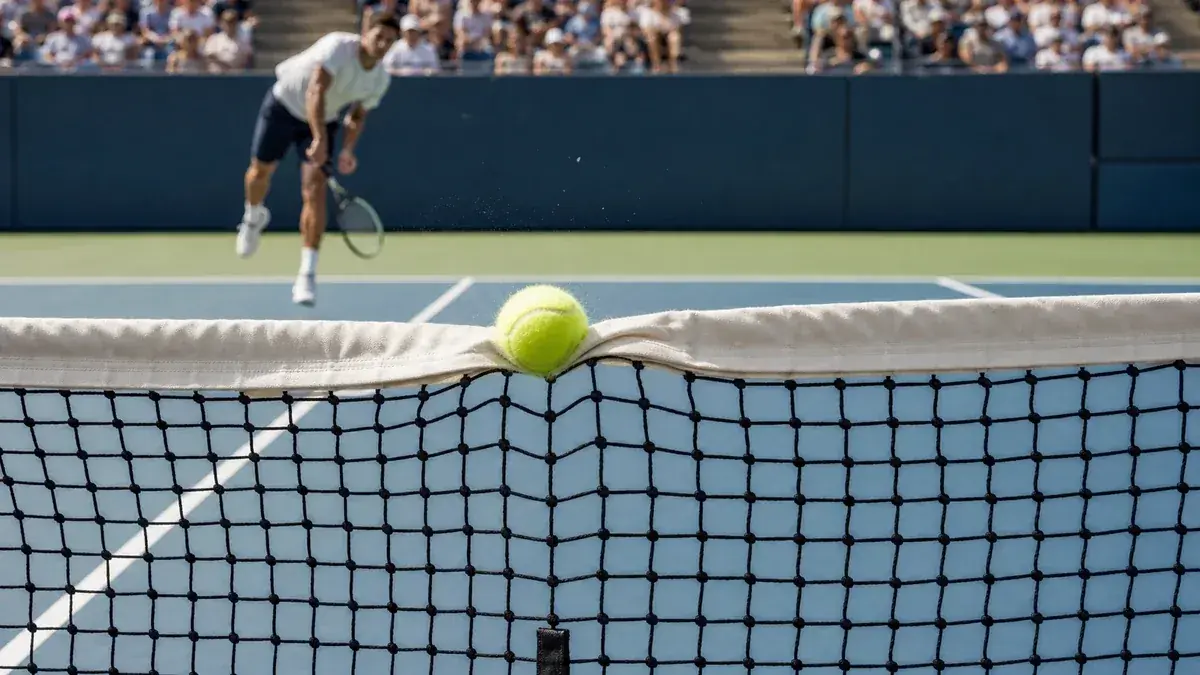
A let in tennis stops play without giving either side a point. Most often, it happens when a serve touches the net, strap, or band and still lands in the correct service box. That service is replayed, but a net touch during a normal rally is usually live.
When is a serve a let in tennis?
A serve is a let when it touches the net, strap, or band and is otherwise good. In the usual case, the ball then lands on a line or inside the correct diagonal service box. If you are learning the delivery itself, our guide to serving in tennis explains the stance, toss, and target area.
The 2026 Rules of Tennis include a second, less familiar case. If the serve touches the net, strap, or band and then hits the receiver, the receiver’s partner, or something they wear or carry before bouncing, it is also a service let. A serve that hits the receiver without first touching the net is not automatically a let.
What happens after a first-serve or second-serve let?
A service let repeats the same service and does not change the score. A let on the first serve gives the server another first serve. A let on the second serve gives the server another second serve; it does not cancel the first fault.
There is no numerical limit on consecutive service lets. Each qualifying let does not count, so the server keeps repeating that service until the ball is live or the attempt is a fault.
Is it a let, a fault, or a live ball?
The landing and the stage of the point decide the call. This quick table covers the situations that cause the most arguments in club matches.
| What happens | Correct call | Restart |
|---|---|---|
| Serve touches the net and lands in the correct box | Service let | Repeat that same serve |
| Serve touches the net and lands outside the correct box | Fault | Move to second serve, or lose the point after a second fault |
| Serve hits a net post or singles stick before bouncing | Fault | Same result as another service fault |
| Rally ball touches the net and lands in the correct court | Live ball | Keep playing |
| A stray ball enters during a rally and affects play | Let | Replay the whole point from a first serve |
| Opponent deliberately hinders a player | Point penalty, not a let | Hindered player wins the point |
The distinction between a service let and a missed serve is also covered in our fault and double-fault guide. For the lines that make up the correct box, see the tennis court lines diagram.
When is the whole point replayed?
A let during a rally restarts the whole point, normally with a first serve. The official rules give the example of another ball rolling onto the court. Even if the server had faulted before that rally began, the interruption wipes out the partial point and restores the first serve.
Rule 26 draws an important line between accidental and deliberate hindrance. If an opponent unintentionally interferes with a playable shot, or something outside the player’s control interferes, the point can be replayed. If the opponent deliberately causes the hindrance, the affected player wins the point instead.
What is not grounds for a let?
Not every distraction gives a player a replay. The USTA’s 2026 guidance says ordinary spectator out calls and other spectator noises are not grounds for a player-called let. A player also cannot claim a let because their own racket slips out of their hand, their shoe comes off, or they trip over an item that was already on their side of the court.
A ball touching the net during a rally is another common misconception. If it crosses and lands in the correct court, it is a good return. Play continues, even if the net cord makes the bounce awkward.
Who can call a let in an unofficiated match?
Any player may call a service let under the USTA’s rules for matches without officials, but the call must be prompt. It must come before the return goes out of play or before the server or server’s partner hits that return. A receiver who attempts to return a quick serve is treated as ready and cannot claim otherwise after seeing the result.
For a stray ball or another safety problem, stop immediately and call the let clearly. Do not finish the rally and then ask for a replay because the point ended badly. If you are still learning how points and games fit together, keep our tennis scoring guide handy during your next practice match.
How does the no-let rule work?
The no-let rule makes a net-touching serve live if it lands in the correct service box. It is an approved alternative in Appendix VI of the 2026 Rules of Tennis, so players should check the competition format instead of assuming every event uses the standard replay.
This is not merely an old trial. The 2026 World Tennis Tour Juniors regulations require no-let play for singles and doubles. Tennis therefore differs from format to format, much as the pickleball net-serve rule treats a legal net serve as live.
Lets are not only about net cords: at the 2026 China Open, an LED advertising board change produced a let that led Djokovic to call the video-review rule ‘stupid’ after a point he had won was replayed.
Rules checked against the 2026 World Tennis Rules of Tennis and USTA Friend at Court on August 27, 2026.
Frequently asked questions
What is a let in tennis?+
A let stops play without awarding a point. A service let repeats that particular serve, while a let caused by an interruption during a rally normally restarts the whole point. The most familiar example is a serve that touches the net and still lands in the correct service box.
Does a let use up a serve?+
No. A first-serve let is replayed as a first serve, and a second-serve let is replayed as a second serve. The second-serve let does not erase the earlier fault. A let that restarts an interrupted rally is different because the entire point begins again with a first serve.
How many lets can you have in a row?+
The rules set no numerical limit. Each qualifying service let does not count, so the server repeats the same service until the serve is live or becomes a fault. Two or three consecutive lets may be unusual, but they do not change the score or reduce the player's remaining serves.
What is the difference between a let and a fault?+
A net-touching serve is a let only when it is otherwise good. If it lands outside the correct service box, fails to cross the net, or hits a net post or singles stick before bouncing, it is a fault. A let is replayed; a fault uses one service attempt.
Can a let happen on a second serve?+
Yes. If a second serve touches the net, strap, or band and is otherwise good, the server repeats the second serve. The player does not regain a first serve because Rule 22 says a service let does not cancel a previous fault.
Who can call a service let in an unofficiated match?+
Under the USTA's guidance for unofficiated matches, any player may call a service let. The call must be prompt. It should be made before the return goes out of play or before the server or server's partner hits the returned ball.
Why do some tennis matches play net serves as live balls?+
Those matches use the approved no-let alternative. A serve that touches the net, strap, or band and lands in remains live. The event's sanctioning body must announce that format. The 2026 World Tennis Tour Juniors regulations, for example, apply no-let rules to singles and doubles.
Sources
Play & tools
Free browser games and tools — no account, no download.
- Play today's Sports Connections — Today's Sports Connections — daily hints, answers, and play the grid.
- Play Guess the NFL Player — A new mystery NFL player every day. Eight guesses, with a clue on each — plus free unlimited mode.
- Explore all our games →
Related tennis guides
View all →
Fault vs Double Fault in Tennis: What's the Difference?
A fault is one missed serve; a double fault is two in a row, which hands the point to your opponent. Here's exactly how serving faults work.
Overhead Shot in Tennis: How to Hit the Smash (Complete Guide)
The overhead shot in tennis is a serve-like swing hit above the head to put away a lob. Learn the technique, footwork, and common errors.
Lob in Tennis: Definition, Technique, and When to Use It
A lob in tennis is a high, arcing shot hit over an opponent at the net. Learn the offensive vs. defensive lob, technique, and its counter, the smash.
Pickleball Spin Serve: What's Legal and How to Add Spin
The pickleball spin serve explained: the pre-release hand spin is banned, but legal paddle spin is allowed. How to add safe spin the right way.

A Ball Fell From Fritz's Pocket Twice, and Tsitsipas Had to Earn Match Point Again
Taylor Fritz lost a ball from his pocket on consecutive points at 2-5 in the third set in Shanghai, a match point was replayed, and Stefanos Tsitsipas still closed it out.

Maryland Suspends Its Club Tennis Team Over Racist Imagery Sent to Howard and Other Teams
The University of Maryland suspended its entire club tennis team indefinitely after a tournament document emailed to visiting teams, including Howard, contained KKK imagery in an altered state flag.