
Longboard vs Skateboard: Which to Ride First
On this page5
A longboard is longer, more stable and built for cruising, commuting and downhill riding, while a standard skateboard is shorter, lighter and designed for tricks, ramps and street skating. The longboard rides smoother and is easier to balance on; the skateboard is the tool for ollies, flips and skatepark work. Which one you should ride first comes down to a single question: do you want to cruise, or do you want to do tricks?
They look like cousins, and they are, but they are optimised for opposite goals. The differences in deck shape, wheels and trucks all follow from that split. Here is how they actually compare and how to choose.
The core differences
The two boards diverge in nearly every component, and each difference serves a purpose.
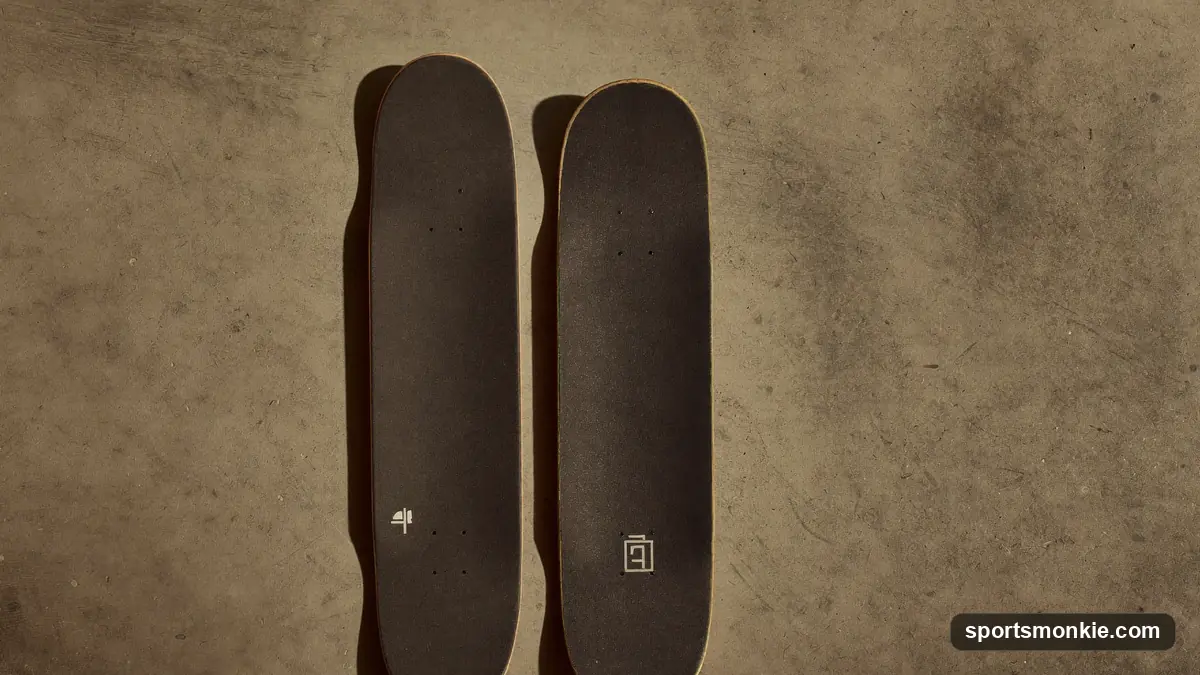
- Deck length and shape. Longboards typically run longer with a wider standing platform; skateboards are shorter with a symmetrical “popsicle” shape and upturned nose and tail for tricks.
- Wheels. Longboards use larger, softer wheels that roll fast and absorb rough ground. Skateboards use smaller, harder wheels that suit smooth park surfaces and flip tricks.
- Trucks. Longboard trucks are often wider and tuned for smooth, stable turning. Skateboard trucks are set up for quick, responsive movements and holding grinds.
- Ride feel. A longboard feels planted and cruisey; a skateboard feels twitchy and responsive, which is exactly what tricks demand.
None of these make one board “better.” They make each board better at a different job.
Side-by-side comparison
| Feature | Longboard | Skateboard |
|---|---|---|
| Deck length | Longer, wider platform | Shorter popsicle shape |
| Wheels | Large, soft | Small, hard |
| Best for | Cruising, commuting, downhill | Tricks, street, skateparks |
| Stability | High | Lower, more responsive |
| Trick capability | Limited | Extensive |
| Beginner-friendly (just riding) | Very | Moderate |
The pattern is clear: everything about a longboard favours smooth, stable riding, and everything about a skateboard favours quick, trick-oriented movement.
Which should you ride first?
Match the board to your goal.
- You want to get around, cruise or commute. Start on a longboard. The stability shortens the learning curve for balance, turning and stopping, and the soft wheels handle real-world pavement.
- You want to learn tricks and skate parks. Start on a standard skateboard. There is no shortcut here; ollies and flips can only be learned on a trick board, and starting on one builds the right muscle memory sooner.
A common path is to begin on a longboard to get comfortable simply rolling and turning, then switch to a skateboard once you catch the trick bug. There is no rule against owning both, and many riders eventually do. If you go the skateboard route, our skateboard size chart helps you pick a deck width that fits your feet and style, which matters more than beginners expect.
There are also sub-styles within each board that can steer the choice. Among longboards, a drop-through or drop deck sits lower to the ground and is the friendliest for cruising and beginners because it is stable and easy to push, while a stiff downhill longboard is built for speed and is not where a newcomer should start. Among skateboards, most beginners want a standard popsicle street deck rather than an old-school shaped board, because the symmetrical shape is what nearly every modern trick is designed around.
Learning curve, step by step
Whichever board you pick, the first sessions look similar: find your stance, learn to push, and practise stopping. Longboarders usually master these faster because the board does not wobble underneath them. On a skateboard the same basics take a little longer, and then the real trick progression, ollie first, begins, which can take weeks of practice before it clicks. Setting that expectation early stops beginners from getting discouraged when a skateboard feels harder than a longboard did.
Terrain shapes the experience too. Longboards shine on open paths, gentle hills and rough pavement, while skateboards want smooth flat ground, skateparks and ledges. Picking the board that matches the surfaces near you matters as much as matching it to your goal, because a longboard on a cramped skatepark, or a street deck on a broken sidewalk, will frustrate anyone.
Safety and speed
The safety comparison is not as simple as “longboards are safer.” At low, cruising speeds a longboard is more forgiving and less likely to throw you. But longboards are also used for downhill “bombing,” where speeds climb high and a crash is genuinely dangerous. A skateboard rarely reaches those speeds but exposes you to more falls while learning tricks. A helmet, and pads while learning, make sense on either board.
Skateboarding has grown from a subculture into an Olympic sport under World Skate, which is worth remembering when you see debates about which board is “real” skating, both are legitimate, just different disciplines. If you are drawn to the culture and history behind the deck, our roundup of the greatest skateboarders shows how far the trick side of the sport has come, and the best surfboards for beginners guide covers a close relative for anyone who likes the board-sport feel on water.
The short version: longboards are longer, softer and built for stable cruising; skateboards are shorter, harder and built for tricks. Ride a longboard first if you want to cruise and commute, and a skateboard first if you want to learn tricks. Neither is objectively better, only better suited to a goal.
Frequently asked questions
Is longboarding easier than skateboarding?+
For balance and basic riding, yes. A longboard's longer wheelbase, wider deck and larger, softer wheels make it far more stable at speed and much more forgiving over cracks and rough pavement. That stability is why longboards are popular for commuting and cruising. Trick skateboarding, by contrast, has a much steeper learning curve regardless, so 'easier' really means easier to simply ride and roll.
Are longboards for beginners?+
They are an excellent beginner choice if your goal is cruising, commuting or building confidence on wheels, because the extra stability makes falling less likely early on. They are not the right tool for learning tricks. Many people start on a longboard to get comfortable rolling and turning, then move to a standard skateboard if they later want to learn ollies and skatepark skills.
Why do skaters not like longboards?+
It is mostly a culture and function gap rather than genuine dislike. Street and park skaters value tricks, and a longboard cannot do most of them, so it sits outside that scene. Some skateparks also discourage longboards for safety and space reasons. The two are really different disciplines that happen to share a family resemblance, so each community tends to stick to its own gear.
Is a longboard safer than a skateboard?+
For low-speed cruising, a longboard's stability makes casual riding feel safer and reduces minor spills. But longboards also reach much higher speeds downhill, where crashes are far more dangerous, so the honest answer is that it depends on how you ride. At walking-and-cruising speeds a longboard is more forgiving; bombing hills on one is riskier than most street skating. A helmet matters on either board.
Sources
Play & tools
Free browser games and tools — no account, no download.
- Play today's Sports Connections — Today's Sports Connections — daily hints, answers, and play the grid.
- Play Guess the NFL Player — A new mystery NFL player every day. Eight guesses, with a clue on each — plus free unlimited mode.
- Explore all our games →
Related guides
Disc Golf Rules for Beginners: Tees and Lies
Disc golf rules made simple: tee off, play from where your disc lands, avoid penalties, and reach the basket in fewest throws. PDGA basics for beginners.

How to Throw a Disc Golf Disc: The Basics
Learn to throw a disc golf disc: backhand and forehand grips, the reach-back and pull, the release, and how far a beginner should expect to throw.
Pickleball Rules for Beginners: A Simple Guide
New to pickleball? Learn the serve, the two-bounce rule, the non-volley kitchen zone, scoring to 11, and the faults that trip up beginners the most.

Best track spikes for heptathlon: what to buy first
Best track spikes for heptathlon athletes, from a one-pair beginner setup to specialist sprint, jump, distance and replacement-pin options.
How to Hold a Pickleball Paddle: Grips and Grip Pressure
How to hold a pickleball paddle: the continental and eastern grips, the neutral ready grip, and how much grip pressure to use for control.

How to Serve in Pickleball: Technique for a Consistent Serve
A step-by-step pickleball serve technique: grip, ball drop or toss, contact point below the waist, and follow-through for a deep, reliable serve.