
Greatest Skateboarders of All Time

On this page14
- 01Greatest skateboarders of all time at a glance
- 02Rodney Mullen
- 03Tony Hawk
- 04Mark Gonzales
- 05Nyjah Huston
- 06Yuto Horigome
- 07Steve Caballero
- 08Rayssa Leal
- 09Leticia Bufoni
- 10How We Ranked
- 11Street vs. Vert: Two Paths to Greatness
- 12How Competitive Skateboarding Is Judged
- 13At a Glance
- 14The Olympic Era Changed the Math
We weighed three things: technical invention (did they add tricks the whole sport now uses), competitive record (titles, Olympic medals, contest longevity), and cultural reach (how far they pushed skateboarding beyond its own scene). Invention scores highest, because a trick outlives any contest result.
Greatest skateboarders of all time at a glance
| Rank | Skateboarder | Primary discipline | Strongest ranking argument |
|---|---|---|---|
| 1 | Rodney Mullen | Freestyle / street | Invented much of modern street skating's trick vocabulary |
| 2 | Tony Hawk | Vert | Competitive dominance, the 900 and global cultural reach |
| 3 | Mark Gonzales | Street | Pioneered creative street and handrail skating |
| 4 | Nyjah Huston | Street | Exceptional contest longevity and SLS success |
| 5 | Yuto Horigome | Street | Won the first two Olympic men's street titles |
| 6 | Steve Caballero | Vert / street | Invented the caballerial and sustained a long career |
- Godfather of street
Rodney Mullen
Most of what a street skater does today started with Mullen. He landed the first documented flatground ollie in 1982 and went on to invent or co-invent the kickflip, heelflip, 360-flip, and the impossible — the core vocabulary every modern street trick is assembled from. Remove those and the discipline has no grammar. He ranks above Tony Hawk here on invention alone: Hawk perfected and popularized vert, but Mullen supplied the raw material other people build careers on. He also won 34 of 35 freestyle contests across roughly a decade, the most lopsided competitive run the sport has recorded.
Nationality: USA · Discipline: Freestyle → street · Defining feat: Invented the flatground ollie, kickflip, and 360-flip
- Vert icon
Tony Hawk
Hawk is the skater non-skaters can name, and the record backs the fame. He landed the first documented 900 — two and a half aerial rotations — at the 1999 X Games, after more than a decade of failed attempts. He also won a stack of vert contests through the 1980s and '90s that few peers came close to. What separates him from other vert greats is reach: his video-game franchise put skateboarding in millions of homes that had never seen a half-pipe, widening the sport's audience more than any single contest result ever did.
Nationality: USA · Discipline: Vert · Defining feat: First documented 900 (1999 X Games)
- Street originator
Mark Gonzales
Gonzales turned the city into the skatepark. In 1986 he and Natas Kaupas became the first skaters to ride handrails, and he was board-sliding ledges and gaps when the sport still revolved around pools and ramps. That shift — obstacles over transitions — is the entire premise of street skating. He ranks below Mullen because his contribution was stylistic and cultural rather than a catalog of named tricks, but no one did more to legitimize skating urban terrain as a discipline in its own right.
Nationality: USA · Discipline: Street · Defining feat: Among the first to ride handrails (1986)
- Career leader
Nyjah Huston
Huston owns the competitive era. He has won seven SLS Super Crown world titles — in 2010, 2012, 2014, 2017, 2019 and 2024 among them — more than anyone in Street League Skateboarding history, with podium consistency stretching across more than a decade. He ranks here rather than higher because his case is built on results, not invention. His breakthrough came at the 2024 Paris Olympics, where he added a bronze in men's street to close a gap the pioneers above him filled with new tricks instead.
Nationality: USA · Discipline: Street · Defining feat: Most SLS Super Crown titles + Paris 2024 Olympic bronze
- Olympic first
Yuto Horigome
Horigome is the first skateboarder to win two Olympic golds. He took the inaugural men's street title at Tokyo 2020, then defended it at Paris 2024 with a last-run trick that pushed him from off the podium to first — a nerve-level performance that defined the sport's Olympic era. His placement reflects how young that era still is: two Games, two golds, and a competitive prime still ahead of him. On invention he can't match the top three, but no skater has a better Olympic record.
Nationality: Japan · Discipline: Street · Defining feat: Back-to-back Olympic gold (Tokyo 2020, Paris 2024)
- Multi-decade great
Steve Caballero
Caballero has outlasted almost everyone. A Bones Brigade standout who dominated vert in the 1980s, he gave his name to the caballerial — a fakie backside 360 ollie — then reinvented himself as a top street and rail skater in the '90s rather than fading with his era. He ranks below the Olympic names on peak achievement but above them on durability: he was still skating and designing boards past 60, a span no one else on this list has matched.
Nationality: USA · Discipline: Vert → street · Defining feat: Invented the caballerial; 40-plus-year career
- Prodigy
Rayssa Leal
Leal collected two Olympic medals before turning 17. She won street silver at Tokyo 2020 aged 13, becoming Brazil's youngest-ever Olympic medalist, then backed it up with bronze at Paris 2024 — proof the first result was a foundation, not a fluke. She ranks here on trajectory rather than a completed body of work. For the deeper women's field she leads, see our list of the best female skateboarders; Leal is the name most likely to climb this ranking over the next decade.
Nationality: Brazil · Discipline: Street · Defining feat: Olympic silver at 13 (Tokyo 2020) + bronze (Paris 2024)
- X Games great
Leticia Bufoni
Bufoni built the contest résumé that made women's street a headline event. She is a six-time X Games gold medalist with a dozen X Games medals overall, and in 2013 became the only woman to win three X Games golds in a single year. She sits at the foot of this list because her prime predated the Olympic stage where her successors are now measured, but her run through the 2010s did much of the work of raising women's skating to a marquee level.
Nationality: Brazil · Discipline: Street · Defining feat: Six X Games gold medals
Reader interaction
Build your ranking
Drag the names into the order you think is right — or use the arrows — then submit to see how your list compares with everyone else's.
- Rodney Mullen
- Tony Hawk
- Mark Gonzales
- Nyjah Huston
- Yuto Horigome
- Steve Caballero
- Rayssa Leal
- Leticia Bufoni
Audience ranking
How everyone ranked them
Built from reader rankings using position-based points.
Ask ten skaters to name the greatest of all time and you’ll get ten answers, split along one fault line: did they grow up watching vert or street? This list weighs both worlds against a single set of criteria instead of picking a side.
How We Ranked
Three factors, in order of weight. Invention comes first — a trick outlives any contest, and the skaters who added new moves to the sport’s vocabulary shaped everyone who came after. Competitive record comes next: X Games and Street League titles, Olympic medals, and how long someone stayed at the top. Cultural reach is the tiebreaker — how far a skater pushed the sport beyond its own scene.
That order is why Rodney Mullen edges Tony Hawk despite Hawk’s larger public profile, and why career competitors like Nyjah Huston rank below inventors who changed how everyone skates. It is also why the Olympic generation, still early in their careers, place on trajectory rather than a finished body of work.
Street vs. Vert: Two Paths to Greatness
Skateboarding never had one arena, so it never produced one type of legend.
- Vert skating happens on ramps and half-pipes and rewards height, amplitude, and spin combinations. Tony Hawk and Steve Caballero are its defining figures.
- Street skating treats the city as the course — stairs, rails, ledges, gaps — and rewards technical precision. Mark Gonzales built it; Mullen, Huston, and the Olympic street stars carry it.
Plenty of the sport’s biggest names crossed between the two, which is part of why a single ranking is so contested. Skaters who came up on transition often measure greatness differently from those raised on handrails — a divide you also see in adjacent board sports like surfing.
How Competitive Skateboarding Is Judged
Modern contests score runs and best tricks on a points system, with judges weighing difficulty, execution, consistency, and use of the course. That framework rewards a different skater than the old freestyle and vert eras did — technical repeatability under pressure over raw first-of-its-kind invention.
It matters for this list because contest results and historical influence don’t always point at the same names. Huston is the most decorated competitor of the SLS era; Mullen barely competed under anything resembling today’s format yet outranks him on impact. Equipment shapes the gap too — deck dimensions and trick style are closely linked, as our skateboard size chart lays out.
At a Glance
| Rank | Skater | Discipline | Country | Defining feat |
|---|---|---|---|---|
| 1 | Rodney Mullen | Freestyle → Street | USA | Invented flatground ollie, kickflip, 360-flip |
| 2 | Tony Hawk | Vert | USA | First documented 900 (1999 X Games) |
| 3 | Mark Gonzales | Street | USA | Among first to ride handrails (1986) |
| 4 | Nyjah Huston | Street | USA | Most SLS titles + Paris 2024 bronze |
| 5 | Yuto Horigome | Street | Japan | Back-to-back Olympic gold |
| 6 | Steve Caballero | Vert → Street | USA | Caballerial; 40-year career |
| 7 | Rayssa Leal | Street | Brazil | Olympic silver at 13; Paris bronze |
| 8 | Leticia Bufoni | Street | Brazil | Six X Games golds |
The Olympic Era Changed the Math
For most of skateboarding’s history, greatness was argued in video parts and contest circuits, not on a podium with a flag. Tokyo 2020 changed that overnight. Teenagers from Japan and Brazil walked onto a stage built for older, more established sports and matched it — Rayssa Leal medaled at 13, Yuto Horigome won the first men’s street gold, and Paris 2024 confirmed neither was a one-off.
None of this settles who is “the greatest” inside skateboarding’s own community, where contest results have never carried the weight they do elsewhere. But it added new names, new nations, and a new kind of résumé to a debate that used to run entirely through California.
Frequently asked questions
Who is the greatest skateboarder of all time?+
It depends on how you weigh invention versus fame. We rank Rodney Mullen first because he invented the flatground ollie, kickflip, and 360-flip — the tricks nearly all modern street skating is built from. Tony Hawk is the more famous choice thanks to his vert dominance and video-game franchise, and many fans put him first. Both answers are defensible; the disagreement usually comes down to whether you grew up watching street or vert.
Has any skateboarder won two Olympic gold medals?+
Yes. Japan's Yuto Horigome is the first skateboarder to win two Olympic golds, taking the men's street title at Tokyo 2020 and defending it at Paris 2024. Skateboarding only debuted at Tokyo 2020, so the Olympic record book is very short — most disciplines have crowned just two champions so far. Horigome's back-to-back wins already make him the most accomplished skateboarder the Games have produced, with more chances ahead at LA28.
Who has won the most Street League Skateboarding titles?+
Nyjah Huston holds the record with seven SLS Super Crown world championships, including wins spread from 2010 through 2024. No other skater is close in that circuit, which is why he is regarded as the most successful competitive street skater of the modern era. He added an Olympic bronze in men's street at Paris 2024, his first Games medal, filling the one notable gap on an otherwise dominant contest résumé.
Who actually invented the ollie?+
Alan 'Ollie' Gelfand invented the original ollie around 1978, a no-handed aerial he performed in bowls and pools on vert terrain. Rodney Mullen then adapted the motion to flat ground in 1982, striking the tail and leveling the board with his front foot. Gelfand's version made vert skating possible; Mullen's flatground version became the foundation of street skating, since almost every street trick now begins with an ollie off level pavement.
When did skateboarding become an Olympic sport?+
Skateboarding made its Olympic debut at the Tokyo 2020 Games, which were held in 2021 after a pandemic delay. It featured street and park disciplines for both men and women. Paris 2024 confirmed it as a fixture, and it is scheduled again for the 2028 Los Angeles Games. The Olympic format judges runs and best tricks on a points system, which differs from the older X Games and Street League contest circuits that shaped earlier generations.
What is the difference between street and vert skating?+
Street skating uses urban-style obstacles — rails, stairs, ledges, and gaps — and rewards technical trick difficulty on flat and near-flat terrain. Vert skating happens on large ramps and half-pipes, rewarding height, spin combinations, and amplitude in the air. The two demand different bodies of skill and have produced separate lineages of legends: Mullen and Gonzales from street, Hawk and Caballero from vert. Many top skaters have crossed between the two over a career.
Sources
Play & tools
Free browser games and tools — no account, no download.
- Play today's Sports Connections — Today's Sports Connections — daily hints, answers, and play the grid.
- Play Guess the NFL Player — A new mystery NFL player every day. Eight guesses, with a clue on each — plus free unlimited mode.
- Explore all our games →
Related records & rankings guides
View all →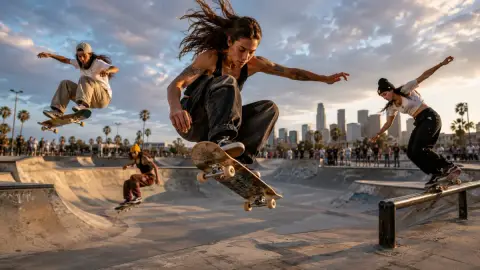
Best Female Skateboarders of All Time, Ranked
Leticia Bufoni, Lizzie Armanto, Sky Brown, Rayssa Leal, and Patti McGee headline our ranked list of the best female skateboarders, with the record behind each name.

Greatest Lacrosse Players of All Time
From Jim Brown to Paul Rabil, these are the greatest lacrosse players in history — ranked by dominance, legacy, and impact on the sport.

Best Pool Players of All Time: The Greatest in Billiards
The greatest pool players of all time include Efren Reyes, Earl Strickland, Ralph Greenleaf and Shane Van Boening — ranked by world titles, U.S. Open wins and longevity at the top of the pro game.
Greatest Boxers of All Time: The Complete Ranked List
The greatest boxers ever, ranked — from Sugar Ray Robinson and Muhammad Ali to Manny Pacquiao — weighed by pound-for-pound skill, opposition, titles, and reigns.
Best Volleyball Players of All Time: The Greatest Ever
A ranked look at the greatest volleyball players in history, covering legendary setters, outside hitters, and blockers who defined the sport across decades.

Greatest Judo Players (Athletes) of All Time
The greatest judo players of all time, including Teddy Riner, Yasuhiro Yamashita, and Ryoko Tani, who dominated World and Olympic podiums for decades.