
How Does the 24 Hours of Le Mans Work?
On this page7
The 24 Hours of Le Mans is an endurance race in which teams of drivers share a single car and race continuously for 24 hours, and the car that covers the greatest distance in that time wins. Held every June at the Circuit de la Sarthe in France and organised by the Automobile Club de l’Ouest (ACO), it is one of the oldest and most prestigious motor races in the world.
Unlike a normal Grand Prix, which is decided in a couple of hours, Le Mans is a test of speed, reliability, strategy and human stamina stretched across a full day and night. No single driver races the whole time, and several different classes of car battle on the same track at once. Here is how the whole thing actually works.
The basic goal: distance, not a finish line
Most races end when the leader crosses the line after a set number of laps. Le Mans is the opposite. The clock, not a lap count, ends the race. Cars set off and run for 24 hours, and whoever has completed the most laps, and therefore covered the most distance, when time runs out is the winner. When the leader takes the chequered flag after the 24 hours elapse, the race is over.
That single rule shapes everything else. To win, a team must go fast enough to bank laps and keep the car running for an entire day. A blistering car that breaks down is beaten by a slightly slower one that never stops, which is why reliability is as prized as raw pace.
Teams of drivers, not one hero
Because a human cannot safely race for 24 hours, each car is driven by a team of drivers, usually three. They take turns in “stints,” driving for a period and then handing over to a teammate during a pit stop. The rules cap how long any one driver can be at the wheel, both in a single stint and in total over the race, so no driver can hog the car.
Between stints, resting drivers eat, sleep briefly, and are monitored by the team. Managing that human rotation, keeping each driver sharp through the night and into the following afternoon, is a strategic puzzle on top of the racing itself.
Racing at night and in all conditions
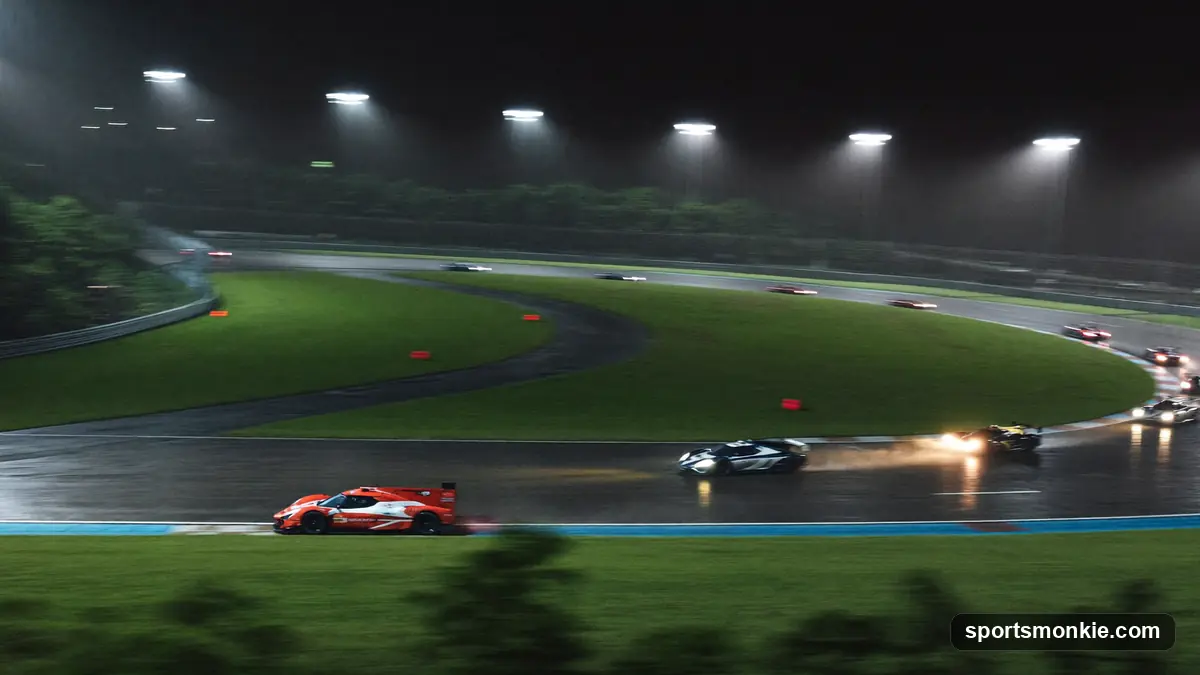
Le Mans runs straight through the night, so drivers race in darkness for hours, relying on headlights down long straights at very high speed. Weather can change repeatedly over 24 hours, bringing rain, cold and shifting grip. A team may face bright afternoon sun, a cold damp midnight and a foggy dawn all in one race, and must adapt tyres and pace to each. This constantly changing environment is a defining part of the event’s difficulty.
Multiple classes on one track
One of the most confusing things for newcomers is that Le Mans is not a single race but several running at once. Different categories of car, with very different speeds, share the circuit at the same time. That means the fastest prototypes are constantly overtaking slower cars, and drivers must manage traffic all race long.
| Element | How it works at Le Mans |
|---|---|
| Race length | 24 hours (time-based, not lap-based) |
| Winner | Car covering the greatest distance |
| Drivers per car | Typically 3, rotating in stints |
| Circuit | Circuit de la Sarthe, France |
| Classes | Top-tier prototypes (Hypercars) down to GT cars, racing together |
| Organiser | Automobile Club de l’Ouest (ACO) |
Because of the classes, there is an overall winner, the top car from the fastest category, plus a separate winner in each other class. Two teams can both “win Le Mans” on the same day in different categories.
Pit stops and strategy
Pit stops are where much of the race is won and lost. Cars come in for fuel, fresh tyres and driver changes, and teams try to combine these efficiently to lose as little time as possible. Deciding when to pit, how many laps to run on a set of tyres, and how to react to a safety car all feed into strategy. A well-timed stop, or an unnecessary one, can be worth many places over 24 hours.
How Le Mans compares to Formula 1
Fans often ask how Le Mans stacks up against F1. The short version: an F1 car is faster over one lap thanks to enormous downforce and acceleration, but Le Mans cars are built to be fast and survive a full day. They are different disciplines with different championships and organisers, so they rarely get compared directly on track. If you enjoy contrasting racing formats, our look at IndyCar vs F1 and MotoGP vs F1 breaks down how other series differ, and our guide to the F1 points system shows how a sprint-style championship is scored by comparison.
Why it matters
Le Mans endures because it asks a different question from most motorsport. Not “who is fastest for two hours?” but “who is fastest and toughest and smartest for a full day and night?” It rewards engineering, teamwork, driver stamina and cool strategy in equal measure. That combination is why a win at Le Mans is one of the most respected achievements in all of racing.
Frequently asked questions
How does someone win Le Mans?+
You win Le Mans by covering the greatest distance, the most laps of the circuit, in the 24-hour period. When time expires, the leader completes one final lap and the car that has travelled furthest is the overall winner. Because several classes race together, there is one overall winner (from the fastest, top class) plus a winner in each other class. Winning requires speed and, just as importantly, reliability: a car that breaks down or crashes cannot bank distance while it is stopped.
Do drivers really drive for 24 hours straight?+
No. Each car is shared by a team of drivers, normally three, and the rules limit how long any one driver can be behind the wheel, both per stint and in total across the race. Drivers rotate in and out during pit stops, so while the car runs for 24 hours, each driver races in shifts and rests, eats and is checked over between stints. Managing driver fatigue is part of the strategy.
What is faster, F1 or Le Mans?+
A Formula 1 car is faster over a single flying lap; F1 machines have far more downforce and acceleration and would lap most circuits quicker. Le Mans prototypes reach very high top speeds on the long Mulsanne straight but are built for 24 hours of endurance, not a one-lap sprint. So F1 is faster lap-for-lap, while Le Mans cars are engineered to be fast and durable for a full day of racing, a different challenge entirely.
Why doesn't Formula 1 race at Le Mans?+
F1 and Le Mans are different championships with different cars, rules and organisers, F1 is run under the FIA's Formula 1 regulations, while Le Mans is organised by the ACO as the centrepiece of endurance racing. F1 cars are single-seat sprint machines not designed for endurance racing, shared driving, or the mixed-class, day-long format at the Circuit de la Sarthe. The two simply belong to separate branches of motorsport.
Sources
Play & tools
Free browser games and tools — no account, no download.
- Play 24-0 — Draft an F1 chassis and two drivers, then chase a perfect 24-0 — win every race on the 24-round calendar.
- Explore all our games →
Related motorsport guides
View all →
Best Race Car Drivers of All Time: Ranked Across Motorsport
The greatest race car drivers ever, ranked across F1, IndyCar, NASCAR and Le Mans — from Hamilton and Schumacher to Fangio and Andretti, with the case for each.
How Do NASCAR Playoffs Work?
NASCAR's playoffs feature 16 drivers in a 10-race, four-round elimination format that ends with a winner-take-all Championship 4 finale. Explained simply.

Norris Appears to Mock Stroll in a Nightclub Video Hours After His Singapore Apology
Lando Norris was filmed at a Singapore nightclub appearing to mock Lance Stroll hours after apologising to McLaren for his sprint collision with Piastri.
What Is a Drive-Through Penalty in F1?
A drive-through penalty in F1 makes a driver drive through the pit lane at the speed limit without stopping, losing around 20 seconds but staying in the race.
What Is Dirty Air in F1? Why It Kills Overtaking
Dirty air in F1 is the turbulent wake behind a car that robs the following car of downforce, making it slide and struggle to follow closely or overtake.
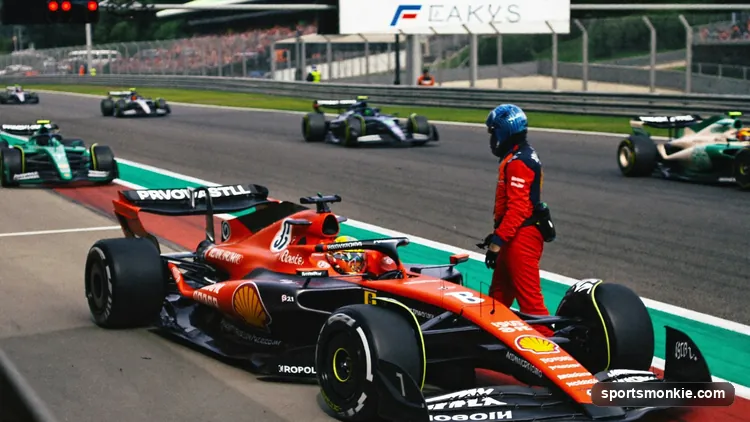
What Is a DNF in F1? Did Not Finish, Explained
A DNF in F1 means 'Did Not Finish' — a driver who retires from a race through a crash, mechanical failure or other issue and is not classified in the results.