
FIA to Investigate Software Glitch That Stopped F1 Cars on the Formation Lap in Malaysia
On this page6
The FIA has promised a full investigation into a software bug that cut power to several Formula 1 cars on the formation lap of Sunday’s Bahrain Grand Prix in Malaysia, held at Sepang. Max Verstappen slowed dramatically at the front, Lewis Hamilton crawled to a halt and had to stop and restart his car on track for the first time in his career, and the start was abandoned while officials pushed a software update to every team, Reuters reports. Verstappen went on to win the race, but the result is not the story anyone is telling.
What happened on the formation lap?
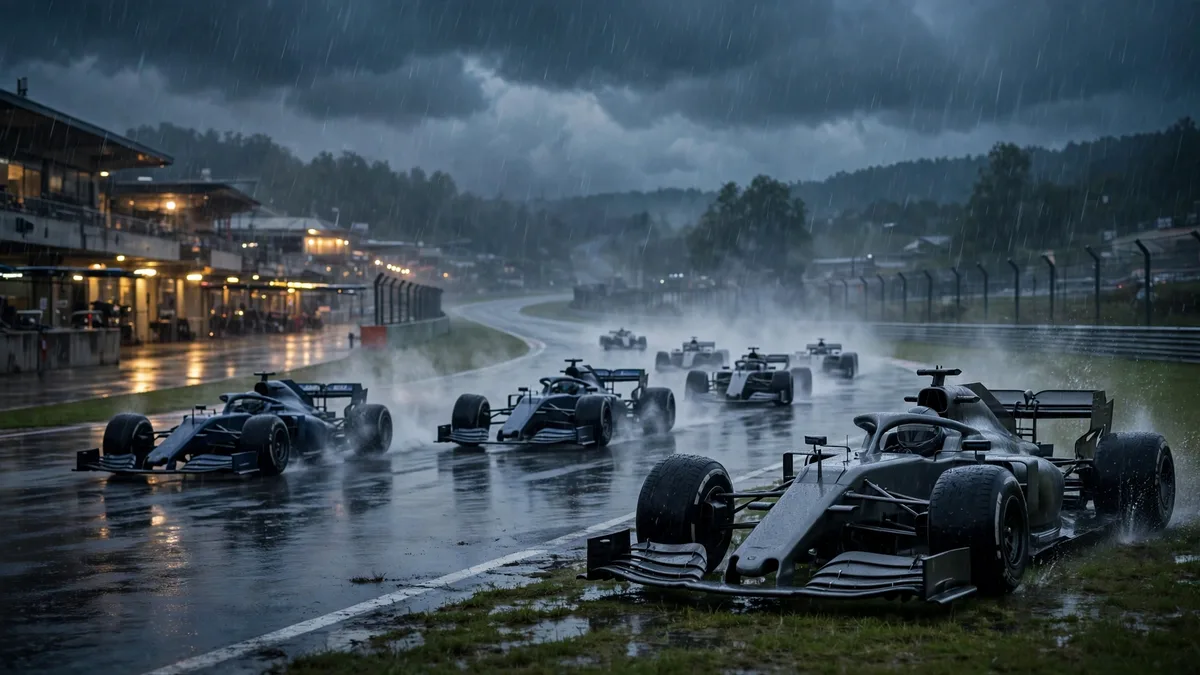
Heavy rain had already delayed the original start by 40 minutes before the field took to the track behind the safety car on intermediate tyres, RACER reports. Halfway through the opening lap Verstappen slowed dramatically, Hamilton ground to a halt before the final corner, and multiple other cars slowed or stopped.
Charles Leclerc, running fourth, described realising mid-lap that everyone had the same problem and the field was stuck at 20kph, Sky Sports reports. Kimi Antonelli said the cars were at one point five-wide on the straight because nobody understood what was happening. The start procedure was abandoned, a red flag situation rather than a normal formation lap, and the race eventually began with the original grid order, almost an hour after the chaos on Sky Sports’ timing and over 90 minutes behind schedule in total, ESPN reports.
What caused the cars to lose power?
A software interaction nobody had tested for. The FIA said “an unprecedented combination of low engine speed, low-grip conditions, wet-weather energy management settings and the Sepang circuit’s sector configuration led to an unintended loss of power for a number of cars.”
Sky Sports analyst Anthony Davidson explained the chain: at low speed the turbo spools down because the cars no longer have an MGU-H, the battery drains trying to meet torque demand on intermediate tyres, and the car falls outside the FIA’s energy regulations and cannot reaccelerate. FIA single-seater director Nikolas Tombazis told reporters the bug “prevented the power from being redeployed,” Reuters reports, and admitted a lack of wet pre-season testing let it slip through.
How did the FIA fix it during the delay?
By patching the whole grid. The FIA technical department removed the energy limit constraint in the affected sectors through an updated software release distributed to all competitors during the rain delay, enabling teams to change the power unit settings before the start.
Tombazis told SiriusXM that the update was issued within a few minutes of the problem being understood, but installing it on every car and verifying each one cost about 20 to 25 minutes, RACER reports. He also conceded that every checker missed the bug beforehand: the FIA, the teams, the power unit manufacturers and the official ECU provider all failed to spot it in testing.
What did the drivers say afterwards?
They laughed about it, then stopped laughing. In the press conference, Verstappen, Hamilton and championship leader Antonelli joked it felt “like the Lego race,” a reference to the drivers’ parade in Lego cars at Silverstone, Sky Sports reports. Hamilton added: “I had to stop on track and stop the car and engine and restart it. I’ve never done that before.” Verstappen concluded: “That’s not what you want for the sport and I hope there is a lesson learned.”
The sharper verdicts came elsewhere. Reigning champion Lando Norris called the experience “horrible” and said it proves the electronics should not work this way, while Lance Stroll said the field should have been out racing on wet tyres instead of fixing software, ESPN reports. Drivers had already criticised the 2026 power units, which are almost 50 percent electric, since the opening race of the season, Reuters reports.
What did the FIA review actually find? (Update, October 8)
A specific operating window, not a general failure. The review concluded that cars running at low engine revs in circuit sectors where a 250kW power reduction was applied lost power beyond what was intended, and could not recover that power inside those sectors, Reuters reports. That explains why the crawl struck on the slow parts of the lap and why removing the sector constraint during the delay got the field moving again.
The response runs in two stages. The configuration established at Sepang will be reinstated for this weekend’s Singapore Grand Prix if wet weather is expected, and a further update to the wet-weather software will be released for the United States Grand Prix on October 25, the FIA said via Reuters. The review also recommended stronger testing measures, with the FIA, teams and power unit manufacturers strengthening validation through independent assessment and input from the supplier of the standardised control unit, Sky Sports reports.
The FIA pushed back on one part of the original story: the suggestion the software had never been tested. It said teams and manufacturers ran simulation exercises before deployment and that the package was then run at full scale in first practice sessions at the Belgian and Dutch Grands Prix, Sky Sports reports. Its published chronology has the start suspended at 3.45 p.m. local time, the cause identified within five minutes, guidance issued to teams at 4.03 p.m., the revised software integrated by 4.20 p.m. and cars leaving the pit lane again at 4.33 p.m., Reuters reports. Drivers are expected to discuss the episode with the FIA in Singapore, where a heat hazard has already been declared for the weekend.
What happens next for the FIA and the teams?
A full review, on a short clock. The FIA said it will review the issue together with the teams and power unit manufacturers, and Tombazis accepted that “sometimes things fall through the net,” Reuters reports.
The test comes immediately: Formula 1 heads to Singapore next for the final Sprint weekend of the season, with track action starting Friday, Sky Sports reports. One driver’s Singapore is already compromised by Sepang’s other failure: Mercedes has confirmed George Russell will start from the back of the grid there with a new engine after his power unit died five laps from the finish. One wet session there and the same software, minus one energy constraint, is back under examination. Sepang was the first wet weekend of the year; the sport now knows what its new cars do in the rain, and so does everyone who watched them stop.
Frequently asked questions
What happened on the formation lap at Sepang?+
After heavy rain delayed the start, the field set off behind the safety car on intermediate tyres and several cars lost power on the opening lap, RACER reports. Pole-sitter Max Verstappen slowed dramatically, Lewis Hamilton crawled to a halt before the final corner, and Charles Leclerc hit the same problem, leaving cars running at about 20kph before the start procedure was abandoned.
What caused the F1 cars to lose power?+
The FIA said an unprecedented combination of low engine speed, low-grip conditions, wet-weather energy management settings and the Sepang circuit's sector configuration caused an unintended loss of power. Sky Sports analyst Anthony Davidson explained that running slowly lets the turbo spool down, the battery drains, and the car is left with internal combustion power only, outside the permitted energy limits.
How did the FIA fix the glitch during the delay?+
The FIA technical department removed the energy limit constraint in the affected sectors through an updated software release distributed to all competitors, the FIA statement said. Single-seater director Nikolas Tombazis told SiriusXM, via RACER, that the update was issued within minutes but installing and verifying it on every car cost about 20 to 25 minutes of the delay.
What did Lewis Hamilton say about stopping on track?+
Hamilton said he had to stop on track, switch the car and engine off and restart it, something he had never done before, Sky Sports reports. In the post-race press conference he, Max Verstappen and Kimi Antonelli joked that the crawl felt like the Lego race the drivers staged at Silverstone, while Verstappen concluded that it is not what you want for the sport.
Why had the 2026 power units already frustrated drivers?+
The 2026 power units are almost 50 percent electric, Sky Sports notes, and drivers have criticised the energy management they demand since the opening race, Reuters reports. Sepang was the first wet race weekend of the season, and Tombazis said the lack of pre-season testing in wet conditions played a part in the bug escaping detection by the FIA, the teams and the manufacturers.
What did the FIA review find on October 8?+
That low-rev running did it. The review concluded cars running at low engine revs in circuit sectors where a 250kW power reduction applied lost more power than intended and could not recover it in those sectors, Reuters reports. The Sepang configuration will be reinstated for Singapore if it is wet, with a further wet-weather update due at the United States Grand Prix on October 25.
What happens next after the FIA investigation?+
The fix travels to Singapore first. The FIA said the configuration established at Sepang will be used there if similar weather is expected, and that it will strengthen power-unit software testing with the teams, manufacturers and the standard ECU supplier, Sky Sports reports. Drivers are expected to discuss Sepang with the FIA during the Singapore weekend, Reuters reports.
Sources
- Reuters: FIA to investigate software bug after Bahrain GP in Malaysia
- Sky Sports: FIA explain 'unprecedented' glitch that caused Bahrain GP in Malaysia start chaos on formation laps
- RACER: FIA explains software glitch behind delayed Bahrain GP in Malaysia start
- ESPN via 10bmnews: 'Totally unacceptable': F1 drivers slam delayed start to Bahrain Grand Prix in Malaysia
- Reuters: Sepang software fix to remain in place for Singapore if wet
- Sky Sports: FIA reveals Bahrain GP 'software bug' findings and planned changes after glitch caused issues before rain-hit Malaysia race
Play & tools
Free browser games and tools — no account, no download.
- Play 24-0 — Draft an F1 chassis and two drivers, then chase a perfect 24-0 — win every race on the 24-round calendar.
- Explore all our games →
Related motorsport guides
View all →
Antonelli Takes COTA Pole With Title on the Line as FIA Clears Delta-Time Investigation
Kimi Antonelli took pole for the United States Grand Prix at Austin, where a win plus help from Russell and Hamilton would make him F1's youngest champion.
Verstappen and Hamilton Say F1 Should Not Run Sprints Where Cars Cannot Pass
Singapore sprint winner Max Verstappen and runner-up Lewis Hamilton say street tracks where passing is near impossible are the wrong place for sprint races.
Verstappen Keeps Singapore Sprint Pole After Stewards Find a Yellow-Flag Breach but No Penalty
Max Verstappen breached the yellow-flag rule passing Lewis Hamilton in Singapore sprint qualifying, but the stewards imposed no penalty and he keeps pole.
FIA Admits Human Error Gave Some Cars Extra Power in Singapore Sprint Qualifying
The FIA says a Race Control human error switched Overtake Mode on for 27 seconds in Singapore SQ1, giving some cars extra power, and Sainz wants to know why.
Verstappen Calls Austin Bumps 'Unacceptable' as Norris Reveals His Headache-Tablet Routine
Max Verstappen called the Circuit of the Americas bumps 'unacceptable' and warned of spine damage, with Lando Norris backing him and revealing he takes headache tablets before sessions on rough tracks.
F1 Restores 305km Race Distance in 2028 After One Season at 290km
The FIA's published 2027 regulations restore the 305km grand prix distance from 2028. The 290km cut lasts one season. Here is the timeline and the engine changes behind it.