
Verstappen Keeps Singapore Sprint Pole After Stewards Find a Yellow-Flag Breach but No Penalty
On this page5
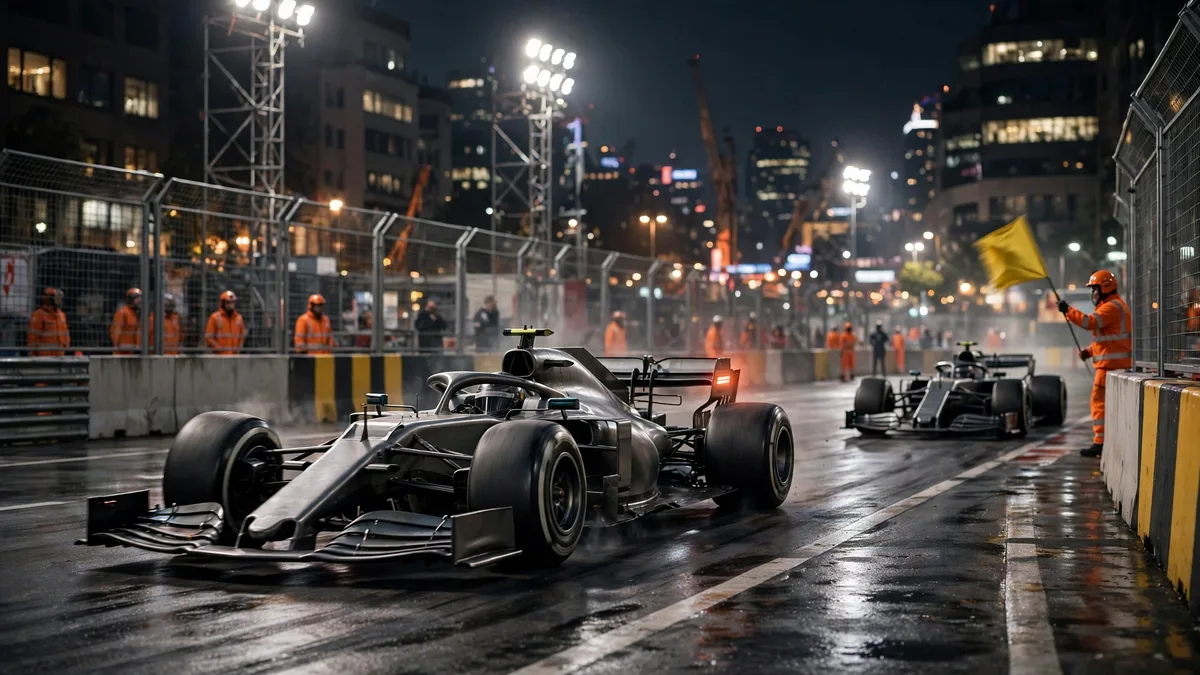
Max Verstappen broke the yellow-flag rule in Singapore sprint qualifying and kept his pole position anyway. The stewards’ decision, published late on Friday night, found that Verstappen breached the regulation when he passed Lewis Hamilton under a single yellow flag, RACER reports, then imposed no penalty after telemetry showed he had lifted off, slowed by some 70km/h and passed a car travelling at under 60km/h. He starts Saturday’s sprint from the front.
What exactly happened between Turns 7 and 8?
A debris yellow created the trap. Sergio Perez had hit the Turn 5 barriers in the first part of sprint qualifying, leaving debris that brought out a single yellow flag in the Turn 7 to Turn 8 sector, Crash.net reports. Hamilton, ahead of Verstappen, was warned of the faster car’s approach, slowed to less than 60km/h and moved right off the racing line.
Verstappen arrived on a push lap, on throttle out of Turn 7. He saw the flag and lifted, and telemetry confirmed he was fully off the throttle within about 40 metres of entering the sector, the stewards found. It was not enough to stop the closing speed doing the rest: he passed Hamilton before Turn 8, still inside the yellow sector, and then abandoned the lap. His radio message, reported by Crash.net, shows a driver who already knew the problem, saying he would let Hamilton by again and that he wanted to be safe.
How can a driver breach the rule and keep pole?
By the stewards separating the act from the reaction. The regulation prohibits overtaking under yellows, and the decision states plainly that Verstappen breached it. The sanction, though, turned on whether he had responded the way the rule intends: he had lifted, he had cut his speed by roughly 70km/h against his own push-lap reference, and the car ahead had slowed so sharply that the overlap was, in the stewards’ phrase, an unfortunate consequence of the closing-speed differential.
The second half of the reasoning is the part rivals will study. Verstappen argued that avoiding the overtake would have required extremely heavy braking, which he considered could have created an unsafe situation, and the stewards accepted it. In other words, the safest available action produced the breach. That is a very different precedent from the usual yellow-flag case, where the driver simply failed to slow down, and it sits oddly beside a Singapore weekend that began with George Russell taking a new power unit and a back-of-grid start for Sunday’s race: one favourite’s weekend was decided by a hardware choice, the other’s survived a rule breach on a judgment call.
Why is the telemetry the real story here?
Because without it, this is a radio complaint and a video clip. Hamilton reported the pass, the footage showed an overtake under a yellow flag, and on pictures alone the standard outcome is a grid penalty. The numbers are what changed the ending: fully off the throttle within about 40 metres, 70km/h below his comparable speed at the passing point, against a car braking below 60km/h.
That evidence chain is also why the verdict is hard to use as a free pass. A driver who lifts late, or lifts less, will not match those figures, and the stewards published them precisely so the exception is measurable. Singapore has already produced one piece of software-and-systems fallout this season, after the FIA published its review of the formation-lap power-loss glitch; this time the data exonerated the driver instead of the system.
What does the verdict do to the Singapore weekend?
It keeps the sprint’s front row as qualifying wrote it. Verstappen, who won last weekend in Malaysia, starts ahead of Russell, with Charles Leclerc third and the championship leader Kimi Antonelli only seventh after an off-pace session, the PA report of qualifying says. Antonelli’s 84-point lead over Russell with seven rounds left means the title arithmetic barely moves either way, but Russell’s Sunday is already compromised by his engine penalty, and a sprint win from pole would let Verstappen pressure a Mercedes camp that spent Friday arguing about itself, after Toto Wolff dismissed the favouritism claims around his two drivers as brainless.
For Hamilton, the frustration is built into the facts the stewards accepted: he did everything the flag asked, slowed, moved aside, and the car behind still went past, lawfully in outcome if not in letter. Expect that distinction to be quoted back at the FIA the next time a yellow-flag overtake is punished without a hearing on closing speeds.
What happens next?
The sprint runs on Saturday over 21 laps, with Verstappen at the front and the verdict now part of the weekend’s record. Sunday’s main race then resets the grid, Russell at the back included. The longer tail is regulatory: teams now have a published, telemetry-based example of a yellow-flag breach drawing no sanction, and the next driver investigated for the same act will arrive at the stewards’ room carrying this document and asking whether his lift, measured the same way lap times are chased across a season, was really any worse.
Frequently asked questions
Why was Verstappen investigated in Singapore sprint qualifying?+
Because he passed Lewis Hamilton between Turns 7 and 8 while a single yellow flag was being waved for debris from Sergio Perez's earlier contact with the Turn 5 barriers, Crash.net reports. Overtaking under a yellow flag is prohibited, Hamilton flagged the pass on team radio, and the stewards opened an investigation after the session.
Did Verstappen break the yellow-flag rule or not?+
He did, on the stewards' own wording. Their decision states that he breached the yellow-flag regulation by overtaking Hamilton, RACER reports. What the stewards then decided was that a breach did not automatically mean a penalty, because his reaction to the flag, lifting off and slowing sharply, was the behaviour the rule exists to produce.
Why was no penalty imposed if the rule was breached?+
Because of the speed difference. Hamilton was braking at under 60km/h and had moved off the racing line, while Verstappen, on a push lap, had lifted fully within about 40 metres yet was still closing fast, the stewards found. They accepted his argument that braking heavily enough to stay behind Hamilton could itself have created an unsafe situation.
What did the telemetry show about Verstappen's reaction?+
It backed his account. He was on throttle out of Turn 7, saw the flag and lifted, and telemetry confirmed he was fully off the throttle within roughly 40 metres of entering the sector, RACER reports. At the point he passed Hamilton his speed was some 70km/h lower than on another push lap in the same session.
What did Verstappen say on the radio at the time?+
He knew he had a problem. After his engineer warned him he was in yellows, Verstappen said he thought he had to abort the lap and would let Hamilton by again, adding that he believed he had passed before the yellow but wanted to be safe, Crash.net reports. He then abandoned the push lap, as the stewards' decision also records.
Does Verstappen keep his sprint pole position?+
Yes. With no penalty imposed, the pole he won stands, ahead of George Russell by 0.120 seconds in the PA report of the session. He starts Saturday's 21-lap sprint at the front, while Russell's separate power-unit change sends him to the back of the grid for Sunday's main Grand Prix instead.
Why does this verdict matter beyond one sprint race?+
Because it draws a line other drivers will cite. Yellow-flag overtakes usually bring automatic grid penalties, so a published decision that separates the breach from the sanction, based on telemetry and the other car's speed, becomes the reference case the next time a driver passes a crawling car under yellows and claims braking harder was the dangerous option.
Sources
- RACER: Verstappen avoids penalty over yellow flag infringement
- Crash.net: Verstappen escapes penalty and keeps Singapore sprint pole after Lewis Hamilton incident
- Formula 1: Verstappen clinches pole position in Singapore Sprint Qualifying ahead of Russell
- GrandPrix247: Verstappen did not expect Singapore Sprint pole as FIA clears Red Bull driver
Play & tools
Free browser games and tools — no account, no download.
- Play 24-0 — Draft an F1 chassis and two drivers, then chase a perfect 24-0 — win every race on the 24-round calendar.
- Explore all our games →
Related motorsport guides
View all →
Russell to Start Singapore GP From Back of Grid After Mercedes Confirms New Engine
Mercedes confirmed George Russell has no engines left in his allocation and will take a new power unit in Singapore, sending him to the back of the grid.

FIA to Investigate Software Glitch That Stopped F1 Cars on the Formation Lap in Malaysia
The FIA promised a full review after a software bug cut power to F1 cars on a wet formation lap at Sepang, forcing Hamilton to stop and restart his car.

Wolff Calls Mercedes Favouritism Claims 'Brainless' and Tells the Accusers to Watch Teletubbies
Toto Wolff dismissed claims Mercedes favour Kimi Antonelli over George Russell as brainless in Singapore, pointing to equal machinery and Russell's bad luck.

No, Kim Kardashian and Lewis Hamilton Are Not Married: The Viral Wedding Screenshot Is Fake
A viral post claiming Kim Kardashian secretly married Lewis Hamilton used a fabricated Instagram story screenshot and AI-generated wedding images. No such post exists.
What Is a Drive-Through Penalty in F1?
A drive-through penalty in F1 makes a driver drive through the pit lane at the speed limit without stopping, losing around 20 seconds but staying in the race.
What Is Pole Position in F1? How It's Decided
Pole position in F1 is first place on the starting grid, earned by setting the fastest lap in qualifying. It gives the cleanest line into turn one and a big advantage.