
The Fastest Lap in F1 History
On this page6
- 01Leaderboard: F1’s fastest laps by average speed
- 02The record holder: Verstappen’s 2025 Monza pole
- 03The chasers: Norris, Hamilton, Raikkonen, and Montoya
- 04The old guard: Montoya at Silverstone and Rosberg’s 160 mph lap
- 05Qualifying pace vs. race pace, and top speed too
- 06Could either record fall again? As of 2026
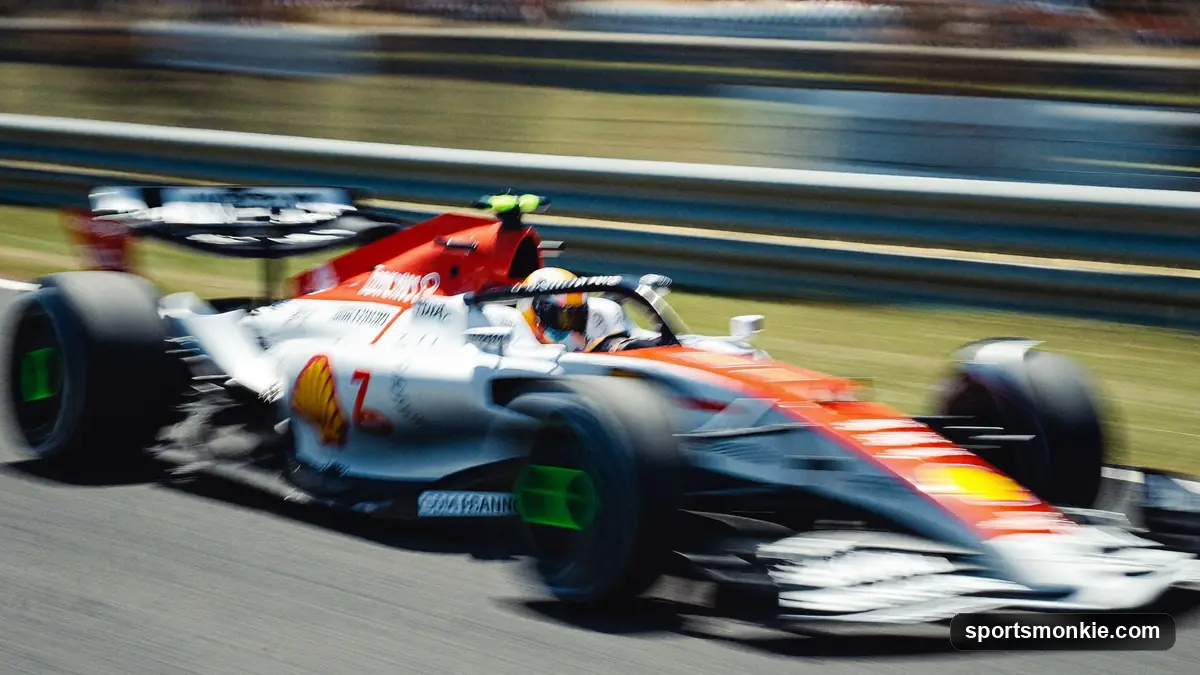
The fastest lap in Formula 1 history, judged by average speed over a complete lap, belongs to Max Verstappen: 1:18.792 around Monza in qualifying for the 2025 Italian Grand Prix, an average of 264.682 km/h. Lando Norris ran almost as fast in the very same session, and a day later set a second, separate record for the fastest lap ever completed inside an actual race. As of the 2026 season, both marks still stand.
Because every circuit is a different length, a raw lap time cannot be compared between tracks, which is why “fastest lap” in F1 is always measured by average speed rather than the clock. That single rule explains why every entry below, qualifying and race alike, was set at just two circuits: Monza and old Silverstone.
Leaderboard: F1’s fastest laps by average speed
| Rank | Driver | Type | Circuit | Year | Lap time | Avg. speed |
|---|---|---|---|---|---|---|
| 1 | Max Verstappen | Qualifying | Monza | 2025 | 1:18.792 | 264.682 km/h |
| 2 | Lando Norris | Qualifying | Monza | 2025 | 1:18.869 | 264.423 km/h |
| 3 | Lewis Hamilton | Qualifying | Monza | 2020 | 1:18.887 | 264.362 km/h |
| 4 | Kimi Raikkonen | Qualifying | Monza | 2018 | 1:19.119 | 263.587 km/h |
| 5 | Juan Pablo Montoya | Qualifying | Monza | 2004 | 1:19.525 | 262.242 km/h |
| 6 | Juan Pablo Montoya | Qualifying | Silverstone | 2002 | 1:18.998 | 259.827 km/h |
| 7 | Keke Rosberg | Qualifying | Silverstone | 1985 | 1:05.591 | 258.983 km/h |
| 8 | Lando Norris | Race | Monza | 2025 | 1:20.901 | 257.8 km/h |
| 9 | Rubens Barrichello | Race | Monza | 2004 | 1:21.046 | ~257.3 km/h |
Sources: Guinness World Records, Formula1.com, RaceFans, Motorsport.com. Qualifying laps run at minimum fuel and maximum downforce trim; race laps carry fuel and tire wear, which is why the fastest race lap ever is still slower than the seventh-fastest qualifying lap in history.
The record holder: Verstappen’s 2025 Monza pole
Verstappen’s lap came in Q3, where he grabbed pole and set the highest average speed ever recorded over a full F1 lap, edging Hamilton’s five-year-old record by just 0.095 seconds. He converted the pole into a race win the following day. The margin was tiny, underlining how close the very fastest laps are once the circuit is held constant — and confirming that even as F1 cars have grown heavier since the 2022 rules change, aero and power-unit gains have kept outright single-lap pace climbing.
The chasers: Norris, Hamilton, Raikkonen, and Montoya
Norris ran the second-fastest qualifying lap in F1 history in that same session, just 0.259 km/h behind Verstappen — the tightest gap ever recorded between the two fastest laps in the sport’s history. Hamilton’s 2020 pole had itself been a landmark, the first F1 lap above 264 km/h, and stood as the outright record for five seasons. Raikkonen’s 2018 pole, at age 38, made him the oldest Monza pole-sitter since Nigel Mansell in 1994. Montoya’s 2004 Monza lap, in a BMW-powered Williams FW26, held the record for 14 years, the longest reign on this list.
The old guard: Montoya at Silverstone and Rosberg’s 160 mph lap
Before Monza became the benchmark, Silverstone’s old high-speed layout held the record. Montoya’s 2002 pole there, 259.827 km/h, briefly stood as the fastest lap ever run in F1. It broke a mark that had lasted 17 years: Keke Rosberg’s 1985 British Grand Prix pole, a 1:05.591 averaging 258.983 km/h. Rosberg remains the only driver to set an F1 pole above 160 mph on that old, unchicaned Silverstone — the benchmark of pure speed for a generation before Monza’s records overtook it.
Qualifying pace vs. race pace, and top speed too
The leaderboard splits into two measurements. Qualifying laps run on near-empty fuel and maximum-attack tires, the outer limit of what car and driver can do for one lap. Race laps carry fuel and tires that must survive dozens more laps, so even F1’s fastest-ever race lap, Norris’s 257.8 km/h in 2025, trails the seventh-fastest qualifying lap in history. That race-lap record broke Barrichello’s 2004 mark, unbroken for 21 years, the longest-standing race lap record in modern F1.
Top speed is a third, separate measurement again: the peak reading at one point on track, not sustained pace through every corner. The official Guinness World Record for outright top speed in a Grand Prix is 372.6 km/h, set by Montoya’s McLaren at Monza in 2005. Bottas went faster still outside race conditions, clocked around 378 km/h during 2016 qualifying practice in Azerbaijan, and Honda’s specially prepared RA106 hit 397.36 km/h in a straight-line test at Bonneville in 2006. For the cars behind these figures, see our guide to the fastest F1 cars.
Could either record fall again? As of 2026
Both records have a history of falling in bursts and then holding for years. The qualifying mark has been broken six times since 1985, but the gap between each new record and the last has shrunk from multiple seconds in the 1980s to fractions of a second today. As of the 2026 season, no lap has come within that margin of Verstappen’s Monza pole, and Barrichello’s 21-year reign on the race-lap record shows these marks can stand for a long time once set. The drivers chasing them tend to be the same names topping the most F1 poles and the most F1 world championships, because the single-lap pace that sets speed records is exactly what wins titles.
Frequently asked questions
What is the fastest lap in F1 history?+
The fastest lap in Formula 1 history, by average speed, is Max Verstappen's pole lap at the 2025 Italian Grand Prix at Monza: 1:18.792, averaging 264.682 km/h. It beat Lewis Hamilton's 2020 record at the same circuit by less than a tenth of a second per lap. Lando Norris ran even closer in the same session, at 264.423 km/h.
What is the fastest lap ever completed during an actual F1 race?+
That is a different record from the fastest qualifying lap, since race cars carry fuel and manage tires. Lando Norris set it at the 2025 Italian Grand Prix with a 1:20.901 at Monza, breaking Rubens Barrichello's 1:21.046 from 2004, which had stood for 21 years. Both are slower than any of the top qualifying laps.
Why is there no single fastest lap time in F1?+
Because circuits vary in length, a raw lap time cannot be compared between tracks. A lap of short Monaco takes about 70 seconds but at a low average speed, while a lap of long, fast Monza takes longer yet is much quicker overall. That is why the fastest-lap record is judged by average speed rather than the lowest clock time.
What is the highest top speed ever recorded in F1?+
The official Guinness World Record for outright top speed in a Grand Prix is 372.6 km/h, set by Juan Pablo Montoya at Monza in 2005. Valtteri Bottas was clocked faster still, around 378 km/h, during a 2016 qualifying session in Azerbaijan, though that came outside race conditions. Top speed measures one point on track, not a full lap.
Did Lewis Hamilton hold the fastest lap record before Verstappen?+
Yes. Hamilton set the fastest lap in F1 history during qualifying for the 2020 Italian Grand Prix at Monza, 1:18.887 at 264.362 km/h. That mark stood for five years until Verstappen beat it at the same circuit in 2025. Hamilton's lap had itself broken Kimi Raikkonen's 2018 Monza record.
Why are almost all of F1's fastest laps set at Monza?+
Monza is F1's lowest-downforce circuit, built around three long straights connected by a handful of chicanes, so cars spend more of the lap at or near top speed than anywhere else on the calendar. That combination of minimal drag and maximum straight-line running is why every qualifying record since 2004, and the two fastest race laps, were all set there.
Could Verstappen's fastest-lap record be broken again?+
Yes, and it likely will be. The record has fallen six times since 1985 as engines, aerodynamics, and tires have improved, with the gap between each new mark and the last shrinking to fractions of a second. As of the 2026 season it still stands, but any future low-downforce Monza package with more power is a realistic threat to it.
Sources
Play & tools
Free browser games and tools — no account, no download.
- Play 24-0 — Draft an F1 chassis and two drivers, then chase a perfect 24-0 — win every race on the 24-round calendar.
- Explore all our games →
Related motorsport guides
View all →
Youngest World Champion in F1 History
Sebastian Vettel is the youngest F1 World Champion, winning the 2010 title at 23 years and 134 days. Full leaderboard of the youngest champions, explained.

The Fastest Goal in Premier League History
Shane Long scored after just 7.69 seconds in 2019, the fastest goal in Premier League history. The full leaderboard of the quickest strikes.
The Fastest Goal in Soccer History (Ranked, With Every Level Verified)
Gavin Stokes' 2.1-second strike for Maryhill in 2017 is the fastest goal ever recorded, but Damian Mori's 3.69 seconds is the official top-flight record. The full ranked leaderboard, verified.

The Fastest Goal in World Cup History
Hakan Sukur scored after just 10.8 seconds for Turkey in 2002, the fastest goal in World Cup history. The full leaderboard of the quickest goals ever.

Fastest Hat-Trick in Premier League History
Sadio Mane scored the fastest Premier League hat-trick in just 2 minutes 56 seconds in 2015. The full leaderboard, explained.
The Fastest Hat-Trick in Soccer History
Tommy Ross scored the fastest recognized hat-trick in soccer in just 90 seconds in 1964. The full leaderboard of the quickest hat-tricks.