
Futsal Rules Explained: Court Size, Fouls, Goalkeeper and Restarts
On this page9
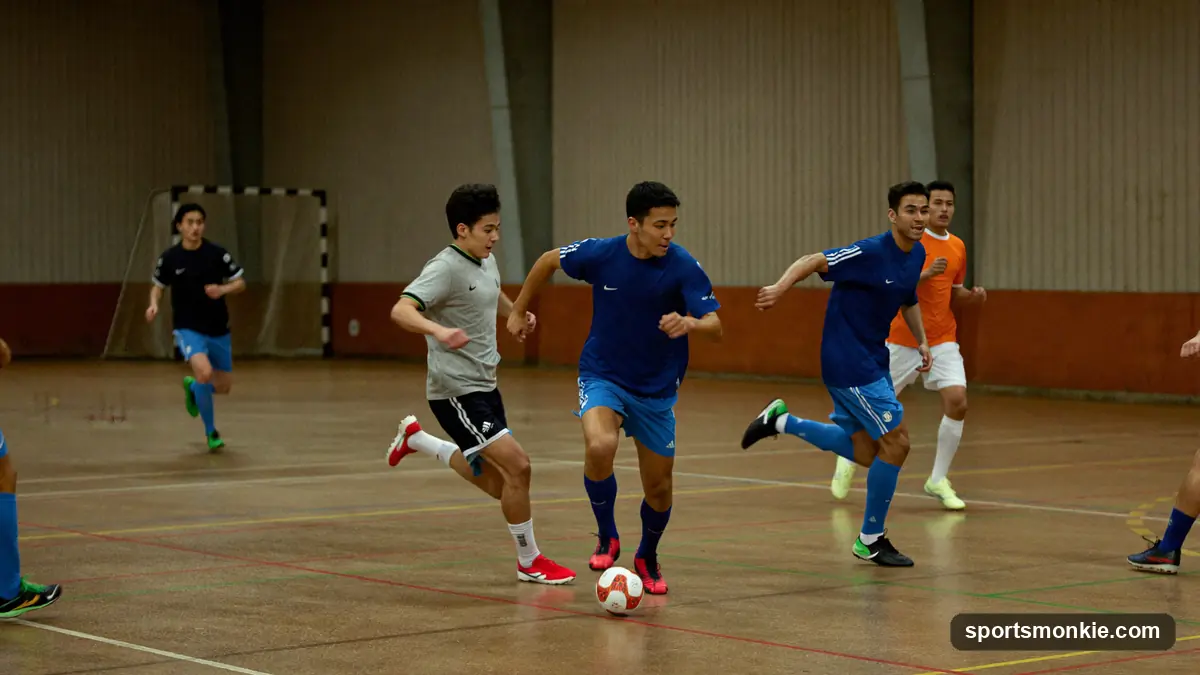
Futsal is five-a-side football played on a hard court, usually indoors, with a smaller low-bounce ball. A standard team has four outfield players and a goalkeeper. Matches are normally two 20-minute halves with a stopped clock, so the game is short on paper but frantic in practice.
The rules make it different from outdoor soccer in useful ways: there is no offside, touchline restarts are kick-ins, substitutions roll on and off, many restarts have a four-second clock, and team fouls are counted. After the sixth accumulated foul in a half, the next direct-free-kick foul becomes a dangerous no-wall free kick.
Futsal rules at a glance
| Rule area | Standard futsal answer |
|---|---|
| Players | 5 per team: 4 outfield players plus 1 goalkeeper |
| Court | Hard surface with boundary lines, not walls |
| International court size | 38 to 42 m long, 20 to 25 m wide |
| Broader adult court range | 25 to 42 m long, 16 to 25 m wide |
| Ball | Size 4, low-bounce futsal ball |
| Goals | 3 m wide by 2 m high |
| Match length | Two 20-minute halves, stopped clock |
| Substitutions | Unlimited rolling substitutions through the substitution zone |
| Offside | None |
| Touchline restart | Kick-in, not throw-in |
| Goalkeeper restart | Goal clearance by hand, not a soccer-style goal kick |
| Restart clock | Four seconds for many restarts and goalkeeper possession in own half |
| Accumulated fouls | No-wall direct free kick from the sixth team foul in a half |
If you only remember three things, remember these: no offside, four-second restarts and accumulated fouls. Those three rules explain most of the game’s speed.
Futsal court size calculator
Use this to check whether a court fits a standard adult range. It checks the playing rectangle only. Real venues also need run-off, benches, substitution zones, scorers’ table, spectator safety and local facility rules.
The youth option is only a planning check. FIFA allows competition organizers to modify some details for youth, disability, veteran and grassroots formats, but your local league’s document should state those changes.
Court dimensions and markings
Futsal is a line game, not a wall game. If the ball crosses the touchline or goal line, play restarts. There is no rebound wall like some indoor soccer leagues use.
| Court element | Measurement or rule | Why it matters |
|---|---|---|
| International court length | 38 to 42 m | Used for top-level international play |
| International court width | 20 to 25 m | Keeps the 5-a-side game compact but not cramped |
| Broader adult length range | 25 to 42 m | Used outside international matches |
| Broader adult width range | 16 to 25 m | Gives local venues more flexibility |
| Goal size | 3 x 2 m | Smaller than outdoor football |
| Penalty mark | 6 m from goal | Used for penalty kicks |
| Second penalty mark | 10 m from goal | Used for no-wall free kicks after accumulated fouls |
| Substitution zone | In front of team benches | Controls rolling substitutions |
Court size affects everything. A full 42 x 25 m court gives wingers more room to isolate defenders. A smaller recreational court turns every touch into pressure, which can be excellent for training but harsh on beginners.
How futsal differs from soccer
Futsal looks familiar until the ball goes out or the goalkeeper receives it. Then the differences show up fast.
| Rule | Futsal | Outdoor soccer |
|---|---|---|
| Team size | 5 players | 11 players |
| Surface | Hard court | Grass or artificial turf |
| Ball | Size 4, lower bounce | Size 5, normal bounce |
| Touchline restart | Kick-in | Throw-in |
| Offside | No offside | Offside applies |
| Match clock | Stopped clock in standard adult futsal | Running clock with added time |
| Substitutions | Unlimited rolling changes | Limited by competition rules |
| Team-foul count | Direct-free-kick fouls accumulate | No futsal-style accumulated-foul limit |
This is why futsal develops quick feet. The court gives less time, the ball stays lower, and the lack of offside rewards clever movement. Outdoor football asks for more running range; futsal compresses the problem into one busy rectangle.
For the outdoor comparison, use how big a soccer field is and offside in soccer. If you are comparing indoor formats, our futsal vs indoor soccer guide explains the wall, surface and restart differences, while soccer ball weight and pressure helps show why the lower-bounce futsal ball changes the touch. Futsal borrows football’s roots but makes very different design choices.
Kick-ins, corners and the four-second rule
There are no throw-ins in futsal. When the ball crosses the touchline, the restart is a kick-in from the line. The ball must be stationary, and the restart has to happen quickly once the player is ready and the ball is positioned.
The four-second count applies to many restarts, including kick-ins, corner kicks, free kicks and goal clearances. It also applies when the goalkeeper controls the ball in their own half. Referees visibly count, and a delay can hand possession to the opponent.
That one clock changes the whole mood of the sport. You cannot stroll to the ball, scan for ten seconds and restart when everyone is comfortable. The game keeps nudging you to make the next decision.
Accumulated fouls and the 10-metre free kick
Futsal does not only punish a single foul. It tracks repeated direct-free-kick fouls by team.
| Foul count in a half | Usual result |
|---|---|
| First to fifth accumulated foul | Direct free kick or penalty, depending on the foul and location |
| Sixth accumulated foul and later | Direct free kick without a defensive wall |
| Foul farther from goal than the second penalty mark | Free kick usually taken from the 10-metre mark |
| Foul closer to goal than the second penalty mark | Attacking team may be allowed to use the foul spot instead |
| Half-time | Accumulated-foul count resets for the second half |
This rule keeps defending honest. Tactical fouls become expensive, because the sixth one gives the other team a clear shot with no wall.
Goalkeeper rules
The futsal goalkeeper is not just a smaller-court version of a soccer keeper. The role has extra possession restrictions.
The keeper cannot handle a ball deliberately kicked by a teammate. After releasing the ball, the keeper also cannot receive it again in their own half until an opponent touches it or the ball has gone out of play. The keeper must also deal with the four-second count when controlling the ball in their own half.
In attack, many teams use a flying goalkeeper or rush keeper late in a match. That means the goalkeeper or an extra outfield player joins the attack to create a 5-on-4 possession shape. It can work, but the empty goal is sitting there waiting for a loose pass. Very futsal. Tiny court, huge consequences.
Timeouts and substitutions
Standard futsal gives each team one one-minute timeout per half. A team can normally request it when it has possession and the ball is out of play. There is no saved timeout if you skip the first half.
Substitutions are rolling and unlimited, but they are not random. Players use the substitution zone near the benches, and the player leaving must come off before the replacement enters. Bad substitutions can be punished because they create an unfair extra-player moment.
This is where futsal feels more like basketball or hockey than outdoor football. Coaches can rotate tired players, press in bursts and use timeouts to repair a game that is slipping away.
Common beginner mistakes
| Mistake | Correct futsal habit |
|---|---|
| Looking for a throw-in | Restart with a kick-in from the touchline |
| Waiting too long on restarts | Expect the four-second count |
| Treating the goalkeeper as a safe reset every time | Remember the return-pass restriction in the keeper’s own half |
| Assuming offside exists | Use rotations and recovery runs instead |
| Forgetting team fouls | Track the count because the sixth foul changes the risk |
| Using a bouncy outdoor ball | Use a proper size 4 futsal ball |
One more: do not assume “2-touch rule” is a FIFA law. Some youth coaches or local leagues use touch limits as a development rule, but standard futsal does not require every player to take exactly two touches.
Sources
Frequently asked questions
What are the basic rules of futsal?+
Futsal is played 5-a-side, with four outfield players and one goalkeeper. Matches are usually two 20-minute halves with a stopped clock. There is no offside, throw-ins become kick-ins, substitutions are unlimited and rolling, many restarts must be taken within four seconds, and direct-free-kick fouls count toward accumulated fouls.
What is the official futsal court size?+
FIFA's international futsal court range is 38 to 42 metres long and 20 to 25 metres wide. The broader non-international range is 25 to 42 metres long and 16 to 25 metres wide. Local youth and recreational leagues may use smaller courts if their competition rules allow it.
What is the four-second rule in futsal?+
Players usually have four seconds to restart play from kick-ins, corner kicks, free kicks and goal clearances once they are ready and the ball is in position. Goalkeepers also have a four-second limit when they control the ball in their own half.
Is there offside in futsal?+
No. Futsal has no offside rule. Attackers can stand anywhere on the court, which is one reason the game uses tight marking, quick rotations and fast recovery runs.
What happens after six fouls in futsal?+
Direct-free-kick fouls are counted as accumulated fouls in each half. From the sixth accumulated foul onward, the opponent gets a direct free kick without a wall, usually from the 10-metre mark or from the foul spot if that is closer and the rules allow that choice.
Can you pass back to the goalkeeper in futsal?+
The goalkeeper cannot handle a ball deliberately kicked by a teammate. After the goalkeeper has released the ball, they also cannot receive it again in their own half until an opponent touches it or the ball has gone out of play, unless the competition applies a local modification.
Sources
Play & tools
Free browser games and tools — no account, no download.
- Play 38-0 — Sign a 4-4-2 of all-time football legends and chase a perfect 38-0 league season — perfect, not just unbeaten.
- Explore all our games →
Related football guides
View all →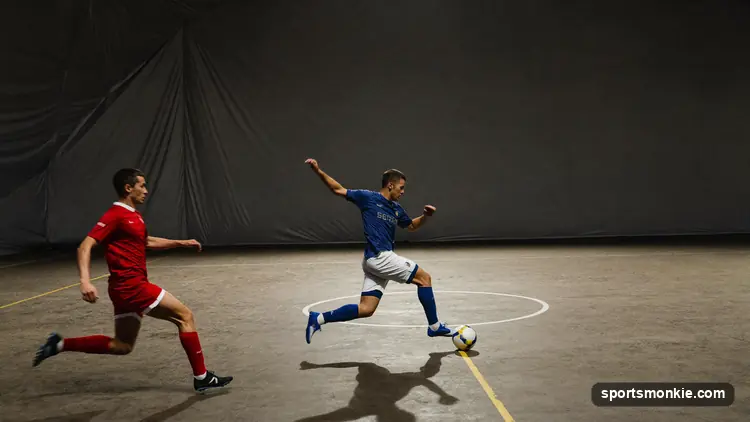
Futsal vs Indoor Soccer: Differences
Futsal is FIFA's 5-a-side game on a hard court with a low-bounce ball; indoor (arena) soccer is played with walls. The key differences, side by side.
Ultimate Frisbee Rules Explained: Field Size, Stall Count and Fouls
Ultimate frisbee rules explained for beginners: players, field size, scoring, turnovers, stall count, pulls, fouls, picks, travels and Spirit of the Game.
Padel Court Dimensions and Space Needed
Official padel court dimensions from the 2026 FIP rules: 20m x 10m court size, net height, service lines, walls, ceiling height and build footprint.
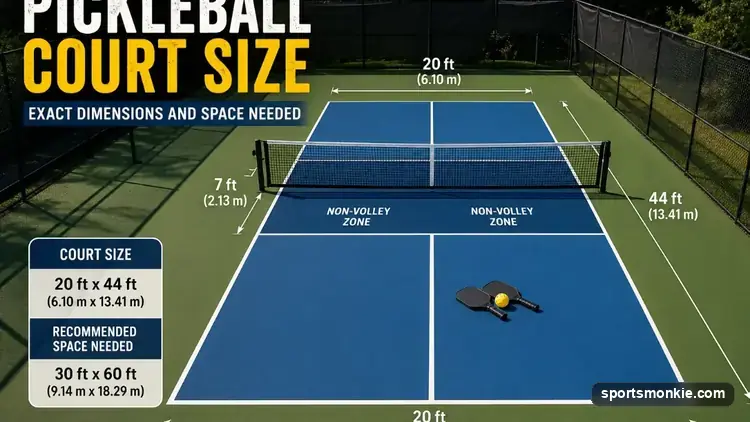
Pickleball Court Dimensions and Space Needed
Official pickleball court dimensions: 20 x 44 ft lines, 30 x 60 ft minimum playing surface, 34 x 64 ft preferred space, kitchen, net and layout.
Cosgrove Tells a Reporter to Bugger Off Over the Ban He Served in the Reserves
Sam Cosgrove served a two-game FIFA ban in Auckland's reserve side, then clashed with the reporter who questioned it at Thursday's press conference.
12 Hajduk Fans Arrested After Antisemitic Chants and Flares Halt the Ajax Match
Police in Split arrested 12 Hajduk fans on Friday after antisemitic chanting before the Ajax match and a 12-minute flare stoppage during it, AP reports.