
Futsal vs Indoor Soccer: Differences
On this page6
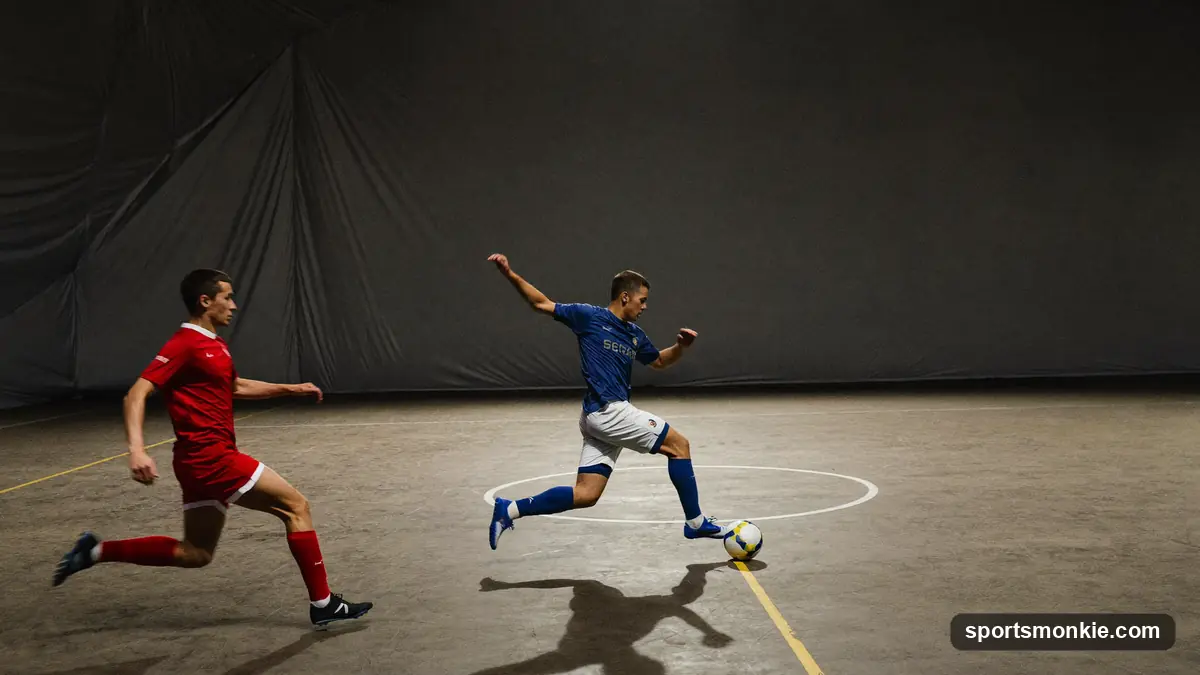
Futsal and indoor soccer are both small-sided indoor forms of football, but they are different sports. Futsal is FIFA’s official game — 5-a-side on a hard court with boundary lines and a low-bounce ball — while indoor (or arena) soccer is usually played inside a walled rink on turf, where the boards keep the ball in play and rebounds off the walls are part of the game.
If you have booked a session at a local facility and are unsure which one you are playing, the giveaway is simple: lines and a special ball mean futsal; walls and a normal ball mean indoor soccer. Here is how the two compare across the details that matter.
The core difference: lines vs walls
The single biggest distinction is what happens at the edge of the playing area. In futsal, the court is marked with boundary lines, exactly like outdoor football, so when the ball crosses a line it goes out of play and is restarted with a kick-in. In indoor soccer, the pitch is surrounded by walls or boards, so the ball ricochets and stays live, producing a faster, more continuous, more physical game.
That one difference cascades into everything else — the ball, the surface, the footwear and even the tactics. Futsal is a technical, on-the-floor passing game; walled indoor soccer is a rebound-heavy, high-tempo scramble.
The ball and the surface
Futsal uses a distinctive ball: a size 4 with reduced bounce, so it stays low and rewards close control and crisp passing rather than bouncing away. It is played on a flat, hard court. Indoor soccer typically uses a standard-bounce ball on artificial turf, closer to the outdoor game underfoot.
This is also why footwear differs. Futsal demands flat, non-marking court shoes for a smooth hard floor, whereas turf-based indoor soccer often allows flat turf trainers. Studded outdoor boots suit neither.
Side-by-side comparison
| Feature | Futsal | Indoor / arena soccer |
|---|---|---|
| Governing body | FIFA | Varies (regional / league-run) |
| Boundary | Lines — ball goes out of play | Walls / boards — ball stays live |
| Ball | Size 4, low-bounce | Standard-bounce |
| Surface | Hard court | Usually artificial turf |
| Typical team size | 5 (4 outfield + keeper) | 5 or 6, varies by league |
| Style | Technical, passing, close control | Fast, physical, rebound-driven |
| Footwear | Flat court shoes | Flat turf shoes often allowed |
Reading down the table, futsal is the standardised, globally governed sport, while “indoor soccer” is more of a family of walled small-sided games whose exact rules vary by facility and league.
How each game plays
Futsal’s lines, low-bounce ball and hard court combine to reward technique. Players must control the ball tightly and pass quickly because there are no walls to bail them out and the ball will not bounce over pressure. It is intense in short bursts and famous as a technical crucible — many top footballers grew up on it. For the full rulebook, our guide to futsal rules covers court size, fouls and the four-second restart in detail.
Indoor soccer plays very differently. Because the walls keep the ball live, there are fewer stoppages and the ball caroms unpredictably, so positioning, quick reactions and physicality matter more than in futsal. Using the boards to play a one-two off the wall is a legitimate tactic that has no equivalent in futsal.
What they share with the outdoor game
Both are recognisably football: you score in goals, you cannot use your hands (except the keeper), and the basic idea of moving the ball into space to create chances is the same. One notable shared trait is that futsal, like the walled game, drops the offside rule — a sharp departure from the outdoor pitch, which our offside in soccer explainer covers.
Where they diverge most from eleven-a-side is scale and pace. Both compress the sport into a small space, something you can appreciate against our guides to how big a soccer field is and how long a soccer game lasts — indoor formats are shorter, faster and far more confined than the outdoor game they descend from.
Which should you play?
If you want to sharpen technique, close control and passing under pressure, choose futsal. If you want a fast, physical, rebound-heavy game where the ball rarely stops, choose walled indoor soccer. Neither is strictly “better” — they train different skills and reward different styles.
The short version: futsal is FIFA’s 5-a-side game on a hard court with boundary lines and a low-bounce ball; indoor (arena) soccer is usually a walled, turf-based game where the boards keep the ball live. Lines and a special ball point to futsal; walls and a normal ball point to indoor soccer.
Frequently asked questions
Is futsal basically the same as indoor soccer?+
No. They are related but distinct sports. Futsal is FIFA's official small-sided game, played on a hard court with boundary lines and a low-bounce ball, so the ball goes out of play like in outdoor football. Indoor (arena) soccer is typically played inside a walled rink on turf, where the boards keep the ball in play and allow rebounds off the walls. The playing surface, the ball and the way the ball behaves at the edges are all different.
Why is futsal harder than regular soccer?+
Futsal is not necessarily harder, but it is more demanding technically. The smaller court, low-bounce ball and constant close pressure force players to control the ball tightly, pass quickly and make faster decisions than they would on a full outdoor pitch. That is why many elite footballers credit futsal for sharpening their technique. Outdoor soccer, by contrast, demands more endurance and covers far more ground.
Can you wear normal shoes for futsal?+
You should wear flat-soled indoor court shoes, not studded boots or running shoes. Futsal is played on a hard, smooth surface, so boots with cleats are not allowed and offer no grip, while cushioned running shoes lack the low-profile sole futsal's quick pivots need. Purpose-made futsal shoes have a flat, non-marking gum rubber sole designed for indoor courts. Indoor soccer on turf, by contrast, often allows flat turf shoes.
Where is futsal most popular?+
Futsal is most popular in South America and parts of Europe, with Brazil, Spain, Portugal and Argentina among its strongest nations. Brazil in particular treats futsal as a national development tool, and many of its greatest footballers grew up playing it before moving to the outdoor game. Indoor (arena) soccer, meanwhile, has a strong recreational following in North America, where walled indoor facilities are common.
Sources
Play & tools
Free browser games and tools — no account, no download.
- Play 38-0 — Sign a 4-4-2 of all-time football legends and chase a perfect 38-0 league season — perfect, not just unbeaten.
- Explore all our games →
Related football guides
View all →
How Do Soccer Transfers Work?
A soccer transfer moves a player between clubs during a transfer window, usually for a fee paid to the selling club, plus wages agreed with the player.
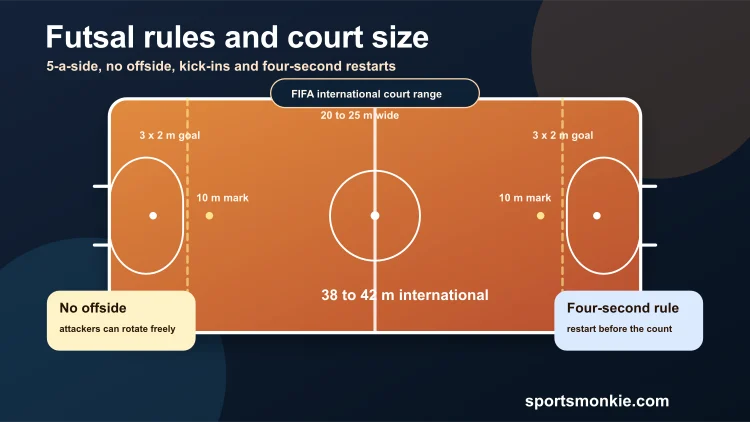
Futsal Rules Explained: Court Size, Fouls, Goalkeeper and Restarts
Futsal rules explained for beginners: 5-a-side teams, court size, two 20-minute halves, kick-ins, four-second rule, fouls, goalkeeper rules and soccer differences.
Infantino Apologises to His Council and Is Told He Is Not Fit to Lead Without Answers
Gianni Infantino apologised to the FIFA Council over the World Cup sell-off plan, gave no documents, and was told by Debbie Hewitt he is not fit to lead without answers.

Balogun Rule Change Is Put Off to December 16 After the Council Meets Without a Vote
The FIFA Council met in Zurich without voting on the Article 27 amendment. The Balogun case specifics and the rule change are now due on December 16.
FIFA Knew Congo Goalkeeper Mpasi Was Ineligible, Reports Say, and Let Him Play On
Internal FIFA documents reported by the New York Times and Le Monde say Lionel Mpasi never completed his switch from France, yet Congo kept him for the World Cup.
Suriname Call on FIFA and Concacaf to Act After Racist Abuse Allegation in Guatemala
Suriname have called on FIFA and Concacaf to investigate alleged racist abuse in Guatemala, after Richonell Margaret was sent off for reacting to the crowd.