
Worst Players in NBA History: The Busts Most Often Named
On this page12
We rank by the gap between draft slot and NBA production: the higher a player was picked and the less he delivered, the higher he lands here. We also weigh how long the league kept investing minutes and the star talent passed over to take him. Absolute skill isn't the measure — expectation is.
- Worst No. 1 ever
Anthony Bennett
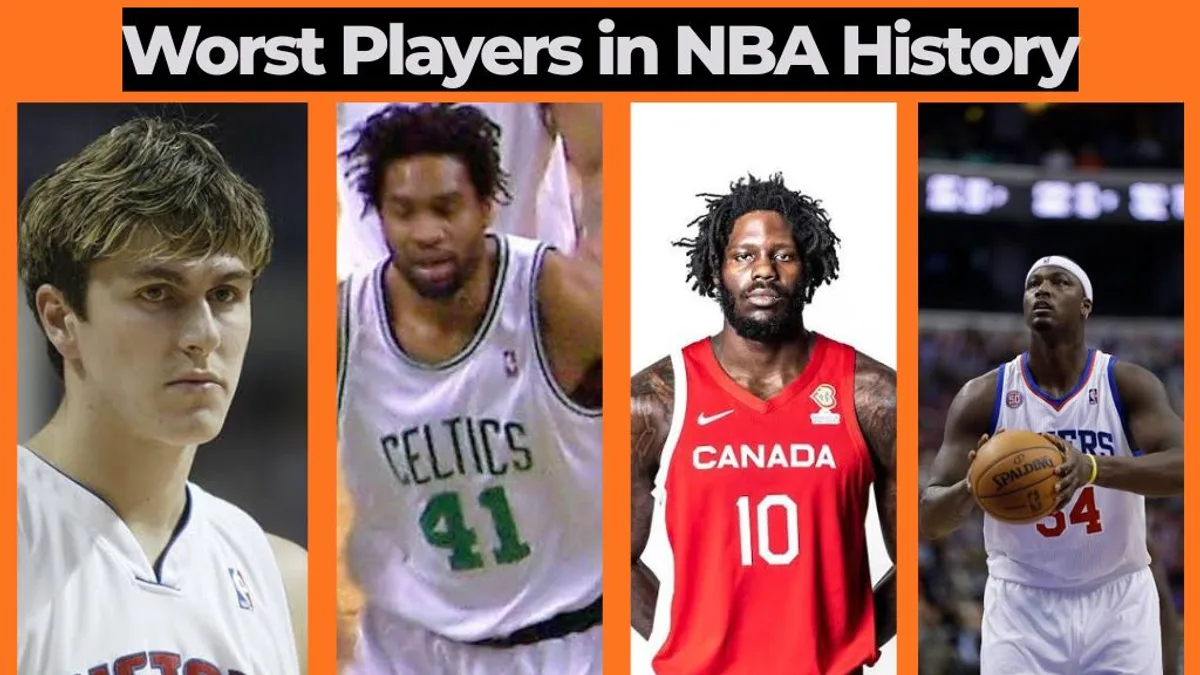
Cleveland took Bennett first overall in 2013, and he averaged 4.4 points and 3.1 rebounds across 151 career games before leaving the NBA by 2017. That scoring average is the lowest of any modern No. 1 pick, which is why he outranks every other name here: no top selection combined this high a draft slot with this little on-court output.
His rookie year set the tone — he missed his opening run of NBA field-goal attempts and went weeks before a double-figure scoring game. Four teams cycled him through in four seasons, none finding a role that stuck. He remains the reference point whenever a lottery pick starts slowly, and he anchors most biggest NBA draft busts lists.
Draft: 1st overall, 2013 · Career: 4.4 PPG / 3.1 RPG · Games: 151 · Out of NBA by: 2017
- Costliest miss
Darko Milicic
Detroit picked Milicic second in 2003, one slot after LeBron James and ahead of Carmelo Anthony, Dwyane Wade, and Chris Bosh — three more players who reached the greatest NBA players conversation. He finished with roughly 6.0 points and 4.2 rebounds per game. He ranks below Bennett only because he scored more; the talent passed over to take him is the worst of any pick on this list.
There's a strange footnote: Milicic owns an NBA championship ring from Detroit's 2004 title, earned almost entirely from the bench as a teenager who barely played. He later walked away from basketball for a kickboxing dabble and then an apple farm, one of the sport's odder post-NBA exits.
Draft: 2nd overall, 2003 · Career: ~6.0 PPG / 4.2 RPG · Passed over: Anthony, Wade, Bosh · Note: 2004 champion (bench)
- Prep-to-pro cautionary tale
Kwame Brown
Brown was the first high schooler ever taken first overall, picked by Washington in 2001 under Michael Jordan's front office. Unlike most names here he actually stuck around — 607 games across 12 seasons — but produced just 6.6 points and 5.5 rebounds a night the whole way. He lands above Olowokandi because his ceiling never rose despite more than a decade of chances.
His longevity is the quiet twist: coaches kept valuing his defense and frame enough to keep him employed long after the "bust" label hardened. That gap — a franchise-cornerstone slot, a solid-backup career — is exactly what "draft bust" describes.
Draft: 1st overall, 2001 · Career: 6.6 PPG / 5.5 RPG · Games: 607 · Seasons: 12
- Overshadowed No. 1
Michael Olowokandi
The Clippers took "The Kandi Man" first overall in 1998, ahead of future Hall of Famers Dirk Nowitzki, Paul Pierce, and Vince Carter. He managed 8.3 points and 6.8 rebounds over 500 games — the healthiest raw numbers on this list, which is why he sits below Brown rather than above.
Context sinks him anyway: he'd played organized basketball for only a few years before the NBA, and his production never grew into the top slot the way a No. 1 pick's is supposed to. Nine seasons in, he retired as a serviceable center picked one spot ahead of three all-time greats.
Draft: 1st overall, 1998 · Career: 8.3 PPG / 6.8 RPG · Games: 500 · Passed over: Nowitzki, Pierce, Carter
- NBA flop, EuroLeague great
Jan Vesely
Washington reached for Vesely sixth overall in 2011, and he managed just 3.6 points per game before leaving the NBA in 2014. His scoring is the lowest here, but he ranks fifth rather than first because his draft slot was lower than the No. 1 and No. 2 picks above him — the fall wasn't as far.
His case is the redemption arc none of the others got. Back in Europe he became a EuroLeague champion with Fenerbahce in 2017 and the league's MVP in 2019, retiring in 2026 as one of the competition's all-time leaders. NBA failure often means poor fit, not a lack of ability.
Draft: 6th overall, 2011 · NBA career: 3.6 PPG · Left NBA: 2014 · After: EuroLeague champ (2017), MVP (2019)
Reader interaction
Build your ranking
Drag the names into the order you think is right — or use the arrows — then submit to see how your list compares with everyone else's.
- Anthony Bennett
- Darko Milicic
- Kwame Brown
- Michael Olowokandi
- Jan Vesely
Audience ranking
How everyone ranked them
Built from reader rankings using position-based points.
There is no official “worst player in NBA history.” The label attaches almost entirely to high draft picks who never approached their expectations, because the criticism follows how much a player was supposed to give — not his rank against the millions who never reached the league at all.
How we ranked the worst
Draft slot versus production does most of the work. The higher a player was picked and the less he delivered, the higher he lands on this list. Two tiebreakers separate close cases: how long the league kept handing him minutes despite the results, and how much star talent was passed over to draft him. By that logic Anthony Bennett tops the list — lowest output of any modern No. 1 — while Darko Milicic sits just behind him because he scored slightly more but cost his team a shot at three future Hall of Famers.
What actually counts as “bad” here
A lottery pick who fizzles in three seasons draws far more heat than the 15th man who quietly plays his role. Every player ranked above beat out millions of hopefuls to reach the NBA, but draft slot, salary, and minutes all raise the bar for what counts as a disappointment. Three factors decide who ends up in the conversation:
- Draft slot versus what showed up. The higher the pick, the harder the fall when the production never arrives.
- The numbers. Shooting that never improved, plus-minus stuck underwater, scoring below rotation level.
- How long the league kept investing. Some players barely cleared a rookie deal; others got years of minutes and still stalled.
At a glance: high picks who disappointed
| Player | Draft position | Career PPG / RPG | Why he’s here |
|---|---|---|---|
| Anthony Bennett | 1st overall (2013) | 4.4 / 3.1 | Out of NBA by 2017; lowest output of any modern No. 1 |
| Darko Milicic | 2nd overall (2003) | ~6.0 / 4.2 | Picked over Anthony, Wade, and Bosh |
| Kwame Brown | 1st overall (2001) | 6.6 / 5.5 | 12-year career but never starter-caliber |
| Michael Olowokandi | 1st overall (1998) | 8.3 / 6.8 | Taken ahead of Nowitzki, Pierce, and Carter |
| Jan Vesely | 6th overall (2011) | 3.6 / 3.5 | Minimal NBA impact; later a EuroLeague MVP |
Why busts keep happening
Draft busts have existed as long as the draft, and it’s rarely one single cause.
- Injuries derail promising players before their game gets a chance to develop.
- Bad fit buries a player on a roster with no use for what he actually does well.
- Scouts misjudge translation. Production against college or international competition doesn’t always survive NBA speed and physicality.
- Some players simply stop improving once the free development years of college or a G League stint run out.
European prospects in particular used to draw harsher criticism when things didn’t work out, though front offices have gotten far better at scouting and developing international talent since then.
The modern conversation (2024-26)
The bust discussion has stayed current well into the 2020s. The 2020 draft is frequently called one of the weakest in recent memory, and James Wiseman — taken second overall by Golden State that year — became its symbol. He averaged around nine points but never stuck, bouncing from the Warriors to Detroit to Indiana. He tore his Achilles in the 2024-25 opener, and after a brief return the Pacers released him in December 2025, sometimes on the kind of 10-day contract that marks a career on the fringe.
Markelle Fultz, the No. 1 pick in 2017, is a different kind of cautionary tale. His shooting mechanics unraveled after an early shoulder injury, yet he still owns a respectable career average above 10 points and re-signed with Toronto on a short-term deal in early 2026 — a reminder that “bust” and “bad player” aren’t the same thing. As of 2026 the pattern holds: the harshest judgments land on high picks who never repaid the investment, not on the anonymous end of the bench.
The players nobody remembers
High picks get the headlines, but there’s a quieter group: end-of-bench players who logged a handful of minutes, shot poorly, and got cut before anyone learned their names. They are the actual bottom of the league’s talent pool in any given season, yet they stay obscure because no draft-night hype attached to them. Criticism follows expectation, and no one expected much of them — the same reason a struggling star draws more heat than a struggling roster on a worst NBA teams ever list.
Reputations shift
Players mocked during their careers sometimes get a second look years later, credited for hustle, locker-room value, or a bad situation nobody accounted for at the time. Others go the opposite way, as analytics reveal how little some once-respected role players contributed to winning. In a league this competitive, even the names ranked above cleared a bar most players never reach — the “worst in the NBA” is still, in absolute terms, among the best in the world.
Frequently asked questions
Who is considered the worst NBA player ever?+
There's no official pick, but Anthony Bennett is named most often. As the No. 1 overall selection in 2013 who averaged 4.4 points across 151 games before leaving the league by 2017, he's widely called the worst first-overall pick in history. Kwame Brown and Darko Milicic draw the same label mainly because of the distance between their high draft slots and modest output, not their absolute skill.
What makes an NBA player 'bad' if he still reached the league?+
The label is relative to expectation, not to the general public. A late second-round pick who plays spot minutes is rarely called bad; the criticism concentrates on players handed high draft slots, big minutes, or large contracts who never became even average contributors. Poor shooting efficiency, negative plus-minus, and an inability to hold a rotation spot all feed the reputation once expectations were high to begin with.
Why do so many No. 1 overall picks turn into busts?+
High picks carry the highest expectations, so any shortfall reads as failure. Injuries can derail a prospect before his game matures, a poor roster fit can bury useful skills, and scouts sometimes misjudge how college or international production translates to NBA speed. Teenagers picked on potential are especially risky. Even with modern analytics and better international scouting, projecting young prospects at the top of the draft remains an inexact science.
Have any 'worst' NBA players succeeded elsewhere?+
Yes, and Jan Vesely is the clearest example. The sixth pick in 2011 averaged just 3.6 points in the NBA, then returned to Europe and became a EuroLeague champion in 2017 and the league's MVP in 2019 before retiring in 2026. His career shows NBA failure often reflects a poor fit with league pace and role demands rather than a lack of overall basketball ability. Several other NBA benchwarmers later thrived abroad or in the G League.
Is James Wiseman a modern NBA draft bust?+
Wiseman, the second overall pick in 2020, is widely cited as one of the decade's most notable busts. Golden State waited years for him to develop before trading him, and he later bounced between Detroit and Indiana. He tore his Achilles in the 2024-25 opener, and after a brief return on a short-term deal the Pacers released him in December 2025, leaving his NBA future uncertain. He carries a career average near nine points per game.
Do bad reputations in the NBA ever change over time?+
They move both ways. Some players mocked during their careers are later credited for defense, hustle, or locker-room value that box scores missed, softening the verdict. Others fall further as modern analytics expose how little certain once-respected role players actually contributed to winning. Reputation in the NBA is rarely fixed — a name treated as a punchline in one era can be reassessed, for better or worse, a decade later.
Sources
Play & tools
Free browser games and tools — no account, no download.
- Play 82-0 — Draft five, one per position, and see if your lineup can go a flawless NBA season.
- Play Era Ball — Draft an all-time NBA roster from a single era, then simulate a season and chase a perfect run.
- Play 32-0 — Draft five college basketball legends, one per position, and chase a perfect 32-0 national title.
- Explore all our games →
- Get the printable bracket — Download and print a blank tournament bracket to fill out by hand.
- Open the TS% calculator — Calculate TS% from points, field goal attempts and free throw attempts — scoring efficiency in one number.
- Explore all our free sports tools →
Related basketball guides
View all →
NBA Players Fear Wearable Tech Data Could Be Used Against Them in Contract Talks
Adam Silver says the NBA and the Players Association have no agreement on wearable tech in games, because players fear their own data could be used in bargaining.

Biggest NBA Draft Busts of All Time
Anthony Bennett, Greg Oden and Sam Bowie top most lists of the biggest NBA draft busts. What defines a bust, and the players drafted after them.
Longest Winning Streak in NBA History
The longest winning streak in NBA history is the 1971-72 Lakers' 33 straight. The full list, plus how single-season streaks differ from cross-season runs.

The Worst NBA Teams Ever: 76ers vs Bobcats
The 1972-73 76ers lost a record 73 games; the 2011-12 Bobcats own the worst win rate (.106) in a shorter, lockout season. Both records, explained.
Oldest NBA Teams: A History of the League's Founding Franchises
Several NBA franchises date to the league's earliest days in the late 1940s. See the oldest teams, their origins, and what makes each historically vital.
NBA Bans Under Parlays, First-Basket Bets and Tip-Off Wagers in Integrity Clampdown
The NBA has told its sportsbook partners to remove under parlays on one player, unders on sub-12-minute players and first-of bets after the gambling scandals.