
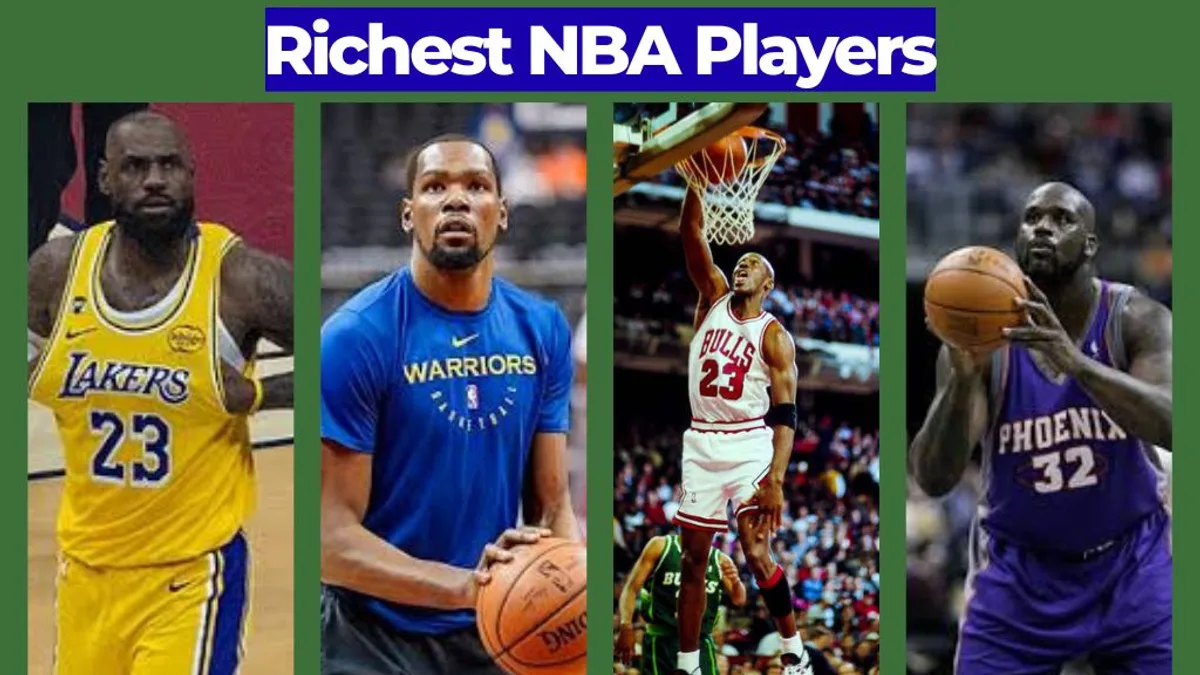
Richest NBA Players Ranked (2026): Net Worth of the Top 12
On this page16
- 01Michael Jordan
- 02Magic Johnson
- 03Junior Bridgeman
- 04LeBron James
- 05Shaquille O'Neal
- 06Vinnie Johnson
- 07Rick Fox
- 08Kevin Durant
- 09Hakeem Olajuwon
- 10David Robinson
- 11Russell Westbrook
- 12Stephen Curry
- 13How We Ranked the Richest NBA Players
- 14Salary Almost Never Builds These Fortunes
- 15Five Playbooks Behind These Fortunes
- 16Why Net Worth Estimates Vary So Much
We rank by total estimated 2026 net worth, not career earnings, and weight the ranking toward wealth that outlived the playing career — shoe royalties, operating businesses, and equity stakes rather than salary that was already spent or taxed.
- In a class of one
Michael Jordan
Jordan's fortune isn't just the biggest in the NBA — Forbes puts it above $4 billion in 2026, more than any other retired team-sport athlete. His playing checks totaled only about $90 million. The engine is the Jordan Brand, the Nike sub-label on which he earns a royalty; it paid him a reported $256 million in 2022 alone, decades after his final game.
That royalty stream is what separates him from everyone below. Where Magic Johnson and Junior Bridgeman built billion-dollar fortunes over 30-year business careers, Jordan's compounds automatically off retail sales he no longer works for. His 2023 sale of the Charlotte Hornets, in a deal valuing the team near $3 billion, added a second nine-figure windfall on top.
Era: 1984–2003 · Est. net worth: ~$4.3 billion · Primary source: Jordan Brand royalties, Hornets sale
- The insurance billionaire
Magic Johnson
Johnson ranks above every self-made-after-basketball name here because his anchor asset is unusually large: a majority stake in EquiTrust Life Insurance, a company managing tens of billions in assets. That single holding did more for his balance sheet than the movie theaters and Starbucks locations he's better known for. In 2026 he was widely reported as the fourth athlete to reach billionaire status, alongside Jordan, LeBron, and Tiger Woods.
His sports portfolio is now a collection of minority ownership stakes — the Los Angeles Dodgers, the Washington Commanders, LAFC, and the WNBA's Los Angeles Sparks — the kind of ownership access that a five-time champion's name and network unlock.
Era: 1979–1996 · Est. net worth: ~$1.6 billion · Primary source: EquiTrust stake, franchise ownership
- Never an All-Star
Junior Bridgeman
Bridgeman is the least famous name here and the most improbable. A sixth man who never made an All-Star team and earned only a few million as a player, he retired in 1987 and built a fast-food and bottling empire — hundreds of Wendy's and Chili's locations plus a Coca-Cola bottling business — that carried him past billionaire status by 2023.
He ranks just behind Magic because his fortune was still climbing when he died at 71 in March 2025, estimated around $1.5 billion — more than nearly every active NBA superstar. He had also become a minority owner of the Milwaukee Bucks, the team he starred for.
Era: 1975–1987 · Est. net worth: ~$1.5 billion (at death) · Primary source: Wendy's/Chili's franchising, Coca-Cola bottling
- First active billionaire
LeBron James
James is the richest player still associated with an active career, and the first widely reported to cross the billion mark while playing. Forbes estimated him near $1.4 billion in 2026 — built on roughly $581 million in career salary, a lifetime Nike deal reported above $1 billion, and equity in Fenway Sports Group (co-owner of Liverpool FC and the Boston Red Sox) and his SpringHill Company.
He ranks below Bridgeman because much of that valuation sits in illiquid equity rather than cash — a point James himself has publicly needled, joking that the headline number overstates what he could actually spend.
Era: 2003–present · Est. net worth: ~$1.2–1.4 billion · Primary source: Nike lifetime deal, SpringHill, Fenway Sports Group
- The media mogul
Shaquille O'Neal
O'Neal converted a Hall of Fame career into one of the most diversified post-basketball portfolios in sports: dozens of Auntie Anne's, Krispy Kreme, and Papa John's franchise locations, early stakes in Google and Ring, and a long-running seat on TNT's studio show. He reportedly earns more per year in retirement than he did at his playing peak.
His estimated ~$500 million ties him with Vinnie Johnson, but he edges ahead on the strength of an active media brand — a revenue source that keeps renewing rather than winding down. (O'Neal has floated a higher figure himself; peers including Charles Barkley have publicly disputed the billionaire framing.)
Era: 1992–2011 · Est. net worth: ~$500 million · Primary source: Endorsements, franchises, media
- The manufacturer
Vinnie Johnson
Johnson, a two-time champion off the "Bad Boy" Pistons bench, took a route almost no other player here did: heavy industry. He earned around $5–6 million as a player, then founded Piston Group, an auto-parts assembler supplying major automakers that now employs more than 11,000 people and generates close to $3 billion in annual revenue.
That revenue dwarfs his ~$500 million personal net worth, a reminder that operating-company owners hold value they can't simply cash out. It's the least glamorous fortune on this list and one of the most durable.
Era: 1979–1992 · Est. net worth: ~$500 million · Primary source: Piston Group auto-parts manufacturing
- The self-reported figure
Rick Fox
Fox, a three-time Lakers champion who earned about $34 million as a player, is the list's biggest question mark. His frequently cited ~$470 million traces to a financial disclosure he filed while pursuing Bahamian political office, tied largely to Partanna, a carbon-negative concrete startup he co-founded — not to Echo Fox, the pioneering esports team he launched and then exited after a 2019 internal dispute that unraveled it.
We place him here on that disclosed figure, but flag it plainly: it is self-reported and unaudited, and other outlets have estimated his wealth in the low tens of millions. Treat this rank as the widest error bar on the page.
Era: 1991–2004 · Est. net worth: ~$470 million (self-reported) · Primary source: Partanna equity, acting, investments
- The venture investor
Kevin Durant
Durant, now with the Houston Rockets, has treated equity as the point. Through Thirty Five Ventures, the firm he co-founded with business partner Rich Kleiman, he took early stakes in Postmates, Coinbase, and Acorns — bets that turned into real exits rather than paper gains.
Stacked on a 2023 Nike lifetime deal reported around $26 million a year and more than $53 million in 2025–26 salary, that portfolio puts his net worth near ~$400 million and makes him the wealthiest active player outside LeBron.
Era: 2007–present · Est. net worth: ~$400 million · Primary source: Thirty Five Ventures, Nike, salary
- The real-estate play
Hakeem Olajuwon
Olajuwon, a two-time champion and 1994 MVP, built his post-career fortune on Houston-area commercial real estate, buying and developing land across the city he played for. Structuring deals to align with his beliefs, he favored cash purchases over debt.
He edges the players below on the strength of that real-estate appreciation over three decades in a fast-growing market, landing him around ~$300 million — a quieter path than franchising or media, but a compounding one.
Era: 1984–2002 · Est. net worth: ~$300 million · Primary source: Houston commercial real estate
- The private-equity founder
David Robinson
"The Admiral" is the rare player who became an institutional investor. He co-founded Admiral Capital Group, a private-equity firm that has deployed capital across real estate and hospitality, and helped launch a San Antonio prep school — turning a Spurs championship pedigree into a second career in finance and education.
His ~$300 million puts him level with Olajuwon and Westbrook, but his wealth is arguably the most professionalized of the three, run through a firm rather than personal holdings.
Era: 1989–2003 · Est. net worth: ~$300 million · Primary source: Admiral Capital Group private equity
- Salary-built
Russell Westbrook
Westbrook is the clearest example of wealth built primarily from the game itself. Across an 18-season career he banked roughly $350 million in salary, layered with a Jordan Brand signature line — his "Why Not?" shoes came from what was described in 2017 as the richest total endorsement package Jordan Brand had ever handed an athlete.
He hasn't assembled the outside operating empire that Magic or Bridgeman did, which is why he sits in the ~$300 million tier rather than higher, but the sheer scale of max-contract earnings alone carried him here.
Era: 2008–present · Est. net worth: ~$300 million · Primary source: Career salary, Jordan Brand endorsement
- Equity, then independence
Stephen Curry
Curry's fortune, estimated around ~$250–300 million, was shaped by an unusual endorsement structure: his long Under Armour partnership reportedly included company equity, not just cash. That relationship ended by mutual agreement in late 2025, and in June 2026 he signed a reported 10-year, $400 million deal with Li-Ning — a rare in-career shoe switch for a superstar.
His SC30 media-and-investment arm has backed gaming, tech, and film ventures. He lands at the bottom of this list only because his outside portfolio is younger than his peers' — a figure still early in its compounding, not a ceiling.
Era: 2009–present · Est. net worth: ~$250–300 million · Primary source: Shoe equity/endorsements, SC30 Inc.
Reader interaction
Build your ranking
Drag the names into the order you think is right — or use the arrows — then submit to see how your list compares with everyone else's.
- Michael Jordan
- Magic Johnson
- Junior Bridgeman
- LeBron James
- Shaquille O'Neal
- Vinnie Johnson
- Rick Fox
- Kevin Durant
- Hakeem Olajuwon
- David Robinson
- Russell Westbrook
- Stephen Curry
Audience ranking
How everyone ranked them
Built from reader rankings using position-based points.
The names above rank by total estimated net worth in 2026. The sections below explain how those estimates are built, why salary barely moves the needle, and the handful of playbooks that actually produce nine- and ten-figure fortunes.
How We Ranked the Richest NBA Players
We rank by total estimated net worth as of 2026, not career earnings. Each figure is cross-checked against the most consistent public reporting — Forbes, Celebrity Net Worth, and primary sources like company filings and franchise valuations — and we lean on the midpoint of the reported range rather than the most flattering number.
Two judgment calls shape the order. First, we weight durable, still-compounding wealth (royalties, operating businesses, equity) over salary that has already been earned and largely spent. Second, when a ranking is genuinely debatable, we say so in the entry — Rick Fox’s placement rests on a self-reported disclosure, and LeBron James sits behind Junior Bridgeman partly because so much of his valuation is illiquid.
Salary Almost Never Builds These Fortunes
The single most useful fact about this list: playing income is rarely the main event. Michael Jordan’s career salary of roughly $90 million is a rounding error against a fortune Forbes now estimates above $4 billion. Magic Johnson, Junior Bridgeman, and Vinnie Johnson each earned modest sums by modern standards and built their wealth almost entirely afterward.
The exceptions prove the rule. Russell Westbrook and, to a large degree, Kevin Durant reflect the era of $40–50 million annual salaries, so their paychecks alone push them into the $300–400 million tier. But even they added equity and endorsements on top. No one reaches the top of this list on salary — the ceiling for a purely salary-built fortune sits well below the leaders.
Five Playbooks Behind These Fortunes
Nearly every fortune on this list maps to one of a few repeatable strategies. Seeing them side by side explains why the order looks the way it does.
| Playbook | How it builds wealth | Players who used it |
|---|---|---|
| Shoe royalties | Ongoing cut of retail sales, paid for decades | Michael Jordan, LeBron James |
| Franchising / operating businesses | Owning restaurant chains, bottling, manufacturing | Junior Bridgeman, Vinnie Johnson, Shaquille O’Neal |
| Financial & insurance stakes | Majority or large stakes in finance companies | Magic Johnson, David Robinson |
| Venture / equity investing | Early stakes in startups that exit big | Kevin Durant, Stephen Curry |
| Real estate | Buying and developing property over decades | Hakeem Olajuwon |
The pattern is clear: the biggest fortunes (Jordan, Magic, Bridgeman) come from assets that keep producing income long after the player stops working. Salary and even endorsements paid in cash can’t match a royalty or an operating company that compounds on its own.
Why Net Worth Estimates Vary So Much
None of these figures should be read as precise. Net worth for private individuals is an estimate, and the assets that make these men wealthy are exactly the hardest to value: privately held companies, real-estate portfolios, franchise equity, and royalty streams that depend on future sales.
Two cautions carry the most weight. Illiquid valuations overstate spendable wealth — a stake in Fenway Sports Group or the Jordan Brand is worth a lot on paper but can’t be withdrawn like cash, which is why LeBron James himself has downplayed his own headline number. And self-reported figures deserve extra skepticism: Rick Fox’s ~$470 million comes from an unaudited personal disclosure, and other outlets have estimated his wealth far lower. Where a number rests on a single source, we’ve said so rather than presenting it as settled fact.
Frequently asked questions
Who is the richest active NBA player?+
LeBron James, with a 2026 net worth estimated near $1.4 billion, is the richest player still tied to an active career and the first widely reported to reach billionaire status while playing. His money comes far more from a lifetime Nike deal and equity in Fenway Sports Group and SpringHill than from his roughly $581 million in career salary. Kevin Durant is the next-wealthiest active player at around $400 million.
How are these net worth figures estimated?+
They aren't audited. Net worth for private individuals is pieced together from disclosed contracts, known business stakes, endorsement reporting, and public records, then estimated by outlets like Forbes and Celebrity Net Worth. Illiquid assets — real estate, franchise chains, private equity — are especially hard to value, so figures can swing by tens or hundreds of millions between sources. We use the most consistently reported ranges and flag any figure that rests on a single or self-reported claim.
Did any of these players get rich mainly from their NBA salary?+
Almost none. Michael Jordan earned about $90 million playing and is worth more than 40 times that. The clearest salary-built fortune belongs to Russell Westbrook, who banked roughly $350 million over 18 seasons. For everyone at the top of the list, the real wealth came from what they did with their money afterward — shoe royalties, insurance, franchising, manufacturing, and equity stakes — not the paychecks themselves.
Who is the richest NBA player who was never a star?+
Junior Bridgeman, a sixth man who never made an All-Star team, retired in 1987 and built a fast-food and Coca-Cola bottling empire worth an estimated $1.5 billion by the time he died in 2025. He ranks third all-time, ahead of nearly every superstar. His story is the strongest evidence that post-career business decisions, not on-court fame, determine who ends up wealthiest.
Is a player's net worth the same as cash in the bank?+
No, and this trips up the biggest names most. Much of LeBron James's and Michael Jordan's estimated wealth sits in illiquid holdings — private-company equity, royalty rights, and ownership stakes that can't be spent like cash. LeBron has publicly joked that his headline number overstates what he could actually access. A ten-figure valuation reflects the market value of assets, not a spendable balance.
Why did Stephen Curry's endorsement situation change?+
Curry spent more than a decade with Under Armour in a deal that reportedly included company equity, an unusually founder-like arrangement for an athlete. The two sides ended the partnership by mutual agreement in late 2025 amid Under Armour's restructuring. In June 2026 Curry signed a reported 10-year, $400 million contract with Chinese brand Li-Ning — a rare mid-career shoe switch for a player of his stature, and a reset of his largest endorsement income stream.
Sources
Play & tools
Free browser games and tools — no account, no download.
- Play 82-0 — Draft five, one per position, and see if your lineup can go a flawless NBA season.
- Play Era Ball — Draft an all-time NBA roster from a single era, then simulate a season and chase a perfect run.
- Play 32-0 — Draft five college basketball legends, one per position, and chase a perfect 32-0 national title.
- Explore all our games →
- Get the printable bracket — Download and print a blank tournament bracket to fill out by hand.
- Open the TS% calculator — Calculate TS% from points, field goal attempts and free throw attempts — scoring efficiency in one number.
- Explore all our free sports tools →
Related basketball guides
View all →
Richest Indian Cricket Players: The Top 13 Ranked by Net Worth
Ajay Jadeja tops the list on inherited royal wealth, but Sachin Tendulkar is the richest Indian cricketer through the game itself. Full ranked top 13 by net worth.

Richest PBA Players: Salaries and Net Worth Explained
PBA player net worth is private. See what salary rules and public career evidence reveal about June Mar Fajardo, Scottie Thompson, Asi Taulava and more.
Highest-Paid NBA Players by Salary
Stephen Curry leads the NBA at about $59.6M for 2025-26, the biggest single-season salary ever. See the full supermax top nine and why salary isn't net worth.

Richest Athletes of All Time by Net Worth
Michael Jordan leads the richest athletes of all time at nearly $4 billion, ahead of tennis tycoon Ion Tiriac, Magic Johnson, LeBron James and Tiger Woods.
Richest Soccer Players by Net Worth
Cristiano Ronaldo is the richest soccer player ever, worth a reported $1 billion. The full net-worth list, and why it differs from salary.
NBA Players Diagnosed With Life-Threatening Diseases
Several NBA players have faced life-threatening diseases during and after their careers. Their stories of diagnosis, treatment, and advocacy still inspire.