
10 Best Push-Up Exercises for Climbers, Ranked
On this page15
- 01At a Glance: The 10 Best Push-Up Exercises for Climbers
- 02Why Climbers Need Push-Up Training
- 031. Standard (Military) Push-Up
- 042. Wide-Hands Push-Up
- 053. Diamond (Triangle) Push-Up
- 064. Decline Push-Up
- 075. Pike Push-Up
- 086. Staggered-Hands Push-Up
- 097. Spiderman Push-Up
- 108. Ring Push-Up
- 119. Archer Push-Up
- 1210. Pseudo Planche Push-Up
- 13How to Program Push-Ups Into Climbing Training
- 14How We Ranked Them
- 15Key Takeaways
Most climbers can crank out a one-arm pull-up progression before they can hold a solid push-up position for thirty seconds. That gap isn’t a coincidence, and it isn’t harmless either. Climbing trains one direction almost exclusively, and the shoulder eventually sends the bill for the imbalance in the form of impingement, tendinopathy, or a nagging ache that shows up every time you reach for a high hold.
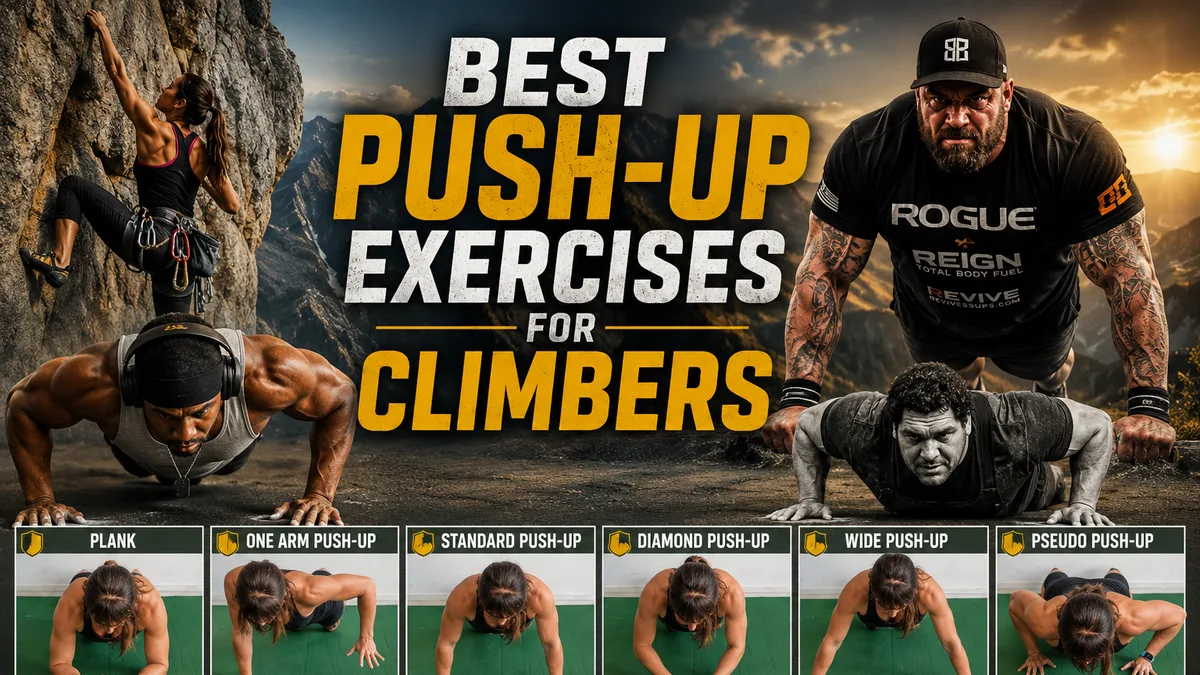
Push-up variations are one of the simplest, most equipment-free ways to correct that. Below are the 10 best push-up exercises for climbers, ranked from foundational to advanced, with the specific climbing movement each one supports.
At a Glance: The 10 Best Push-Up Exercises for Climbers
| # | Exercise | Primary Focus | Difficulty | Climbing Relevance |
|---|---|---|---|---|
| 1 | Standard (Military) Push-Up | Chest, triceps, core | Beginner | Foundation pressing strength for every other variation |
| 2 | Wide-Hands Push-Up | Chest (pecs) | Beginner | Broad pressing base for mantels and slopers |
| 3 | Diamond (Triangle) Push-Up | Triceps | Intermediate | Elbow lockout strength for topping out |
| 4 | Decline Push-Up | Anterior shoulder | Intermediate | Overhead-style pressing for reaching high holds |
| 5 | Pike Push-Up | Shoulders | Intermediate | Overhead pressing and mantel strength |
| 6 | Staggered-Hands Push-Up | Chest, core (asymmetrical) | Intermediate | Uneven-load control, mirrors off-balance holds |
| 7 | Spiderman Push-Up | Core, hip flexors | Intermediate | Rotational core strength for flagging and twisting |
| 8 | Ring Push-Up | Shoulder stabilizers | Intermediate–Advanced | Scapular control on shifting, unstable holds |
| 9 | Archer Push-Up | Unilateral chest/triceps | Advanced | Single-arm loading that mirrors reaching moves |
| 10 | Pseudo Planche Push-Up | Wrists, serratus, shoulders | Advanced | Compression strength and wrist conditioning |
Why Climbers Need Push-Up Training
Climbing is overwhelmingly pull-dominant. Every crimp, pull-through, and lock-off recruits the back, biceps, and forearms, leaving the muscles that press and stabilize the shoulder in the opposite direction comparatively weak — a common contributor to shoulder and elbow injuries in climbers, per coaching resources like the BMC’s injury prevention guidance. Still building a base of technique and wall time? Pair this with the fundamentals in our rock climbing for beginners guide before layering on antagonist work.
1. Standard (Military) Push-Up
The classic push-up is the entry point for every climber new to antagonist training. Keep a rigid plank, track the elbows at roughly 45 degrees from the torso, and use the full range of motion. It builds baseline pressing strength across the chest, triceps, and anterior shoulder while demanding the core and back tension that carries over directly to the tension climbers need on steep terrain. Nothing else on this list should be attempted until a climber can perform 15-20 clean reps, since every harder variation below is a subtraction of stability or leverage from this base position.
2. Wide-Hands Push-Up
Placing the hands two to three feet apart shifts more load onto the pectoral muscles and reduces the triceps contribution compared with a standard push-up. For climbers, this builds a broader pressing base that supports mantels, high steps, and slopey holds where the arms sit wide rather than tucked. Keep the elbows tracking back rather than flaring out to the sides, which protects the shoulder joint under the wider angle. It’s a low-skill, high-value addition to a beginner antagonist circuit and pairs naturally with the standard push-up in the same session.
3. Diamond (Triangle) Push-Up
Bring the hands together under the chest with the index fingers and thumbs touching to form a triangle, then lower the chest toward that point while keeping the elbows tight to the body. This isolates the triceps far more than a wide or standard push-up — exactly what climbers rely on for elbow lockout when pressing through the top of a mantel or extending fully to a high hold. It’s harder than it looks because the narrow hand position removes leverage, so most climbers should master 10-12 standard reps before adding diamond sets.
4. Decline Push-Up
Elevating the feet on a box, bench, or low wall shifts more bodyweight forward onto the hands and increases the demand on the anterior deltoid, similar to an overhead press. This directly supports the reaching and overhead-position strength climbers need for high steps and topping out on steep walls. Start with a modest elevation of 12-18 inches and increase height only once form stays solid through the full range, since a too-steep decline turns the movement into a shoulder-dominant grind rather than a controlled press.
5. Pike Push-Up
With the hips raised into an inverted V and the hands and feet close together, the pike push-up shifts emphasis almost entirely from the chest to the shoulders. Climbing.com’s roundup of push-up variations singles this one out as a direct match for the overhead pressing climbers need for mantel moves and high reaches, and it doubles as a natural progression toward a future handstand push-up for climbers chasing more advanced calisthenics. Climbers not yet ready for the full pike angle can start from a standard push-up and gradually walk the feet closer to the hands over several weeks.
6. Staggered-Hands Push-Up
Placing one hand slightly forward of the other, roughly a hand’s-length stagger, forces the body to manage an uneven load through each rep. That asymmetrical demand builds the same one-sided control climbers rely on when a route forces weight onto an off-balance hold or foot placement. It’s a useful bridge between symmetrical push-ups and the fully unilateral archer push-up later on this list, since the stabilizers work harder without yet bearing the full single-arm load.
7. Spiderman Push-Up
From a standard push-up position, draw one knee up toward the same-side elbow as you lower into the rep, alternating sides each repetition. Beyond the chest, triceps, and shoulders trained by any push-up, this variation heavily recruits the core and hip flexors through rotation, mirroring the twisting, flagging movements climbers use to keep their hips close to the wall on technical footwork. It’s a good addition for climbers whose weak point is core stability rather than raw pressing strength.
8. Ring Push-Up
Performing push-ups on gymnastics rings, or portable straps set to a low height, adds constant instability that forces the shoulder and scapular stabilizers to fire throughout the entire rep instead of just locking out at the top. That closely matches the demands of steep terrain and holds that shift or rotate under load. Ring push-ups are noticeably more demanding than their floor equivalent even at the same rep count, so climbers new to rings should drop to half the reps they’d normally do on a stable surface until control catches up.
9. Archer Push-Up
From a wide hand position, shift the bodyweight to one arm while the other extends straight out to the side, letting the working arm carry nearly the full load. This is widely considered one of the more climbing-specific push-up variations because it trains true unilateral pressing strength, mirroring the one-sided reaching and weight-shifting that happens constantly on the wall. Climbing.com’s own breakdown of push-up progressions flags it as a key stepping stone toward the one-arm push-up. Master 8-10 reps per side before adding load or chasing the full one-arm variation.
10. Pseudo Planche Push-Up
Hands sit at hip level with fingers pointing back toward the feet, and the shoulders lean forward past the wrists through the rep. This advanced variation builds scapular protraction strength and wrist conditioning that carries over well to compression climbing and technical slab, where the shoulders and wrists load at unusual angles. It’s the most demanding entry on this list and should be layered in only after a climber has a solid base in the diamond and decline push-up, since the forward lean places significant, unfamiliar stress on the wrists.
How to Program Push-Ups Into Climbing Training
Antagonist push-up work fits best on climbing days, either right after a session or on lighter days — doing it before climbing can pre-fatigue the shoulder stabilizers needed on the wall. A common structure is 3 sets of 10-12 reps across two or three variations, two to three times per week, progressing by adding reps, elevating the feet, or moving to a harder variation rather than piling on volume. Climbers assembling a home training setup should check our climbing and bouldering gear for beginners guide and make sure footwear fits properly per our climbing shoes for beginners breakdown, since sloppy footwork undoes a lot of upper-body strength gains.
How We Ranked Them
This list is ordered by progression difficulty and climbing specificity, not raw popularity. Foundational movements (standard, wide-hands) come first because every other variation is a harder subtraction of stability or leverage from that base. The middle entries (diamond, decline, pike, staggered-hands, Spiderman) each target a muscle group or stability pattern that maps to a named climbing movement — lockout, overhead reach, off-balance footwork. The final three (ring, archer, pseudo planche) close the list because they stack multiple demands at once — instability, unilateral load, or an unfamiliar wrist angle — and should only be attempted once the earlier entries are comfortable.
Key Takeaways
- Push-up training counters the pull-dominant nature of climbing and supports shoulder longevity.
- Archer, ring, and pseudo planche push-ups adapt most directly and most demandingly to climbing-specific movement patterns.
- Two to three sessions a week of moderate volume, done on or near climbing days, is a solid starting point.
- Progress step by step through the list rather than jumping to advanced variations before the foundation holds.
Frequently asked questions
Should climbers do push-ups?+
Yes. Climbers benefit from push-up training because it strengthens the pushing muscles — chest, triceps, and anterior deltoids — that counterbalance the heavy pulling demands of climbing. This balance helps protect the shoulder over time.
What is the single best push-up for climbers?+
The archer push-up is usually ranked highest because it trains one arm at a time under near-full bodyweight load, which mirrors the unilateral, one-sided reaching that climbing constantly demands.
How many push-ups should a climber do per week?+
Most climbing coaches recommend 2-3 antagonist sessions per week. Starting with 3-4 sets of 8-15 reps per session across two or three variations is a widely used baseline, adjusted for your current strength level.
Is the diamond push-up good for climbers?+
Yes. The diamond (triangle) push-up isolates the triceps more than a standard push-up, which supports the elbow lockout strength climbers use when pressing through a mantel or topping out a boulder problem.
Should push-ups be done before or after a climbing session?+
After, or on a separate lighter day. Doing heavy pushing work before climbing can pre-fatigue the shoulder stabilizers you need for pulling and holding positions on the wall.
Are ring push-ups better than push-ups on the floor?+
For climbers specifically, yes, in one respect: rings add instability that forces the scapular stabilizers to fire throughout the entire movement, which more closely matches the shifting demands of steep, technical terrain than a fixed floor surface does.
Sources
Play & tools
Free browser games and tools — no account, no download.
- Play today's Sports Connections — Today's Sports Connections — daily hints, answers, and play the grid.
- Play Guess the NFL Player — A new mystery NFL player every day. Eight guesses, with a clue on each — plus free unlimited mode.
- Explore all our games →
Related records & rankings guides
View all →
Olympic Heptathlon History, Records and Legends
A concise history of the Olympic heptathlon, from the pentathlon switch in 1984 to Joyner-Kersee, Thiam, Klüft, Ennis-Hill, Hall and records.
Best VNL Players: The Top Stars of the Nations League
The best VNL players, named and ranked: Wilfredo León, Yuji Nishida, Paola Egonu, Tijana Bošković, Gabi and more — with why each one made the list.

Most Marketable Athletes: Who Earns Most Off the Field
Shohei Ohtani earned $125m off the field in 2026, per Forbes. The most marketable athletes ranked by endorsement income, and why marketability differs from pay.

Highest-Paid WWE Women Wrestlers: What We Actually Know
The highest-paid WWE women wrestlers earn a reported $1m-$3m a year. Here are the figures that trace to real reporting, and how WWE contracts pay.

Richest WAGs in Sports: Partners With Their Own Fortunes
The richest WAGs in sports, ranked by the careers and businesses they built themselves: a $2bn music catalogue, NWSL ownership, an NFL apparel licence.

Sports Illustrated Swimsuit Cover History: 1964 to Now
Sports Illustrated launched its Swimsuit Issue in January 1964 to fill the winter sports gap. The full cover history, and every athlete milestone since.