
The Most Important Athletes of All Time: Who Changed Sport
On this page15
In 1936, Jesse Owens ran and jumped his way to four gold medals in Berlin, in a stadium built to showcase Nazi racial theory, with Hitler watching from the stands. No trophy case captures what that moment did. That’s the gap this list is trying to name: the difference between winning a lot and actually changing something.
Greatness and importance aren’t the same thing in sport. Plenty of athletes have swept every trophy on offer and left barely a mark outside their own discipline. The 12 names below did something different — they moved how people thought about race, gender, class, or what a human body could do, and several paid a real career cost for it.
At a Glance: The 12 Most Important Athletes
| Athlete | Sport | Era | Defining Legacy |
|---|---|---|---|
| Muhammad Ali | Boxing | 1960s–1970s | Draft refusal, Muslim conversion, global conscience |
| Jesse Owens | Track and field | 1930s | Four golds undercut Nazi racial propaganda at Berlin 1936 |
| Jackie Robinson | Baseball | 1940s–1950s | Broke MLB’s color line in 1947 |
| Billie Jean King | Tennis | 1960s–1970s | ”Battle of the Sexes,” equal prize money fight |
| Pelé | Soccer | 1950s–1970s | Three World Cups; globalized the sport |
| Michael Jordan | Basketball | 1980s–1990s | Made the individual athlete a global brand |
| Serena Williams | Tennis | 1990s–2020s | 23 Grand Slam singles titles; equal-pay advocacy |
| Sachin Tendulkar | Cricket | 1980s–2010s | Most international runs and centuries in history |
| Arthur Ashe | Tennis | 1960s–1970s | First Black man to win Wimbledon; HIV/AIDS advocacy |
| Nadia Comăneci | Gymnastics | 1970s | First perfect 10 in Olympic history |
| Colin Kaepernick | American football | 2010s | Anthem protests against police violence, career cost |
| Babe Didrikson Zaharias | Track and field, golf | 1930s–1950s | Multi-sport dominance; founding LPGA member |
The Criteria for Importance
A few things separate importance from a strong career record.
- Being first. The athlete who broke into a sport or league that had excluded people like them.
- Reach well past the fanbase, into people who never watched the sport.
- Using a platform to push for change, sometimes at real personal cost.
- Staying relevant decades after the last game or match.
- Recognition that crosses borders, not just national fame.
Muhammad Ali
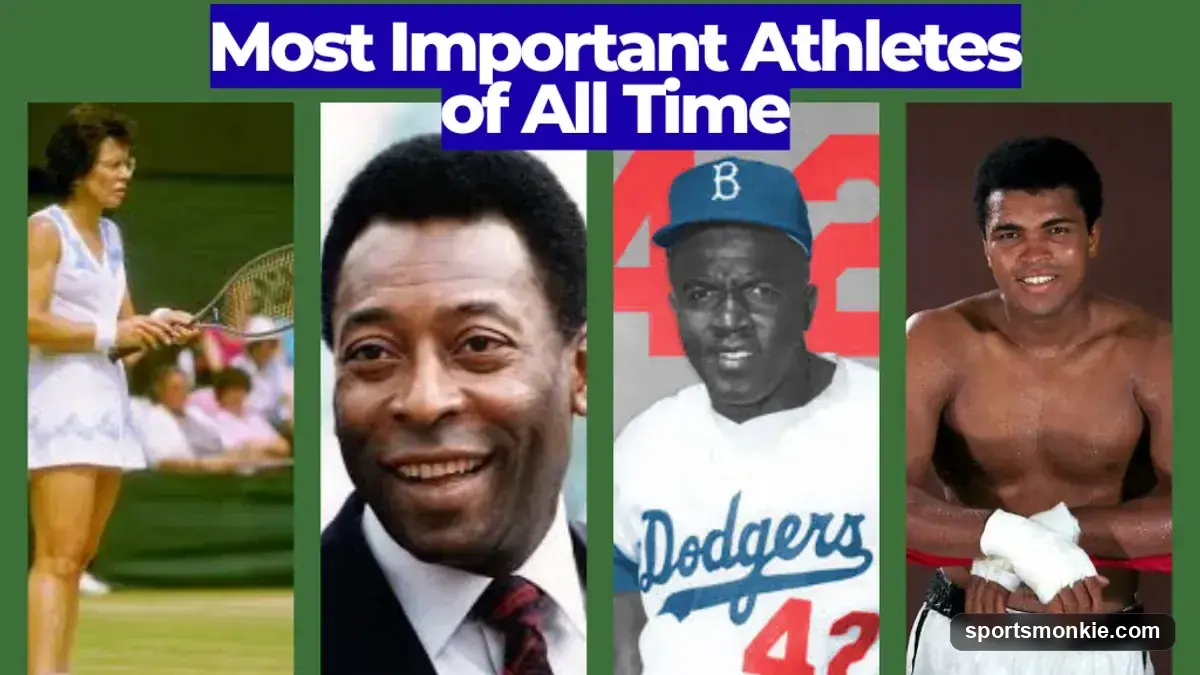
Ali tops nearly every version of this list, and not just for what he did in the ring across three separate heavyweight title reigns. He refused induction into the U.S. Army during the Vietnam War in 1967 on religious grounds, was stripped of his title and boxing license for three years, and won a unanimous Supreme Court reversal of his conviction in 1971. He had converted to Islam and changed his name from Cassius Clay years earlier, at real commercial cost. By the time he lit the Olympic cauldron in Atlanta in 1996, hands trembling from Parkinson’s, he had become a global symbol independent of boxing, more so than any name on this site’s own ranking of the greatest boxers.
Jesse Owens
Owens’ four golds at the 1936 Berlin Olympics — 100m, 200m, long jump, and the 4x100m relay — did more than win medals. They undercut Nazi claims of Aryan racial superiority in front of the regime making them, on German soil, with Hitler in the stadium. Owens returned home to a country that still denied him full citizenship rights and equal opportunity, a contradiction that has followed his legacy ever since. His performance remains one of the most cited entries in any Olympic medal record, not for the count alone but for what it meant in that specific room, at that specific moment.
Jackie Robinson
Robinson broke Major League Baseball’s color line on April 15, 1947, with the Brooklyn Dodgers, and kept performing at an elite level — Rookie of the Year that season, NL MVP by 1949 — while absorbing abuse, death threats, and hotel and restaurant refusals that would have broken most people. Commissioner Ford Frick retired his number 42 across all of MLB in 1997, the only number ever honored league-wide. What he opened stretched well past baseball, into the broader civil rights movement he later worked alongside.
Billie Jean King
King beat Bobby Riggs in the nationally televised 1973 “Battle of the Sexes” and spent years afterward fighting for equal prize money, work that helped make the 1973 US Open the first Grand Slam to pay men and women equally. She founded the Women’s Tennis Association the same year and won 39 Grand Slam titles across singles, doubles, and mixed doubles over her career. That combination of on-court excellence and off-court organizing reshaped the economics of women’s sport far beyond tennis, a legacy this site also traces in its list of the greatest tennis players of all time.
Pelé
Pelé won three World Cups with Brazil — 1958, 1962, and 1970, the only player to do so — and gave the sport a global identity that needed no translation. He is credited with popularizing soccer commercially in markets like the United States during his time with the New York Cosmos in the 1970s, and later served as Brazil’s Extraordinary Minister for Sport. He isn’t just a great player in the site’s own ranking of the greatest soccer players; he’s closer to an institution, the reference point every subsequent global superstar of the sport gets measured against.
Michael Jordan
Jordan won six NBA championships and five MVP awards with the Chicago Bulls, but his larger significance is commercial and cultural: his partnership with Nike, beginning with the Air Jordan line in 1985, built the template for the modern athlete-as-global-brand that basketball stars, and stars in other sports entirely, have followed ever since. He turned the NBA into a genuinely international product during the 1990s in a way this site’s own ranking of the greatest NBA players still measures every successor against.
Serena Williams
Williams retired with 23 Grand Slam singles titles, the most of the Open Era, won while also becoming one of the most recognizable athletes in the world regardless of sport. She has spoken publicly about near-fatal complications after childbirth in 2017, using that platform to push for better maternal health outcomes for Black women, and has built a venture capital firm, Serena Ventures, investing specifically in founders overlooked by traditional funding. She changed what young girls, across backgrounds, believed was possible for them in a sport with a long history of exclusion.
Sachin Tendulkar
Tendulkar retired in 2013 holding the record for most runs and most centuries in both Test and one-day international cricket, records that still stand. Over a 24-year international career for India, he became something close to a religious figure for over a billion cricket fans, widely called cricket’s “God” in the Indian press. In 2014, he became the first sportsperson ever awarded India’s highest civilian honor, the Bharat Ratna — a level of formal national recognition few athletes anywhere have matched.
Arthur Ashe
Ashe became the first Black man to win Wimbledon in 1975, having already won the US Open in 1968 and the Australian Open in 1970. He contracted HIV from a blood transfusion during heart surgery in 1983, disclosed his status publicly in 1992 after a newspaper was preparing to report it, and spent his final year building global AIDS awareness before dying in 1993. His career and its final chapter turned a private illness into a public cause that outlasted every title he won.
Nadia Comăneci
At the 1976 Montreal Olympics, 14-year-old Comăneci became the first gymnast in Olympic history to score a perfect 10.0, a mark the scoreboard wasn’t even built to display. She won five golds across the 1976 and 1980 Games and reset what precision in gymnastics was assumed to look like, launching the modern elite era that still measures routines against her standard.
Colin Kaepernick
Kaepernick began kneeling during the national anthem in 2016 as a quarterback for the San Francisco 49ers, protesting police violence against Black Americans. He opted out of his contract after that season and was never signed by another NFL team, an outcome he and others have argued amounted to blackballing. Nike made him the face of the 2018 “Just Do It” 30th-anniversary campaign, and his protest reshaped how American sports leagues, players, and sponsors talk about athlete activism nearly a decade on.
Babe Didrikson Zaharias
Didrikson Zaharias won two golds and a silver in track and field at the 1932 Los Angeles Olympics at a time when women were actively discouraged from competing seriously in multiple sports. She then rebuilt herself as a dominant golfer, winning 10 LPGA major championships and becoming a founding member of the LPGA Tour itself in 1950. Few athletes in history, male or female, have been genuinely elite in two entirely different sports; almost none did it while fighting the era’s assumptions about what women’s bodies could do.
How We Ranked Them
This list weighs five factors, roughly in this order: whether the athlete was first through a barrier that had excluded people like them; how far their reach extended past people who actually followed the sport; whether they used their platform for change at real personal or career cost, not just symbolic gestures; how their relevance has held up decades after retirement; and whether recognition of their impact crosses national borders. Ali, Owens, and Robinson rank at the top because they satisfy all five clearly. Comăneci and Didrikson Zaharias rank slightly behind mainly on reach — enormous within their sports and eras, narrower globally than Ali’s or Pelé’s. No ranking here survives contact with a different country’s perspective: Ali reads differently in the United States than Tendulkar does in India or Pelé does in Brazil. What connects all 12 is the size of the audience each reached outside the scoreboard; more debates like this one live in our Records & Rankings hub.
Frequently asked questions
Who is considered the most important athlete in history?+
Muhammad Ali is the most commonly named single choice, combining three heavyweight title reigns with his refusal of the Vietnam draft, his conversion to Islam, and decades as a global symbol of Black pride and conscience beyond the ring.
Is Jesse Owens more important than Jackie Robinson?+
They're rarely ranked against each other because the moments are different. Owens undercut Nazi racial propaganda in front of Hitler at the 1936 Berlin Olympics; Robinson broke Major League Baseball's color line in 1947 and endured over a full season to make integration stick. Both sit near the top of nearly every serious list.
What makes an athlete 'important' beyond winning?+
Being first through a barrier, reach into people who never watched the sport, using a platform for change at real personal cost, and staying culturally relevant decades after retirement — importance is measured against those, not just trophies.
Which female athlete has had the greatest impact?+
Billie Jean King is cited most often for the 1973 Battle of the Sexes and her fight for equal prize money, which reshaped the economics of women's sport. Serena Williams is the modern parallel, both for her Grand Slam record and for changing what young girls believed was possible.
Why is Colin Kaepernick on a list with Ali and Robinson?+
Kaepernick began kneeling during the national anthem in 2016 to protest police violence, went unsigned by any NFL team afterward, and became the face of Nike's 2018 'Just Do It' 30th-anniversary campaign — a modern case of an athlete paying a career cost for a stance, the same pattern that put Ali and Ashe on this list.
Do important athletes have to be the best in their sport?+
No. Jacques Plante, credited with popularizing the hockey goalie mask, and Curt Flood, who challenged baseball's reserve clause, changed their sports without ever being ranked among the greatest players. Impact and greatness are related but separate measures.
Was Pelé more important to soccer than Diego Maradona?+
Pelé is usually ranked higher on importance specifically, because his three World Cup wins with Brazil (1958, 1962, 1970) and decades as a global ambassador for the sport gave it credibility in markets, including the United States, where it had none. Maradona's importance is concentrated more narrowly in Argentina and Napoli.
Sources
Play & tools
Free browser games and tools — no account, no download.
- Play today's Sports Connections — Today's Sports Connections — daily hints, answers, and play the grid.
- Play Guess the NFL Player — A new mystery NFL player every day. Eight guesses, with a clue on each — plus free unlimited mode.
- Explore all our games →
Related records & rankings guides
View all →
Greatest Judo Players (Athletes) of All Time
The greatest judo players of all time, including Teddy Riner, Yasuhiro Yamashita, and Ryoko Tani, who dominated World and Olympic podiums for decades.
Most Controversial Athletes in Sports History: Infamous Figures
Ranked: the athletes whose scandals reshaped their sports — Armstrong's doping, Ben Johnson's 1988 test, Tyson's ear bite, Maradona and Sharapova, weighed on evidence.

The Oldest Stadiums Around the Globe: A Complete Guide
The oldest sports stadiums still in use include Lord's (1814), The Oval (1845), and Bramall Lane (1855). See the most historic venues still standing today.
The Oldest Sports in the World: Ancient Origins Ranked
Wrestling, running, and archery rank among the oldest sports in the world, with roots stretching back thousands of years. See what history and digs show.
Most Followed Athletes on Twitter/X, Ranked
Cristiano Ronaldo leads the most followed athletes on X/Twitter with 113M+ followers, ahead of Virat Kohli and Neymar. See the full ranked top 11 with counts.
Best Female MMA Fighters of All Time, Ranked
The greatest female MMA fighters ever, ranked with the case for each: Amanda Nunes, Valentina Shevchenko, Ronda Rousey, Cris Cyborg, Zhang Weili and more.