
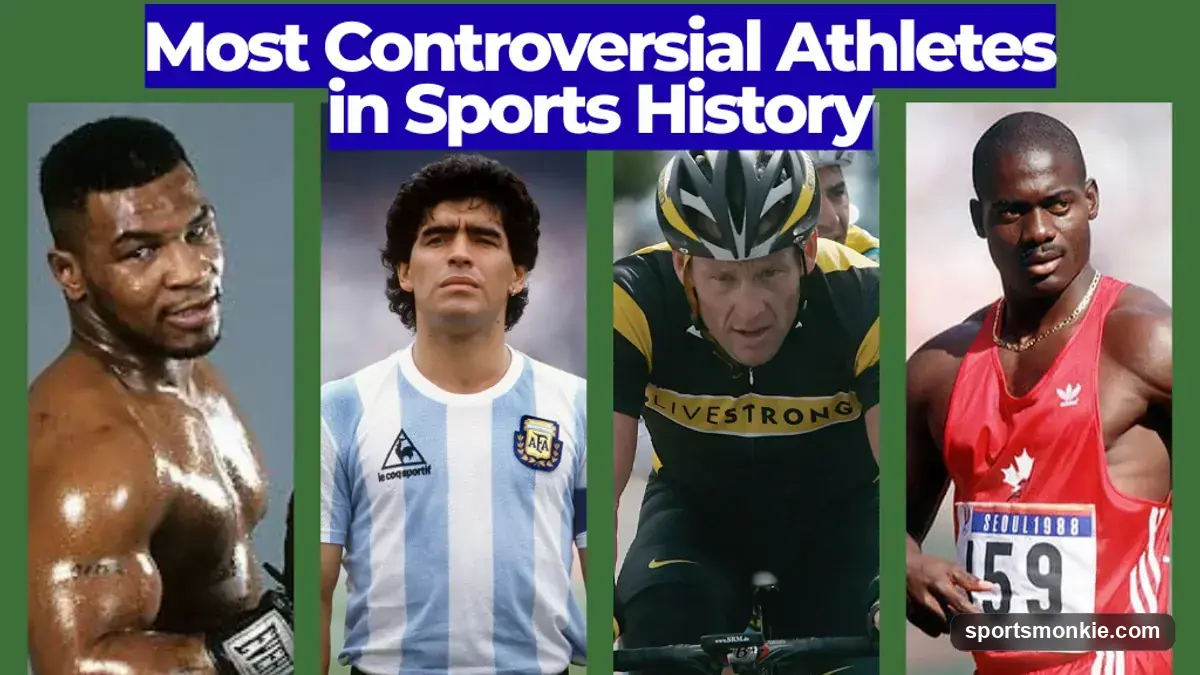
Most Controversial Athletes in Sports History: Infamous Figures
On this page10
- 01Most controversial athletes in sports history at a glance
- 02Lance Armstrong — Cycling
- 03Ben Johnson — Athletics
- 04Diego Maradona — Football
- 05Mike Tyson — Boxing
- 06Maria Sharapova — Tennis
- 07How We Ranked These Athletes
- 08How Different Controversies Are Judged
- 09When Controversy Ages Into Courage
- 10Where These Athletes Rank on Wealth
Placement rewards controversies that were verified by an official body AND permanently changed the sport — stripped records, rewritten rulebooks, or altered testing regimes. Loud outrage alone ranks lower than proven wrongdoing with lasting institutional fallout.
Most controversial athletes in sports history at a glance
| Rank | Athlete | Sport | Documented controversy and fallout |
|---|---|---|---|
| 1 | Lance Armstrong | Cycling | Seven Tour titles voided and lifetime ban for systematic doping |
| 2 | Ben Johnson | Athletics | 1988 Olympic 100m gold stripped after positive test |
| 3 | Diego Maradona | Football | Hand of God plus later drug suspensions |
| 4 | Mike Tyson | Boxing | Holyfield bite disqualification amid wider criminal history |
| 5 | Maria Sharapova | Tennis | Meldonium violation produced a 15-month final ban |
- Systematic doping
Lance Armstrong — Cycling
Armstrong ranks first because the fallout was the most complete on this list: a US Anti-Doping Agency case disqualified every result from August 1, 1998 onward and stripped all seven Tour de France titles he won from 1999 to 2005, with the UCI confirming the lifetime ban on October 22, 2012. No other entry lost a comparable haul of championships.
What separates him from a one-off cheat is the machinery. USADA described an organized team program of drugs and blood transfusions that he denied under oath for years, before admitting it on Oprah Winfrey's broadcast that aired January 17, 2013. The confession, not the racing, is now his defining public moment.
Sport: Road cycling · Fallout: 7 Tour titles voided, lifetime ban · Defining moment: 2013 Oprah confession
- Olympic doping
Ben Johnson — Athletics
Johnson ranks above a typical single positive because the stakes were an Olympic 100m final watched worldwide. He won in a world-record 9.79 seconds at Seoul 1988, then tested positive for the steroid stanozolol; the IOC stripped the gold within days and handed it to Carl Lewis.
The race is remembered as "the dirtiest in history" because six of the eight finalists were later linked to doping — Lewis included. That tangled aftermath is why it accelerated stricter drug testing across track and field rather than fading as one athlete's disgrace.
Sport: 100m sprint · Peak: 9.79 WR, Seoul 1988 · Fallout: Gold stripped days later, medal to Carl Lewis
- On-field cheating
Diego Maradona — Football
Maradona sits mid-ranking because his signature controversy went unpunished at the time and never cost him a title — the opposite of Armstrong or Johnson. In the 1986 World Cup quarter-final he punched the ball past England's goalkeeper, the referee allowed it, and Argentina went on to win the tournament. He called it the "Hand of God" and never apologized.
He also served drug suspensions and faced repeated legal trouble, yet the affection never broke. When he died on November 25, 2020, Argentina held three days of national mourning — a reminder that on-field mischief ages far more gently than proven doping.
Sport: Football · Defining moment: 1986 'Hand of God' vs England · Legacy: 1986 World Cup winner, mourned nationally in 2020
- Criminal + in-ring
Mike Tyson — Boxing
Tyson ranks here for a rare double: a criminal conviction and an in-ring disgrace, though neither erased a title, which keeps him below the doping cases. On June 28, 1997 he bit off part of Evander Holyfield's ear, was disqualified, fined $3 million, and had his license revoked. He remains one of boxing's most destructive punchers.
That night sat on top of a 1992 rape conviction for which he served roughly three years before his 1995 release. The pattern — extraordinary talent repeatedly overshadowed by self-inflicted scandal — defines how his career is retold.
Sport: Heavyweight boxing · Defining moment: 1997 Holyfield ear bite · Fallout: DQ, $3M fine, prior rape conviction
- Reclassified substance
Maria Sharapova — Tennis
Sharapova ranks last because the case hinged on a substance that had only just been banned, not a career-long scheme. She tested positive for meldonium at the 2016 Australian Open, weeks after it was added to the prohibited list on January 1, 2016. An initial two-year ban was cut to 15 months by the Court of Arbitration for Sport, which found she was not an "intentional" doper.
She returned in April 2017, reached the top 30 again, and won one more WTA title before shoulder problems ended her career in 2020. The ranking reflects a genuine violation with the mildest institutional fallout on this list.
Sport: Tennis · Substance: Meldonium (banned Jan 1, 2016) · Fallout: 2-year ban cut to 15 months, retired 2020
Reader interaction
Build your ranking
Drag the names into the order you think is right — or use the arrows — then submit to see how your list compares with everyone else's.
- Lance Armstrong — Cycling
- Ben Johnson — Athletics
- Diego Maradona — Football
- Mike Tyson — Boxing
- Maria Sharapova — Tennis
Audience ranking
How everyone ranked them
Built from reader rankings using position-based points.
This list ranks scandal by consequence, not volume of headlines. The narrative below explains that method and adds context the card entries do not repeat — how different controversy types are judged, why some fade and others do not, and where politically charged cases fit.
How We Ranked These Athletes
Three factors decide placement, in order. First, verification: a controversy confirmed by an anti-doping body, court, or governing federation outranks one that lives only in public opinion. Second, institutional damage: stripped titles, a rewritten record book, or a permanently changed testing regime pushes an athlete up. Third, durability: scandals that still define an athlete decades later rank above flashes of outrage that faded.
That is why Lance Armstrong sits first and Maria Sharapova fifth despite both being doping cases — the gap is the scale of what each cost the sport, not the noise around it. It is also why Diego Maradona, whose defining controversy drew no sanction at all, still ranks above her: the Hand of God reshaped how a World Cup is remembered, even though no title was lost.
How Different Controversies Are Judged
Not every scandal is weighed the same way, and the type often predicts how history treats it.
| Controversy type | Notable athletes | How it tends to age |
|---|---|---|
| Systematic doping | Lance Armstrong, Marion Jones | Titles voided; damage is permanent |
| Single doping violation | Ben Johnson, Maria Sharapova | Ban served; reputation partly recovers |
| On-field misconduct | Zinedine Zidane (2006 headbutt), Mike Tyson (ear bite) | Forgiven faster; no title erased |
| Criminal conduct | O.J. Simpson, Mike Tyson | Separate from the sport; lasting stigma |
| Political statement | Muhammad Ali (draft refusal), Colin Kaepernick | Often reassessed favorably over time |
Doping sits at the top of the severity scale because it attacks the fairness of the result itself — which is why anti-doping uses strict liability and why the record book can be rewritten years after the fact. On-field misconduct and criminal cases, however serious, leave the competition’s outcome intact, so they tend to be forgiven more readily.
When Controversy Ages Into Courage
Political controversy is the outlier this ranking deliberately leaves off, because it is judged by a different clock. Muhammad Ali’s refusal of the Vietnam draft cost him his boxing license and title at his athletic peak, yet it now reads as principled resistance rather than defiance. Colin Kaepernick’s decision to kneel during the anthem split opinion sharply in the moment but pushed a national conversation about race and policing forward.
The pattern is consistent: verified cheating gets harsher with hindsight as the evidence settles, while stances that were divisive in their time are frequently reassessed as moral courage. That is the core reason this list separates proven wrongdoing from principled protest — the two do not belong on the same scale.
Where These Athletes Rank on Wealth
Controversy and earning power rarely move together, and several figures here remained commercially valuable long after their scandals. For a related angle on athlete finances, see our breakdown of the richest boxers and the richest PBA athletes, which show how reputation and revenue can diverge.
Frequently asked questions
Who is the most controversial athlete of all time?+
There is no universal answer, but Lance Armstrong is the most cited case because a proven, systematic doping program erased seven Tour de France titles — the largest championship loss on record for an individual athlete. Ben Johnson, Mike Tyson, and Diego Maradona round out the names most often raised. The label depends on whether you weigh proven cheating, criminal conduct, or sheer public outrage most heavily.
What is the difference between a doping ban and a criminal conviction for an athlete?+
A doping ban is a sporting sanction issued by an anti-doping body or governing federation; it can strip titles and bar competition but is not a court verdict. A criminal conviction comes from a court of law and can carry prison time, as Mike Tyson's 1992 case did. Some athletes, like Marion Jones, faced both — a sports ban plus jail for lying to federal investigators about steroids.
Why was the 1988 Seoul 100m called the dirtiest race in history?+
Ben Johnson tested positive for stanozolol and lost his gold within days, but he was not alone. Over time, six of the eight finalists were linked to doping, including Carl Lewis, who inherited the gold. That is why the race is remembered as a systemic failure rather than one athlete's fall, and why it hardened drug testing across track and field.
Did Diego Maradona ever get punished for the Hand of God?+
No. The 1986 handball against England went unseen by the referee and the goal stood, helping Argentina reach the final they eventually won. Maradona faced no retroactive sanction for it and never apologized, calling it the Hand of God. His later doping suspensions and legal troubles were separate matters and did not touch that World Cup result.
How can an athlete be banned for a substance they did not know was illegal?+
Anti-doping operates on strict liability — athletes are responsible for whatever is in their system, regardless of intent. Maria Sharapova's meldonium had been legal for years before being added to the banned list on January 1, 2016. Ignorance reduced her ban from two years to 15 months on appeal but did not eliminate it, because the substance was prohibited when she tested positive.
Can a controversial athlete still be voted into a hall of fame?+
It depends on the sport and the nature of the scandal. Athletes whose controversies were political or on-field, like Muhammad Ali or Diego Maradona, are widely honored. Those with proven doping or criminal cases face steeper resistance — Lance Armstrong's Tour wins were voided outright, and cycling recognizes no champion for those years, which effectively closes the door on traditional honors.
Sources
Play & tools
Free browser games and tools — no account, no download.
- Play today's Sports Connections — Today's Sports Connections — daily hints, answers, and play the grid.
- Play Guess the NFL Player — A new mystery NFL player every day. Eight guesses, with a clue on each — plus free unlimited mode.
- Explore all our games →
Related records & rankings guides
View all →
The Most Important Athletes of All Time: Who Changed Sport
12 named athletes — Muhammad Ali, Jesse Owens, Jackie Robinson, Billie Jean King, Pelé, and more — ranked and profiled for the barriers they broke and the change they forced.

The Oldest Stadiums Around the Globe: A Complete Guide
The oldest sports stadiums still in use include Lord's (1814), The Oval (1845), and Bramall Lane (1855). See the most historic venues still standing today.

The Oldest Sports in the World: Ancient Origins Ranked
Wrestling, running, and archery rank among the oldest sports in the world, with roots stretching back thousands of years. See what history and digs show.
Most Followed Athletes on Twitter/X, Ranked
Cristiano Ronaldo leads the most followed athletes on X/Twitter with 113M+ followers, ahead of Virat Kohli and Neymar. See the full ranked top 11 with counts.
Best Fielders in Cricket History: Ranked
Jonty Rhodes still tops most lists of cricket's greatest fielders. Here is the full ranking, what the catching records actually prove, and how much a great fielder is worth in runs.
Best Female MMA Fighters of All Time, Ranked
The greatest female MMA fighters ever, ranked with the case for each: Amanda Nunes, Valentina Shevchenko, Ronda Rousey, Cris Cyborg, Zhang Weili and more.