
Richest Boxers in the World: Who Earned the Most?
On this page14
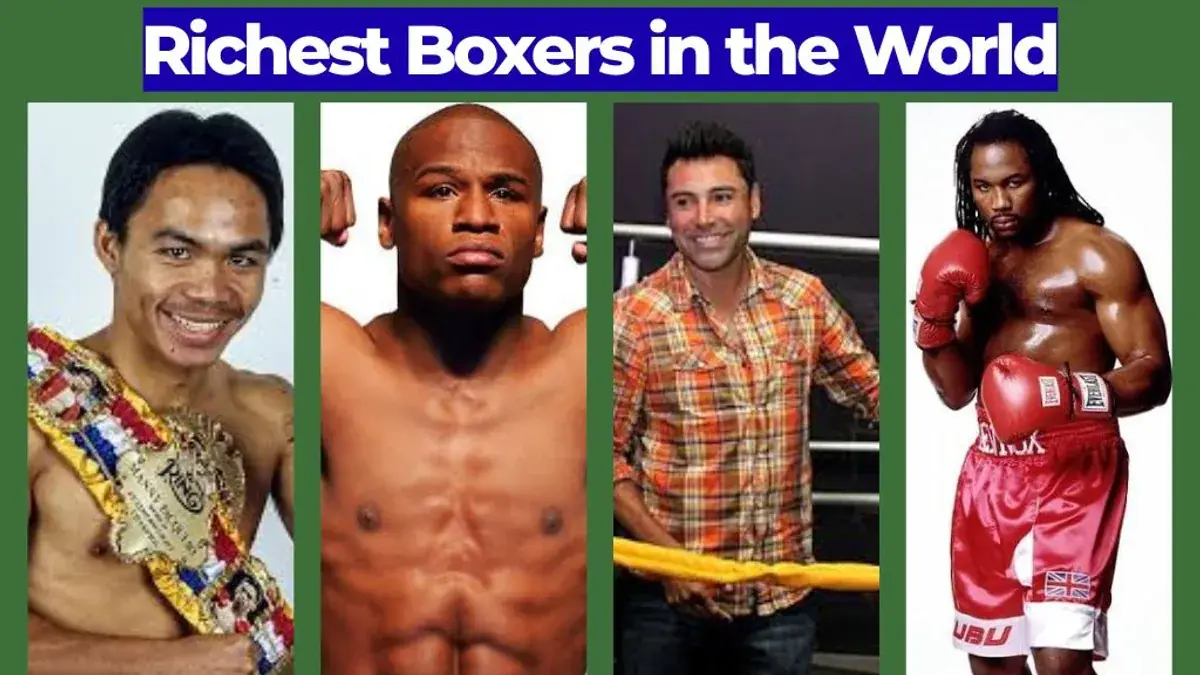
- 01Floyd Mayweather Jr. (USA) — disputed, $50M–$400M+
- 02Saul 'Canelo' Alvarez (Mexico) — about $350 million
- 03George Foreman (USA) — about $300 million
- 04Anthony Joshua (UK) — about $200–250 million
- 05Manny Pacquiao (Philippines) — about $220 million
- 06Tyson Fury (UK) — about $200 million
- 07Oscar De La Hoya (USA) — about $100–200 million
- 08Oleksandr Usyk (Ukraine) — about $150–200 million and rising
- 09Lennox Lewis (UK/Canada) — about $140 million
- 10Mike Tyson (USA) — about $20–30 million
- 11How we ranked the richest boxers
- 12Career earnings vs. current net worth
- 13Why boxing produces bigger single-night fortunes
- 14Where these fighters rank on other lists
We rank primarily by current estimated net worth in 2026. Where a fighter's present-day figure is heavily disputed, we weight peak career earnings and lasting brand equity — which is why Mayweather leads despite a contested current fortune, and why a $400-million career earner like Tyson still ranks last.
- Career leader
Floyd Mayweather Jr. (USA) — disputed, $50M–$400M+
Mayweather retired 50-0, and that unbeaten record was itself the product — it let him sell fights as must-see events and, crucially, run them through Mayweather Promotions so he kept a far larger slice of pay-per-view money than a fighter on someone else's banner ever could. That structure is how his career purses topped $1.2 billion, including a reported $250 million-plus for the 2017 Conor McGregor bout alone.
His current net worth is where the certainty ends. Estimates swing from roughly $50 million to several hundred million, a spread driven by lavish spending and a public revenue dispute with Showtime. We keep him at No. 1 because no other boxer's all-time earnings come close — on the money the sport actually generated for a single man, he is still the benchmark.
Country: USA · Record: 50-0 · Career purses: $1.2B+ · Wealth driver: PPV splits via self-promotion
- Modern great
Saul 'Canelo' Alvarez (Mexico) — about $350 million
Canelo is the clearest active-era wealth story in boxing. A reported four-fight, roughly $400 million deal with Saudi Arabia's Riyadh Season pushed his estimated net worth toward $350 million, and that money is structured to pay out regardless of results — which mattered when he lost his undisputed super-middleweight belts to Terence Crawford by unanimous decision in September 2025.
He ranks above the late George Foreman because his fortune is still actively compounding rather than fixed by an estate. Unlike several names here, Canelo built his wealth almost entirely inside the ring, as boxing's most bankable pay-per-view attraction for over a decade.
Country: Mexico · Status: active · Wealth driver: Riyadh Season deal, DAZN and PPV purses
- Businessman-champion
George Foreman (USA) — about $300 million
Foreman's ring career made him comfortable; the George Foreman Grill made him rich. The appliance sold more than 100 million units and reportedly paid him over $200 million in royalties — a sum that dwarfed his boxing purses and is the real engine behind his roughly $300 million fortune.
What makes his placement unusual is the boxing résumé attached to it: two heavyweight title reigns two decades apart, including a knockout of Michael Moorer in 1994 at age 45. His figure is now fixed rather than growing — Foreman died on March 21, 2025, at 76 — which is why Canelo edges him for second.
Country: USA · Status: deceased (2025) · Wealth driver: George Foreman Grill royalties
- Heavyweight draw
Anthony Joshua (UK) — about $200–250 million
Joshua's fortune rests less on any single purse than on volume and reach: an Olympic gold from London 2012, a run of sold-out UK stadium nights, and mainstream British sponsorship deals that took him well beyond boxing's usual advertisers.
His No. 4 placement sits above Pacquiao's larger single figure because his earning window is still open. A September 2024 fifth-round knockout loss to Daniel Dubois ended his bid for a third title reign, but a long-teased all-British megafight with Tyson Fury — targeted for 2026 in Riyadh — is exactly the kind of payday that could reset his number upward. See how the heavyweight tier fits among boxing's weight classes.
Country: UK · Status: active · Wealth driver: heavyweight gates, global sponsorships
- Eight-division icon
Manny Pacquiao (Philippines) — about $220 million
Pacquiao is the most improbable fortune here. An eight-division world title haul made him a national figure in the Philippines, where he later served a full term in the Senate, and that fame turned into endorsement reach across continents that most fighters never touch.
He is also the rare 40-something still generating live purses: he returned at age 46 on July 19, 2025, and fought WBC welterweight champion Mario Barrios to a majority draw, banking a reported $17–18 million for a single night. That enduring box-office pull, layered on decades of Las Vegas main events, underpins his estimated $220 million.
Country: Philippines · Status: active (2025 return) · Wealth driver: purses, Senate profile, endorsements
- Trilogy money
Tyson Fury (UK) — about $200 million
Fury's roughly $200 million was built on the Deontay Wilder trilogy and the two 2024 undisputed-title fights with Oleksandr Usyk — bouts he lost on the cards but that still paid some of the largest heavyweight purses of the streaming era, because his personality made every one of them an event.
He announced his retirement in January 2025, the fifth of his career, so his figure is currently static. It may not stay that way: a Joshua superfight has been dangled for 2026, and a fighter who has un-retired four times before is a poor bet to stay out if the number is right.
Country: UK · Status: retired (Jan 2025) · Wealth driver: Wilder and Usyk PPV purses
- Promoter equity
Oscar De La Hoya (USA) — about $100–200 million
De La Hoya shows the other route to boxing wealth: converting ring fame into ownership. A six-division world champion, he built Golden Boy Promotions into one of the sport's biggest companies, which means he earns off every major card it runs, not only the fights he took himself.
His wide estimate range — roughly $100 million to $200 million — is almost entirely a question of how you value Golden Boy's equity, an illiquid private stake rather than cash in an account. That's why he ranks on business assets, not purses, and why his true figure is harder to fix than an active fighter's.
Country: USA · Status: retired promoter · Wealth driver: Golden Boy Promotions equity
- Undisputed champ
Oleksandr Usyk (Ukraine) — about $150–200 million and rising
Usyk has the fastest-built fortune on this list. He stopped Daniel Dubois in the fifth round at Wembley in July 2025 to reunify the undisputed heavyweight title, on a night whose total purse was reported near $200 million with the champion taking the majority share.
Stack that on his earlier undisputed cruiserweight run, an Anthony Joshua rematch win, and two 2024 decisions over Fury, and the timeline is remarkably compressed. His placement is deliberately conservative — post-Dubois estimates already push him toward the $200 million tier, so he is more likely under-ranked here than over.
Country: Ukraine · Status: active, undisputed heavyweight · Wealth driver: reunification-fight purses
- Nineties heavyweight
Lennox Lewis (UK/Canada) — about $140 million
Lewis was the last man to hold the undisputed heavyweight crown before Usyk, reigning across the late 1990s and early 2000s when heavyweight boxing still drew some of the biggest audiences in American sports.
He ranks near Usyk on a similar figure but got there the opposite way — slowly and defensively. A business-minded approach to picking and negotiating fights against Mike Tyson, Evander Holyfield, and others let him retire with his roughly $140 million largely intact, a discipline that separates him from most of his hard-living era.
Country: UK/Canada · Status: retired (2004) · Wealth driver: peak-era heavyweight purses, kept intact
- Cautionary tale
Mike Tyson (USA) — about $20–30 million
Tyson earned well over $400 million in purses at his peak, more than almost anyone in boxing history at the time. Mismanagement, an enormous lifestyle, and a 2003 bankruptcy filing with roughly $23 million in debt erased nearly all of it.
He lands last precisely because that gap is the story: his current net worth is estimated around $20–30 million, rebuilt through appearances, a cannabis business, and a reported $20 million-plus for the November 2024 Jake Paul exhibition on Netflix, which he lost on the cards. Career earnings and lasting wealth, his career proves, are not the same measure.
Country: USA · Status: retired · Wealth driver: peak PPV purses (largely lost), later paydays
Reader interaction
Build your ranking
Drag the names into the order you think is right — or use the arrows — then submit to see how your list compares with everyone else's.
- Floyd Mayweather Jr. (USA) — disputed, $50M–$400M+
- Saul 'Canelo' Alvarez (Mexico) — about $350 million
- George Foreman (USA) — about $300 million
- Anthony Joshua (UK) — about $200–250 million
- Manny Pacquiao (Philippines) — about $220 million
- Tyson Fury (UK) — about $200 million
- Oscar De La Hoya (USA) — about $100–200 million
- Oleksandr Usyk (Ukraine) — about $150–200 million and rising
- Lennox Lewis (UK/Canada) — about $140 million
- Mike Tyson (USA) — about $20–30 million
Audience ranking
How everyone ranked them
Built from reader rankings using position-based points.
Boxer wealth is unusually hard to pin down, and the gap between what a fighter earned and what he is worth today is wider in this sport than almost any other. The ranked cards above give each fighter’s figure and the reason behind it; the sections below explain how those numbers were weighed and why they diverge so sharply from one name to the next.
How we ranked the richest boxers
Fighters don’t file earnings reports, so every figure here is an estimate stitched from multiple published sources — and those sources routinely disagree by tens or even hundreds of millions for the same person. We cross-referenced recent 2026 estimates for each boxer, leaned on ranges rather than false-precision single numbers where outlets diverged, and prioritized current net worth as the primary sort.
The one deliberate exception is disputed fortunes. When a fighter’s present-day figure is genuinely contested — Mayweather is the clearest case — we weight all-time career earnings and durable brand equity, because a boxer who verifiably generated $1.2 billion belongs at the top of a “richest boxers” list even if analysts argue over how much he kept.
Career earnings vs. current net worth
These are two different questions, and conflating them is where most wealth lists go wrong. Career earnings measure gross purses and pay-per-view money before taxes, management cuts, and decades of spending. Net worth is what actually remains. The divergence is starkest at the two ends of this list:
| Boxer | Peak career earnings | Estimated net worth (2026) | Why they differ |
|---|---|---|---|
| Floyd Mayweather | $1.2 billion+ | Disputed ($50M–$400M+) | Heavy spending; Showtime revenue dispute |
| Mike Tyson | $400 million+ | ~$20–30 million | 2003 bankruptcy wiped out the fortune |
| George Foreman | Modest ring pay | ~$300 million | Grill royalties dwarfed boxing income |
| Oleksandr Usyk | Compressed, recent | ~$150–200M, rising | Fortune built almost entirely since 2021 |
Why boxing produces bigger single-night fortunes
Boxing’s pay-per-view model concentrates revenue in a way team sports cannot. A single event can pull hundreds of millions of dollars, and a large share flows straight to the two fighters rather than being spread across a roster or capped by a collective-bargaining agreement. That is why a Mayweather–McGregor or a Usyk–Dubois night can out-earn an entire season’s salary for most professional athletes.
The fighters who turned that model into lasting wealth did one of two things: they promoted their own fights to keep a bigger cut, as Mayweather and Oscar De La Hoya did, or they built income that outlived their careers — Foreman’s grill, Pacquiao’s political and endorsement profile, De La Hoya’s Golden Boy equity. Purses alone, as Tyson’s story shows, guarantee nothing.
Where these fighters rank on other lists
Wealth is only one lens. For how these names stack up on skill and achievement rather than bank balance, see our breakdowns of the greatest boxers of all time, the undefeated boxers who retired without a loss, the sport’s career knockout leaders, and how boxing’s weight classes shape which fighters can even share a ring.
Frequently asked questions
Who is the richest boxer of all time?+
It depends on which measure you mean. On career earnings, Floyd Mayweather is the runaway leader, with fight purses and pay-per-view money exceeding $1.2 billion — no other boxer is close. But on current net worth, his figure is disputed and estimated far lower, while active earners like Canelo Alvarez and the late George Foreman's grill fortune rank higher today. We treat Mayweather as the all-time earnings benchmark.
Did losing to Terence Crawford hurt Canelo Alvarez's fortune?+
Not meaningfully. Canelo lost his undisputed super-middleweight belts to Crawford by unanimous decision in September 2025, but his reported four-fight Riyadh Season contract with Saudi Arabia is worth around $400 million and pays out largely regardless of results. Guaranteed money on that scale is what separates a modern superstar's finances from a fighter dependent on winning to keep earning, so a single defeat barely dents his net worth.
How did George Foreman make more from a grill than from boxing?+
Foreman lent his name to a lean-cooking home grill in the mid-1990s. It sold more than 100 million units, and rather than a flat fee he negotiated ongoing royalties, reportedly earning him over $200 million — far beyond what his ring purses ever produced. When the brand's owner later bought the rights to his name outright, it locked in a fortune that pushed his estate to roughly $300 million at his death in 2025.
Why is Mike Tyson worth so little despite earning over $400 million?+
Tyson's career purses were enormous, but almost none of it survived. Extravagant spending, expensive divorces, unpaid taxes, and mismanagement by handlers left him roughly $23 million in debt when he filed for bankruptcy in 2003. His current net worth, estimated around $20–30 million, was rebuilt afterward through paid appearances, a cannabis venture, and exhibition paydays — a fraction of what passed through his hands at his peak.
Which active boxers earn the most heading into 2026?+
Canelo Alvarez leads active earners thanks to his Saudi-backed Riyadh Season deal, followed by heavyweights Oleksandr Usyk and Anthony Joshua, whose reunification and stadium fights command the sport's biggest purses. Manny Pacquiao proved still bankable with a reported $17–18 million for his 2025 comeback at age 46. Tyson Fury would rejoin this group instantly if he reverses his January 2025 retirement for a Joshua fight.
Why do boxers earn more per fight than most team-sport athletes?+
Boxing runs on pay-per-view, where a single marquee night can generate hundreds of millions in revenue that flows largely to the two headliners. Unlike salaried team athletes locked into league contracts and revenue-sharing, top boxers negotiate purses and PPV splits fight by fight — and stars who run their own promotions, as Mayweather and De La Hoya did, keep an even larger cut, so one big event can be worth tens of millions.
Sources
Play & tools
Free browser games and tools — no account, no download.
- Play today's Sports Connections — Today's Sports Connections — daily hints, answers, and play the grid.
- Play Guess the NFL Player — A new mystery NFL player every day. Eight guesses, with a clue on each — plus free unlimited mode.
- Explore all our games →
Related records & rankings guides
View all →
The Most Difficult Sports to Master, Ranked and Explained
Some sports demand a rare blend of athleticism, precision, and mental toughness that makes mastery nearly impossible. Here are the hardest sports and why.
Why Do Boxers Hug? The Clinch Explained
Boxers hug to clinch, a legal tactic used to rest, kill an opponent's momentum and smother punches. Why fighters clinch, what it's called and the rules.
The 10-Point Must System Explained
The 10-point must system scores each round 10 to the winner, 9 or fewer to the loser. How it works in boxing and MMA, with 10-8 and 10-7 rounds.
Boxing Weight Classes in Order: All 17 Divisions
Professional boxing has 17 weight classes, from minimumweight (105 lb) to heavyweight. Every division in order with limits in pounds and kilograms.
How Long Are Boxing Rounds? Length & Rest Times
Men's boxing rounds are three minutes with a one-minute rest; women's rounds are usually two minutes. Round length, rest and total fight time explained.

How Many Rounds Are in a Boxing Match?
Professional title fights are 12 rounds, non-title bouts 4–10, and amateur fights 3 rounds. Round counts explained, plus why boxing dropped 15-round bouts.