
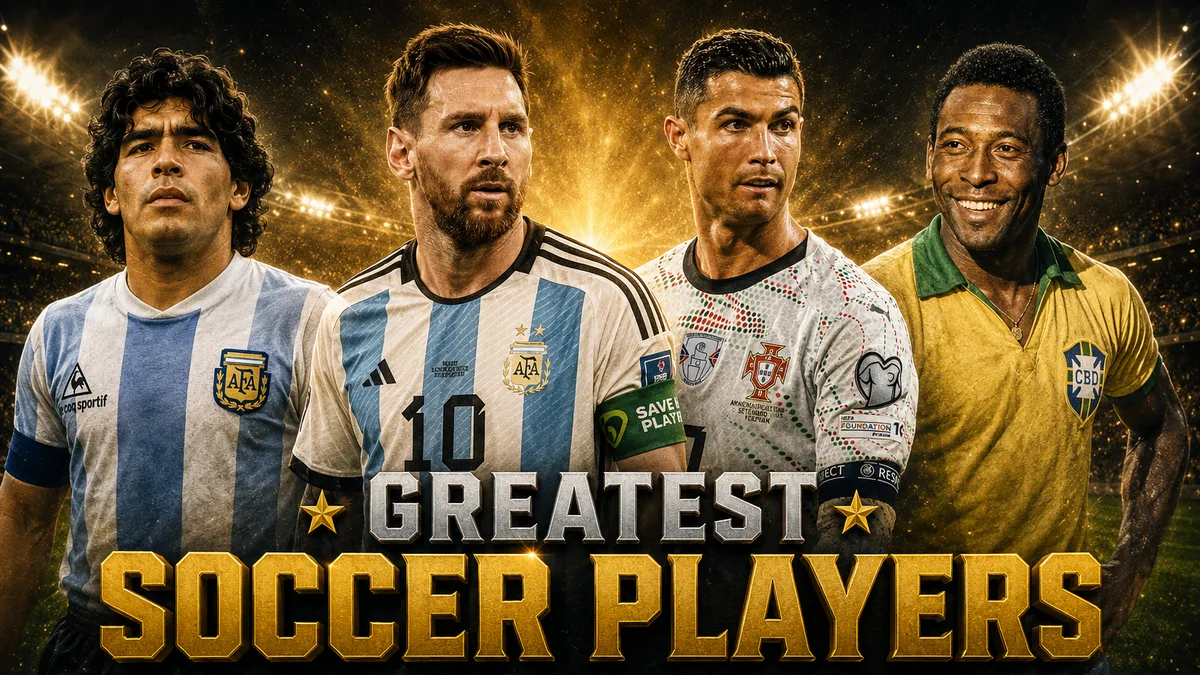
Greatest Soccer Players of All Time: The Definitive Guide
On this page16
- 01Greatest soccer players of all time at a glance
- 02Lionel Messi
- 03Pelé
- 04Diego Maradona
- 05Cristiano Ronaldo
- 06Johan Cruyff
- 07Ronaldo (R9)
- 08Zinédine Zidane
- 09Alfredo Di Stéfano
- 10Franz Beckenbauer
- 11Ronaldinho
- 12How We Ranked This List
- 13Eras Don’t Compare Cleanly
- 14Pelé and Maradona: The Foundation of the Debate
- 15At a Glance
- 16Where the GOAT Debate Stands
Placement here rewards four things: peak level at their best, how long they sustained it, trophies won at club and country, and how much they reshaped how the game is played. Raw goal counts matter, but a player who bent tactics or defined an era outranks a pure accumulator.
Greatest soccer players of all time at a glance
| Rank | Player | Country | Strongest ranking argument |
|---|---|---|---|
| 1 | Lionel Messi | Argentina | Eight Ballon d'Ors, elite longevity and a World Cup |
| 2 | Pelé | Brazil | Only player to win three men's World Cups |
| 3 | Diego Maradona | Argentina | Transformative peak led by the 1986 World Cup |
| 4 | Cristiano Ronaldo | Portugal | Historic scoring output across multiple elite leagues |
| 5 | Johan Cruyff | Netherlands | Three Ballon d'Ors and defining tactical influence |
| 6 | Ronaldo Nazário | Brazil | Two Ballon d'Ors and a dominant 2002 World Cup |
- Modern GOAT
Lionel Messi
Messi holds the record with eight Ballon d'Ors, three clear of anyone else, and his Barcelona sides stayed at the summit of European football for close to a decade. He ranks above Pelé and Maradona because he did it across 15-plus seasons of elite output, not one tournament or one era with thinner competition. The 2022 World Cup in Qatar removed the last argument against him, adding the senior international trophy that had eluded him. He now scores and creates in MLS with Inter Miami, but the case was already closed by then.
Country: Argentina · Peak: FC Barcelona (2008–2015) · Defining feat: 8 Ballon d'Ors + 2022 World Cup
- Three-time champion
Pelé
Pelé is the only player to win three World Cups (1958, 1962, 1970), a haul no outfield player has matched. He ranks above Maradona because he won the biggest prize three times over rather than once, starting as a 17-year-old who scored twice in the 1958 final. His club and country goal tally for Santos and Brazil predates the modern statistical era, so exact totals are debated, but the volume across two decades is not.
Country: Brazil · Peak: Santos (1958–1970) · Defining feat: Only three-time World Cup winner
- 1986 talisman
Diego Maradona
Maradona's 1986 World Cup is the benchmark for a single player carrying a team to a title. He scored or assisted 10 of Argentina's 14 goals and produced both the "Hand of God" handball and, minutes later, a solo run past five England players still shown as the standard for individual skill. He sits below Pelé on trophy count but above the modern pair on peak-tournament dominance, one man deciding a World Cup almost by himself.
Country: Argentina · Peak: Napoli (1984–1991) · Defining feat: 1986 World Cup, won near single-handedly
- Record scorer
Cristiano Ronaldo
Ronaldo is the highest scorer in the history of men's football, with more than 900 career goals for club and country and closing in on the unprecedented 1,000 mark. He is also the record scorer in men's international football and the leading marksman in Champions League history. He ranks below Messi because peak-for-peak the analytics favor Messi's creation and finishing, but Ronaldo's five Ballon d'Ors and his output across the Premier League, La Liga, and Serie A make him impossible to leave out. He and Messi are also the two most popular soccer players alive by social reach.
Country: Portugal · Peak: Real Madrid (2009–2018) · Defining feat: Most career goals in men's football history
- Total Football
Johan Cruyff
Cruyff won three Ballon d'Ors in the 1970s and was the on-field embodiment of Total Football, the fluid positional system that reshaped how teams attack and press. His influence outlived his playing days: the philosophy he later installed at Barcelona underpins the club and national style Messi grew up inside. He ranks above the pure attackers below him because few players double as both a generational talent and the template for a tactical revolution.
Country: Netherlands · Peak: Ajax & Barcelona (1971–1978) · Defining feat: 3 Ballon d'Ors; defined Total Football
- Pure striker
Ronaldo (R9)
Before injuries, the original Ronaldo was the most frightening combination of pace, strength, and finishing the game had seen, a striker who could beat a back line by himself from the halfway line. He won the 2002 World Cup with eight goals, including both in the final, after recovering from career-threatening knee injuries. He ranks here rather than higher only because those injuries cut his absolute peak short; at full fitness in 1996–98 he was arguably the best pure number nine ever.
Country: Brazil · Peak: Barcelona & Inter (1996–1998) · Defining feat: 2002 World Cup Golden Boot
- The stylist
Zinédine Zidane
Zidane paired elite technique with a knack for the biggest occasions: two goals in the 1998 World Cup final for France, then the swept left-foot volley that won the 2002 Champions League final, still cited as one of the greatest goals in a showpiece. He edges the names below him because he then won three straight Champions Leagues as Real Madrid's manager, a rare double as world-class player and elite coach.
Country: France · Peak: Juventus & Real Madrid (1997–2004) · Defining feat: 1998 World Cup + 2002 UCL final volley
- European Cup pioneer
Alfredo Di Stéfano
Di Stéfano powered Real Madrid to five consecutive European Cups from 1956 to 1960 and scored in all five finals, the foundation of Madrid's status as the tournament's defining club. He won two Ballon d'Ors and was a complete forward who dropped deep, created, and finished in equal measure. He never played a World Cup for a competitive nation, which caps his ranking, but his club dominance in the 1950s has no real modern equivalent.
Country: Argentina/Spain · Peak: Real Madrid (1953–1960) · Defining feat: 5 straight European Cups, scored in every final
- Der Kaiser
Franz Beckenbauer
Beckenbauer redefined the sweeper role, turning the last defender into a playmaker who started attacks from deep, and captained West Germany to the 1974 World Cup on home soil. He is one of only a handful to win the World Cup as both player (1974) and manager (1990). He ranks as the highest defender on this list because he did not just defend well, he changed what a defender was allowed to do with the ball.
Country: West Germany · Peak: Bayern Munich (1972–1976) · Defining feat: World Cup as player and manager
- The joy
Ronaldinho
Between 2004 and 2006 Ronaldinho played the most purely entertaining football of the modern era, winning the 2005 Ballon d'Or and a 2006 Champions League with a Barcelona side he dragged back to the top. Real Madrid's home fans once applauded him off the pitch, a rare tribute to an opponent. His peak was shorter than everyone above him, which is why he closes the list rather than sitting mid-table, but at his height nobody was more watchable.
Country: Brazil · Peak: FC Barcelona (2004–2006) · Defining feat: 2005 Ballon d'Or; 2006 Champions League
Reader interaction
Build your ranking
Drag the names into the order you think is right — or use the arrows — then submit to see how your list compares with everyone else's.
- Lionel Messi
- Pelé
- Diego Maradona
- Cristiano Ronaldo
- Johan Cruyff
- Ronaldo (R9)
- Zinédine Zidane
- Alfredo Di Stéfano
- Franz Beckenbauer
- Ronaldinho
Audience ranking
How everyone ranked them
Built from reader rankings using position-based points.
Bar stools have been broken over this argument. Pelé won three World Cups but never played a Champions League match. Messi has eight Ballon d’Ors but went a decade without a senior international trophy before 2022 fixed that. Ronaldo has scored in more competitions than anyone in the sport’s history but still gets told he benefited from playing weaker league opposition at points in his career. None of that settles anything, and it shouldn’t. It’s what keeps the conversation alive.
How We Ranked This List
The order above is not a popularity vote. Each placement weighs four things against each other:
- Peak level: how high a player’s ceiling was at their absolute best.
- Longevity: how many seasons they sustained that level, not just one hot tournament.
- Trophies: silverware at club and country, with the World Cup and European Cup weighted heaviest.
- Influence: whether they changed how the game is played or defined an era.
Where two players are close, tactical impact breaks the tie. That is why Johan Cruyff, with fewer goals than several names below him, ranks fifth: he was both a three-time Ballon d’Or winner and the template for a system that still shapes how top clubs attack. A pure accumulator with no era-defining stretch loses that tiebreaker.
Eras Don’t Compare Cleanly
Every cross-decade ranking carries an asterisk. A striker in 1960 faced heavier pitches, different offside interpretations, and defenders allowed far more contact than today’s rules permit. Modern players benefit from sports science, video analysis, and year-round conditioning that earlier greats never had.
So the fairest question is not “who would win a game between them,” but “how far did each stand above the best of their own time?” By that measure Pelé, Maradona, and Di Stéfano hold their ground against the modern pair, even though their raw numbers look different on paper.
Pelé and Maradona: The Foundation of the Debate
Pelé’s three World Cup winner’s medals remain unmatched by any outfield player, and he scored twice in the 1958 final as a teenager. Maradona’s 1986 tournament sits at the opposite pole of the same argument: one player deciding a World Cup through individual brilliance, from the Hand of God handball to the solo run-quality goal against England minutes later.
The two of them frame the whole conversation. Pelé represents sustained team success at the highest level; Maradona represents the single greatest individual peak. Modern candidates are still measured against both poles.
At a Glance
| # | Player | Country | Peak Era | Defining Feat |
|---|---|---|---|---|
| 1 | Lionel Messi | Argentina | 2008–2015 | 8 Ballon d’Ors + 2022 World Cup |
| 2 | Pelé | Brazil | 1958–1970 | Only three-time World Cup winner |
| 3 | Diego Maradona | Argentina | 1984–1991 | 1986 World Cup near single-handedly |
| 4 | Cristiano Ronaldo | Portugal | 2009–2018 | Most career goals in men’s history |
| 5 | Johan Cruyff | Netherlands | 1971–1978 | 3 Ballon d’Ors; Total Football |
| 6 | Ronaldo (R9) | Brazil | 1996–2002 | 2002 World Cup Golden Boot |
| 7 | Zinédine Zidane | France | 1997–2004 | 1998 World Cup + 2002 UCL volley |
| 8 | Alfredo Di Stéfano | Argentina/Spain | 1953–1960 | 5 straight European Cups |
| 9 | Franz Beckenbauer | West Germany | 1972–1976 | World Cup as player and manager |
| 10 | Ronaldinho | Brazil | 2004–2006 | 2005 Ballon d’Or; 2006 UCL |
Swap in Michel Platini, Ferenc Puskás, Garrincha, Xavi, or Paolo Maldini and a defensible list still holds up, which is exactly why the debate never ends.
Where the GOAT Debate Stands
No consensus exists, and none is coming. Messi has the strongest case from the modern era and tops this list. Pelé and Maradona remain the pre-modern reference points that any ranking has to answer for. Ronaldo’s scoring volume across every league he has played in makes him permanent in the top five. Past the top two, any order is defensible, and anything more specific than that is personal taste.
Frequently asked questions
Who is the greatest soccer player of all time?+
This ranking puts Lionel Messi first on the strength of a record eight Ballon d'Ors, a decade of Barcelona dominance, and the 2022 World Cup that completed his résumé. Pelé and Diego Maradona are the strongest counterarguments from the pre-modern era. There is no universal answer because the debate hinges on whether you weight trophies, peak level, longevity, or era-defining influence most heavily.
Is Messi or Ronaldo the better player?+
Messi ranks first and Ronaldo fourth here. Messi holds the edge on individual honors, eight Ballon d'Ors to Ronaldo's five, and on the underlying creation and finishing numbers at their respective peaks. Ronaldo counters with the all-time men's goals record and titles in three different major leagues. Most neutral analysts place Messi marginally ahead, but both are legitimate top-four choices in any era.
How do you compare players from different eras in football?+
You cannot compare raw numbers directly, because pitches, fitness, tactics, and competitive depth have all changed. A 1960s striker faced different defenders, rules, and travel demands than a modern one. Most analysts use qualitative judgment: how far a player stood above peers of their own time, whether they changed tactics, and how they performed on the biggest stages available to them. That is why this list weighs influence, not just goals.
Why is Cristiano Ronaldo ranked below Pelé and Maradona?+
Ronaldo owns the career goals record and unmatched longevity, but this ranking rewards peak dominance and how much a player bent the game. Pelé won three World Cups; Maradona single-handedly won one. Ronaldo's greatness is cumulative rather than defined by one era-topping stretch or a solo World Cup triumph. It is a close call, and a ranking that prioritized raw output over peak impact could reasonably move him up.
Are there any defenders or goalkeepers among the greatest ever?+
Franz Beckenbauer makes this top ten at nine, because he reinvented the sweeper role rather than simply defending well. Beyond him, all-time greats at the back include Paolo Maldini and Franco Baresi, while Lev Yashin, the only goalkeeper to win a Ballon d'Or, and Gianluigi Buffon lead goalkeeper discussions. They rarely top these lists because individual awards still favor attackers, not because they mattered less to their teams.
Which current players could join this list?+
Kylian Mbappé is the closest, a World Cup winner who scored a final hat-trick in 2022 and now leads Real Madrid's attack. Erling Haaland is breaking scoring records at Manchester City, Jude Bellingham became a Real Madrid talisman in his early twenties, and Vinícius Júnior is a Champions League final match-winner. None yet has the body of work for the top bracket, but each has a decade to build one.
Sources
Play & tools
Free browser games and tools — no account, no download.
- Play 38-0 — Sign a 4-4-2 of all-time football legends and chase a perfect 38-0 league season — perfect, not just unbeaten.
- Explore all our games →
Related football guides
View all →
Most Popular Football Goals of All Time, Ranked
Maradona's 1986 run, Zidane's 2002 volley, Roberto Carlos's impossible free kick, Bale's overhead kick and more: the 10 football goals fans never stop rewatching, ranked.

Greatest Female Soccer Players of All Time, Ranked
Marta, Mia Hamm, Christine Sinclair, and Aitana Bonmatí headline our ranked list of the 12 greatest female soccer players of all time, with the stats behind each pick.
Highest Paid Soccer Players in the World Right Now
Cristiano Ronaldo tops the highest-paid soccer players list at $280M a year. See the full ranked list of the 10 top earners, their salaries, endorsements and clubs.

Richest Female Soccer Players in the World Right Now
The wealthiest women's football players ranked, from Marta and Megan Rapinoe's career fortunes to Khadija Shaw and Trinity Rodman's record 2026 contracts.

Fastest Soccer Players in the World Right Now (2025-26), Ranked
Nany Dimata (39.6 km/h) and Kylian Mbappé top our ranked list of the fastest soccer players in 2025-26, with GPS speeds for Traoré, Van de Ven, Walker, Vinícius and more.
Most Popular Soccer Players in the World Right Now
Ranked: the most popular soccer players in the world right now, from Cristiano Ronaldo's 670M+ Instagram following to breakout stars like Lamine Yamal, judged on reach, marketability, and cultural pull.