
NBA Players Diagnosed With Life-Threatening Diseases
On this page10
- 01What counts as a life-threatening diagnosis in the NBA
- 02NBA players who faced life-threatening diagnoses
- 03Magic Johnson and the announcement that changed everything
- 04Kareem Abdul-Jabbar and chronic myeloid leukemia
- 05Alonzo Mourning’s kidney transplant
- 06Sean Elliott’s return after transplant
- 07Reggie Lewis and a fatal heart condition
- 08Jeff Green’s open-heart surgery and comeback
- 09Where these players stand as of 2026
- 10The advocacy that outlasts the box score
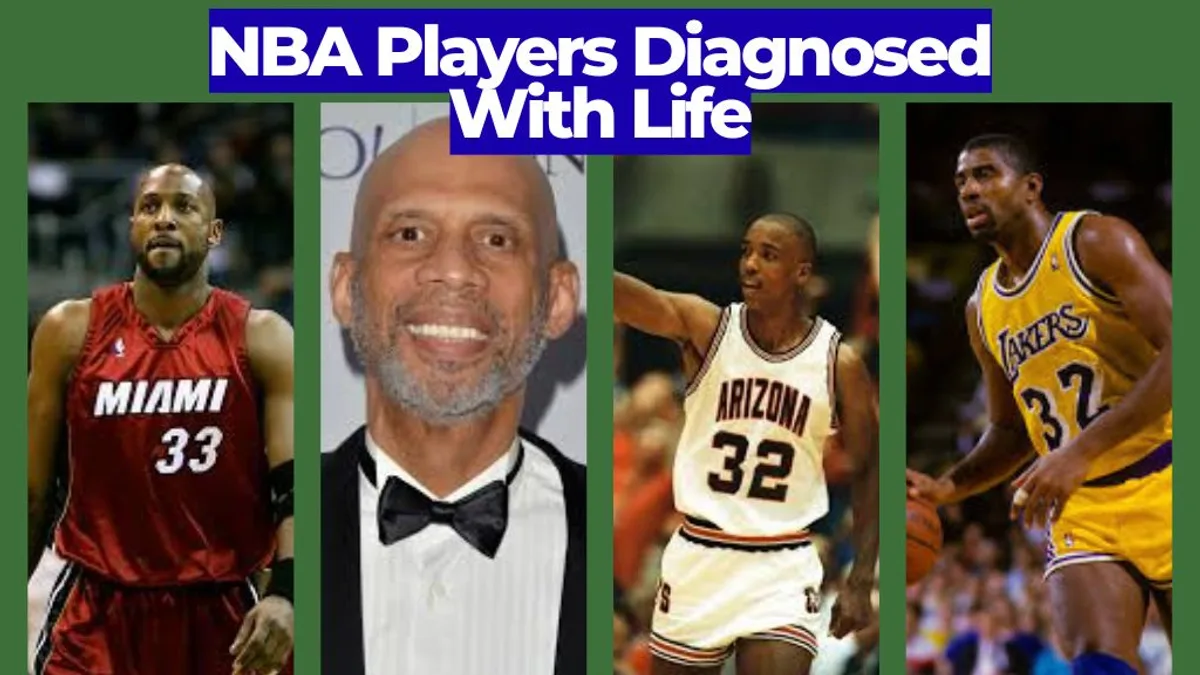
The NBA players most associated with life-threatening diseases include Magic Johnson, who disclosed his HIV diagnosis in 1991; Kareem Abdul-Jabbar, treated for chronic myeloid leukemia; Alonzo Mourning and Sean Elliott, who both underwent kidney transplants; Reggie Lewis, who died of a heart condition at 27; and Jeff Green, who returned to play after open-heart surgery. Their stories reshaped how fans understand illness.
What counts as a life-threatening diagnosis in the NBA
Not every injury belongs on this list. The players below faced conditions that could have ended their lives, not just their careers: viral infection, blood cancer, organ failure, and structural heart disease. What links them is visibility. Because millions had watched these athletes compete, their diagnoses turned abstract medical conditions into human stories, and several used that platform to push fans toward testing, screening, and organ donation.
NBA players who faced life-threatening diagnoses
| Player | Diagnosis | Year disclosed | Outcome |
|---|---|---|---|
| Magic Johnson | HIV-positive | 1991 | Managed with antiretroviral therapy; viral load undetectable; active advocate |
| Kareem Abdul-Jabbar | Chronic myeloid leukemia | 2009 (diagnosed Dec 2008) | Managed with targeted therapy; in remission |
| Sean Elliott | Focal segmental glomerulosclerosis (kidney) | 1999 | Kidney transplant from brother; returned to play |
| Alonzo Mourning | Focal segmental glomerulosclerosis (kidney) | 2000 | Transplant from cousin; returned and won 2006 title |
| Reggie Lewis | Hypertrophic cardiomyopathy (heart) | 1993 | Suffered sudden cardiac death at age 27 |
| Jeff Green | Aortic root aneurysm (heart) | 2011 | Open-heart surgery; returned and won 2023 title |
Magic Johnson and the announcement that changed everything
Earvin “Magic” Johnson learned he was HIV-positive during a routine physical before the 1991-92 season and announced it at a Los Angeles press conference on November 7, 1991, retiring immediately. At the time HIV/AIDS carried enormous stigma built on fear and misinformation. Johnson spoke openly, survived, and briefly returned to basketball, and that combination did more to shift public understanding of the disease than most awareness campaigns of the era. Decades later his viral load remains undetectable on a single daily pill, and he has stayed a prominent HIV/AIDS advocate.
Kareem Abdul-Jabbar and chronic myeloid leukemia
Kareem Abdul-Jabbar was diagnosed with chronic myeloid leukemia in December 2008, long after his record-setting playing career ended, and disclosed it publicly in 2009. He manages the blood cancer with a targeted oral medication that suppresses the abnormal protein driving the disease, and he describes himself as being in remission. Abdul-Jabbar has spoken candidly about the fear of the initial diagnosis and has since used his profile to promote early detection and access to modern treatment for a leukemia most people had never heard of.
Alonzo Mourning’s kidney transplant
Alonzo Mourning was diagnosed with focal segmental glomerulosclerosis in 2000, near the peak of his career, and his kidney function eventually deteriorated to the point that he retired in 2003. The transplant that saved his life came from an unlikely source: an estranged cousin, Jason Cooper, who came forward after seeing news coverage of Mourning’s condition and turned out to be a match. Mourning received the transplant in December 2003, returned to the NBA, and won a championship with the Miami Heat in 2006 before entering the Hall of Fame in 2014.
Sean Elliott’s return after transplant
Sean Elliott of the San Antonio Spurs revealed his kidney disease shortly after the franchise’s 1999 title run and received a kidney from his brother Noel in August 1999. In March 2000 he returned to the court, becoming the first professional athlete to play in a major U.S. sport after a kidney transplant. Doctors called the comeback remarkable, and it brought sustained attention to living organ donation. Elliott has continued to advocate for kidney health and donor awareness in the years since.
Reggie Lewis and a fatal heart condition
Not every story here ends in recovery. Boston Celtics captain Reggie Lewis collapsed during Game 1 of a 1993 playoff series against the Charlotte Hornets. After extensive testing, he died on July 27, 1993, at age 27, suffering sudden cardiac death during an offseason workout. His death was attributed to hypertrophic cardiomyopathy, a thickening of the heart muscle that is the most common cause of sudden cardiac death in young athletes. His loss reshaped how the league approaches cardiac screening.
Jeff Green’s open-heart surgery and comeback
Jeff Green’s aortic root aneurysm was discovered during a 2011 preseason physical with the Celtics, and it was growing at an alarming rate. He underwent open-heart surgery on January 9, 2012, and missed the entire 2011-12 season. Green returned the following year, wore a padded insert beneath his jersey to protect his chest, and went on to a long career, winning an NBA title with the Denver Nuggets in 2023 and remaining an active player in the 2025-26 season.
Where these players stand as of 2026
As of 2026, most of these stories are ongoing testaments to modern medicine. Magic Johnson, honored with the Presidential Medal of Freedom in 2025, and Kareem Abdul-Jabbar both continue to manage chronic conditions while remaining public figures. Alonzo Mourning and Sean Elliott live decades past their transplants and still champion organ donation. Jeff Green is the rare active player on this list, more than a dozen years removed from heart surgery. Reggie Lewis remains the sobering reminder of what is at stake.
The advocacy that outlasts the box score
None of these players retreated from public life after their diagnoses. Most leaned into advocacy, funding research, speaking openly about treatment, and pushing others toward earlier medical care and donor registration. That work, rather than any statistic, is the part of their legacy with the longest reach.
Frequently asked questions
Which NBA player is most famous for a life-threatening disease diagnosis?+
Magic Johnson is the most widely known, announcing he was HIV-positive at a Los Angeles press conference on November 7, 1991. His disclosure, when HIV was still widely misunderstood and heavily stigmatized, reshaped public awareness of the virus far beyond basketball.
Have any NBA players been diagnosed with cancer?+
Yes. Kareem Abdul-Jabbar was diagnosed with chronic myeloid leukemia (a blood cancer) in December 2008 and disclosed it in 2009. He has also spoken publicly about a later prostate cancer diagnosis. He manages the leukemia with a targeted daily medication and describes himself as being in remission.
Which NBA players needed kidney transplants?+
Both Alonzo Mourning and Sean Elliott had focal segmental glomerulosclerosis, a serious kidney disease, and each received a transplant. Elliott's donor was his brother Noel in 1999, and Mourning's was his estranged cousin Jason Cooper in 2003. Kidney disease is not cancer, though it can be life-threatening.
Did any NBA player die from a heart condition?+
Yes. Boston Celtics star Reggie Lewis collapsed during a 1993 playoff game and died on July 27, 1993, at age 27 after suffering sudden cardiac death. His death was attributed to hypertrophic cardiomyopathy, the most common cause of sudden cardiac death in young athletes.
Did Sean Elliott really return to the NBA after a kidney transplant?+
Yes. Elliott received a kidney from his brother in August 1999 and returned to the San Antonio Spurs in March 2000, becoming the first professional athlete to play in a major U.S. sport after a kidney transplant. His comeback drew significant attention to living organ donation.
How is Magic Johnson still healthy decades after his HIV diagnosis?+
Johnson has managed HIV for over three decades with antiretroviral therapy, which has kept his viral load undetectable. Advances in medication mean his regimen is now a single daily pill, and he pairs it with regular exercise. He remains active in HIV/AIDS advocacy and received the Presidential Medal of Freedom in 2025.
Which current NBA-era player overcame a heart condition to keep playing?+
Jeff Green had an aortic root aneurysm discovered during a 2011 preseason physical and underwent open-heart surgery in January 2012. He missed the 2011-12 season, returned, won an NBA title with the Denver Nuggets in 2023, and was still active in the league in the 2025-26 season.
Why do these NBA diagnoses matter beyond sports?+
A public figure's illness reaches people that medical campaigns often cannot. When fans watch a familiar player confront a diagnosis openly, it makes the disease concrete and drives real behavior, including HIV testing, cancer screening, and enrollment in organ-donor registries that outlast the news cycle.
Sources
Play & tools
Free browser games and tools — no account, no download.
- Play 82-0 — Draft five, one per position, and see if your lineup can go a flawless NBA season.
- Play Era Ball — Draft an all-time NBA roster from a single era, then simulate a season and chase a perfect run.
- Play 32-0 — Draft five college basketball legends, one per position, and chase a perfect 32-0 national title.
- Explore all our games →
- Get the printable bracket — Download and print a blank tournament bracket to fill out by hand.
- Open the TS% calculator — Calculate TS% from points, field goal attempts and free throw attempts — scoring efficiency in one number.
- Explore all our free sports tools →
Related basketball guides
View all →
Highest-Paid NBA Players by Salary
Stephen Curry leads the NBA at about $59.6M for 2025-26, the biggest single-season salary ever. See the full supermax top nine and why salary isn't net worth.
Worst Players in NBA History: The Busts Most Often Named
The NBA players most often called the worst — ranked by the gap between draft slot and production, from Anthony Bennett to Kwame Brown and Darko Milicic.
Richest NBA Players Ranked (2026): Net Worth of the Top 12
The 12 richest NBA players ever, ranked by 2026 net worth — from Michael Jordan's Jordan Brand fortune to Magic Johnson, Junior Bridgeman, and LeBron James.
Most Tattooed NBA Players: The 10 Most Inked Bodies in the League
The most tattooed NBA players ever, ranked by coverage and cultural impact — from Chris 'Birdman' Andersen and J.R. Smith to the pioneers Rodman and Iverson.
Greatest NBA Players of All Time: The Top 12, Ranked
The 12 greatest NBA players of all time, ranked and explained — Michael Jordan, LeBron James, Kareem Abdul-Jabbar, Bill Russell, Magic Johnson and more.

NBA Players Fear Wearable Tech Data Could Be Used Against Them in Contract Talks
Adam Silver says the NBA and the Players Association have no agreement on wearable tech in games, because players fear their own data could be used in bargaining.