
What Is a Screen Pass in Football?
On this page5
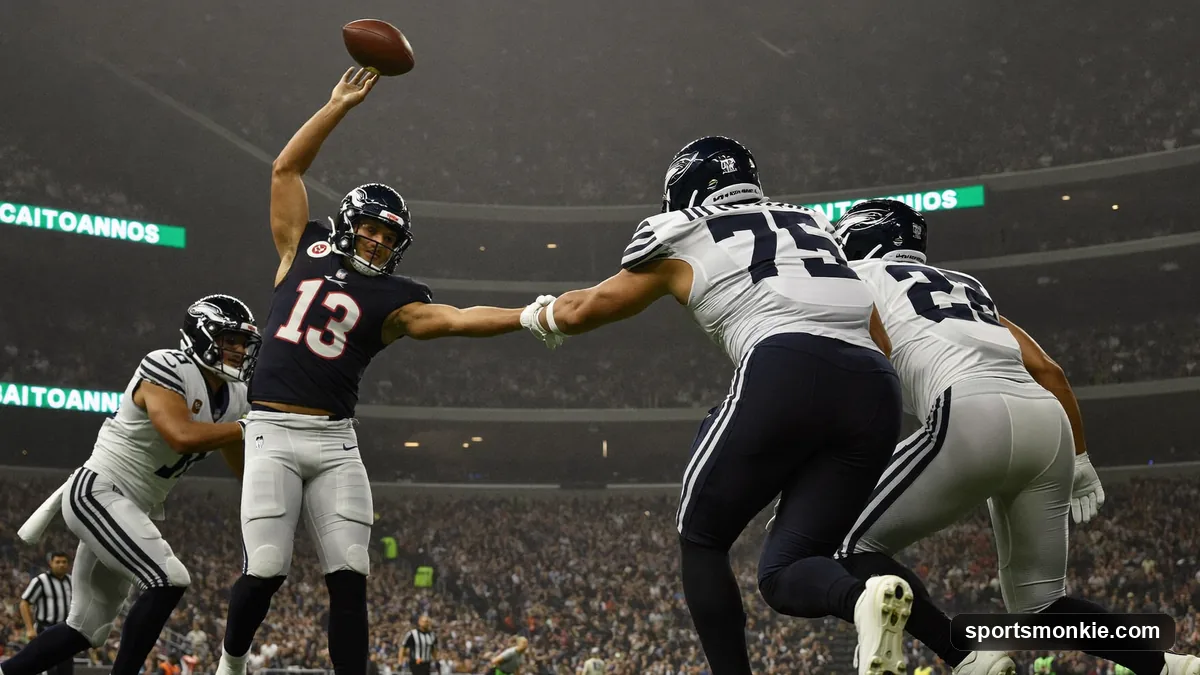
A screen pass is a short throw to a back or receiver at or behind the line of scrimmage, with blockers set up ahead of the catcher. The design lets the pass rush come, then throws over or around it to a player with a wall of linemen in front. Done right, it turns a defense’s aggression against it; done wrong, it risks a loss or an interception.
How a screen works
On a screen, the offensive line briefly invites the rush upfield, then a couple of linemen slip out past the rushers and get in front of the intended catcher — usually a running back or a receiver near the line. The quarterback often lets the rush close in before flipping the ball behind it. Now the catcher has blockers and open grass, while the rushers are stranded upfield, out of the play.
Why offenses love it against pressure
The screen is a natural answer to a hard rush and to a blitz. Every defender who charges upfield is a defender the offense no longer has to block once the ball goes behind them.
| Screen does this | Defense pays this |
|---|---|
| Invites the rush upfield | Rushers taken out of the play |
| Adds blockers ahead of the catcher | Fewer defenders in space |
| Uses the defense’s speed against it | Big-gain risk if unblocked |
The main types
Screens come in several flavors: the running back screen, the quick bubble screen to a receiver, the tunnel screen back inside, and the slower middle screen. Each attacks a different part of the field, but all share the short-throw-plus-blockers DNA.
The risk side
Timing and disguise are everything. A defense that sniffs out the screen can jump the throw for a pick six or blow it up for a loss before the wall forms. That is why screens are called at specific moments — usually when the rush is committed — rather than at random.
Screen vs. a normal short pass
Unlike an ordinary short pass, a screen is built around linemen releasing to block, and the quarterback often waits for the rush. It is officially a pass but plays like an “extended handoff,” which is why it pairs so well with play action and a downhill run game. For more on offensive design, see our NFL guides.
Frequently asked questions
What is a screen pass in football?+
A screen pass is a designed short throw to a back or receiver near the line of scrimmage, set up so that offensive linemen slip past the rushers and get out in front to block. The quarterback often lets the rush come, then flips the ball over or around the defenders to the catcher, who follows the blocking wall. It trades distance for numbers and space.
Why do teams run screen passes?+
Screens are a counter to an aggressive pass rush and to a [blitz](/what-is-a-blitz-in-football/). By inviting the rushers upfield and then throwing behind them, the offense removes those defenders from the play and gives the catcher blockers and open field. Screens also slow down a hard-charging defense over the course of a game, making it think twice about pinning its ears back.
What are the types of screen pass?+
Common types include the running back screen (a back slips out after faking pass protection), the bubble screen (a quick throw to a receiver breaking toward the sideline), the tunnel screen (a receiver comes back inside behind blockers), and the slow/middle screen. Each attacks a different area, but all share the same idea: short throw, blockers ahead, space to run.
What is the risk of a screen pass?+
Timing and disguise are everything. If the defense reads the screen, a defender can jump the throw for an interception, or blow it up for a big loss before the blockers arrive. Screens thrown into unblocked defenders can be disastrous. That is why they are practiced heavily and called at specific moments rather than randomly.
How is a screen different from a normal short pass?+
A normal short pass relies on the receiver's route and the quarterback's timing, with the line pass-blocking as usual. A screen is a designed play where linemen deliberately release downfield to block for the catcher, and the quarterback often waits for the rush before throwing. The blocking scheme in front of the catch is what makes it a screen.
Does a screen pass count as a passing or running play?+
It is officially a passing play, because the ball travels forward through the air and is caught. But it functions much like a running play once the catch is made, with blockers ahead and yards gained on the ground. Analysts sometimes describe screens as an 'extended handoff' for exactly that reason.
When is the best time to call a screen?+
Screens work best on obvious passing downs when the defense is rushing hard, such as third-and-long, and against teams that blitz frequently. They are also useful to settle an offense down, slow the rush, or exploit a defense selling out to stop deep routes. Calling one at the right moment, when the rush is committed, is the difference between a big gain and a busted play.
Sources
Play & tools
Free browser games and tools — no account, no download.
- Play 17-0 — Draft nine and chase a flawless NFL regular season — the perfect 17-0 run, no playoffs.
- Play 20-0 — Draft nine and chase a perfect NFL season — regular season and playoffs, undefeated.
- Play 16-0 — Draft nine and chase a perfect 16-0 — the classic 16-game NFL regular season, no playoffs.
- Play Flawless Six — Draft five players and a head coach, then chase a perfect NFL season with the right chemistry.
- Play Guess the NFL Player — A new mystery NFL player every day. Eight guesses, with a clue on each — plus free unlimited mode.
- Play NFL Wordle — A Wordle for football — guess the daily NFL player in eight tries, with green-amber-grey feedback on every clue.
- Play NFL Connections — Sort sixteen football tiles into four hidden groups of four. A new daily puzzle, four mistakes allowed, plus unlimited mode.
- Explore all our games →
- Open the schedule simulator — Pick every 2026 NFL game and watch the standings and playoff seeds update live.
- Open the squares generator — Generate a randomized, printable Super Bowl squares grid for your party — free, no sign-up.
- Open the trade calculator — Weigh any fantasy football trade instantly — clear winner and value gap.
- Run the NFL predictor — Simulate the NFL bracket and see who your picks send to the Super Bowl.
- Open the passer rating calculator — Calculate the official NFL passer rating (0–158.3) from any passing line, with the formula shown.
- Explore all our free sports tools →
Related nfl guides
View all →
What Is an RPO in Football? Run-Pass Option
An RPO is a run-pass option: one play where the QB reads a defender after the snap and decides to hand off or throw. How it works, explained.
What Is a Blitz in Football? The Defensive Gamble
A blitz in football is when the defense sends extra rushers — more than the usual four — to pressure the quarterback, trading coverage for speed to the passer.
What Is a QB Sneak in Football?
A QB sneak is a short-yardage play where the quarterback takes the snap and dives straight ahead behind the line for a yard or two, ideal on 3rd- or 4th-and-1.
What Is a Sack in Football?
A sack is when the defense tackles the quarterback behind the line of scrimmage before they can throw, losing yards for the offense. It's a key pass-rush stat.
What Is Pass Interference in Football? DPI & OPI
Pass interference is illegal contact that hinders a receiver's chance to catch a pass. In the NFL, defensive PI is a spot foul and automatic first down.
What Is a Challenge Flag in Football? NFL Replay Rules
A challenge flag is the red flag an NFL coach throws to request an instant-replay review. Teams get two challenges, a third if both succeed, and lose a timeout if wrong.