
What Is a False Nine in Football? The Role Explained
On this page5
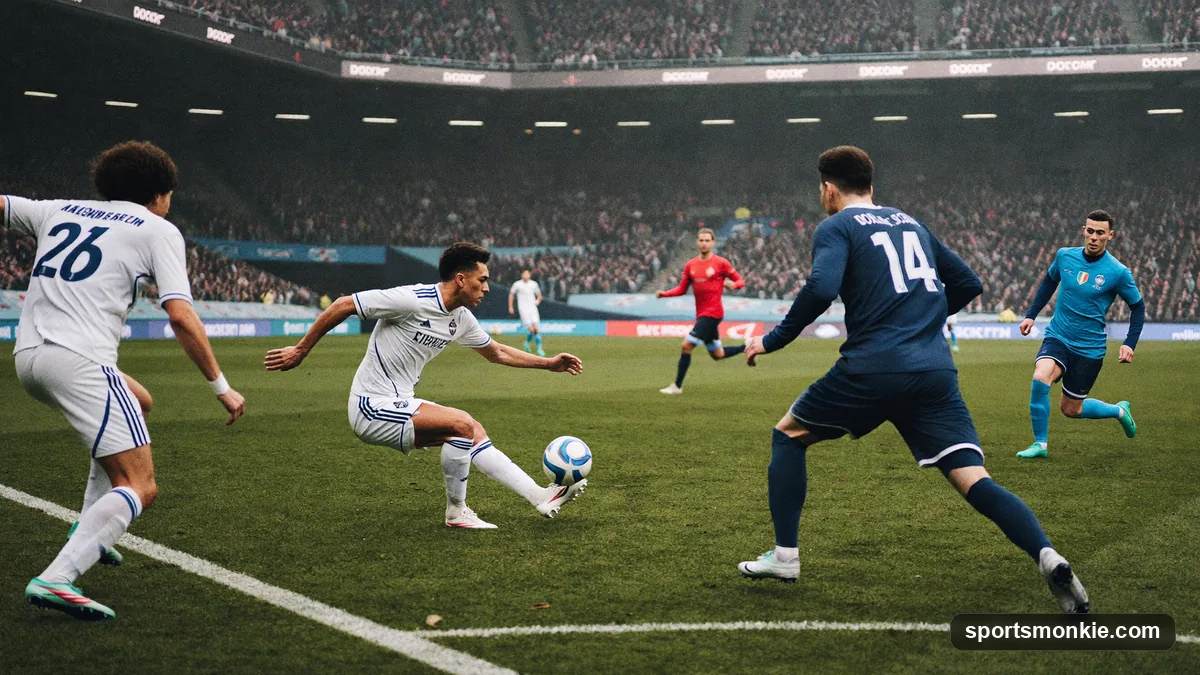
A false nine is a centre-forward who drops deep into midfield instead of staying high up front. By vacating the striker position, they drag defenders out of shape and open space for teammates to attack. It trades a target man’s physical presence for a positional and numerical edge in the buildup — one of modern football’s most influential ideas.
How a false nine changes a defence
The whole trick is the dilemma it poses to the centre-backs. When the nominal striker keeps dropping into midfield, a defender must choose:
| Defender’s choice | Consequence |
|---|---|
| Follow into midfield | Leaves a gap behind for runners to exploit |
| Stay in the line | Gives the false nine time and space to create |
Either option helps the attacking team, which is why a well-run false-nine system can pull a back line apart without a conventional striker ever standing in it.
Where the runners come from
Because the false nine is busy linking play, the goals come from elsewhere — wingers cutting inside, attacking midfielders bursting into the vacated space, full-backs overlapping. The role turns the striker into a creator and asks the rest of the front line to become the finishers. That demands intelligent movement and sharp passing throughout the side.
A short history
Deep-lying forwards existed long ago — Austria’s Matthias Sindelar in the 1930s and Hungary’s Nandor Hidegkuti in the 1950s both played versions of it. But the modern false nine exploded into view when Pep Guardiola used Lionel Messi there for Barcelona around 2009, reshaping how coaches thought about the centre-forward.
When a false nine works best
The system is not a cure-all; it needs the right personnel and the right opponent. It thrives when the “nine” is a gifted passer and dribbler comfortable receiving with their back to goal, and when the midfielders and wingers are quick enough to attack the space that opens up. It works best against a defence that man-marks or steps up aggressively, because those are the back lines most easily dragged apart. Against a deep, compact block that refuses to follow the forward, the space in behind never appears, and the team can look toothless without a genuine target to aim at.
False nine vs. the traditional striker
A conventional striker lives on the last defender’s shoulder and finishes chances; the false nine starts there but drops off to make them. The system also leans heavily on a strong defensive midfielder behind it to cover the space the forward leaves. The false nine is one piece of a broader system — see how it fits with tiki-taka and total football in our guide to soccer tactical systems. For more, browse our football guides and the best football leagues.
Frequently asked questions
What is a false nine in football?+
A false nine is a striker who operates much deeper than a normal centre-forward, dropping into the space between the opposition's defence and midfield. Rather than being the focal point up front, they become an extra creator, linking passes and dragging markers around. The 'false' part is that the player wears the number-9 role but does not behave like a conventional number nine.
How does a false nine work?+
It works by creating a dilemma for the centre-backs. If a defender follows the false nine into midfield, they leave a gap behind for wingers or midfielders to run into; if they stay, the false nine gets time and space to dictate play. Either way the attacking team gains an advantage, turning the striker into a playmaker and inviting runners from deep to become the goal threat.
Who invented the false nine?+
The idea is old — Matthias Sindelar and Nandor Hidegkuti used deep-lying forward roles in the 1930s and 1950s — but it became famous in the modern era when Pep Guardiola deployed Lionel Messi as a false nine at Barcelona around 2009. That Barcelona side turned the role into one of the most influential tactical ideas of its generation.
What is the difference between a false nine and a striker?+
A traditional striker, or number nine, plays on the shoulder of the last defender and focuses on finishing. A false nine starts in that position but drops deep to link play and create, functioning more like an attacking midfielder. The [true striker's role](/what-is-striker-in-soccer/) is to score; the false nine's is to distort the defence and let others score.
What are the weaknesses of a false nine?+
Because the false nine vacates the central striker position, the team can lack a focal point to aim at, making it harder to play direct or attack crosses. It relies on intelligent runners from midfield and quick, accurate passing; against a deep, disciplined defence that refuses to follow, the space in behind may never open up. It is a system that demands the right players.
Is a false nine the same as a number 10?+
Not quite. A number 10 is an attacking midfielder who plays behind the striker, whereas a false nine is nominally the striker who drops into that number-10 zone. The roles overlap heavily in practice, and a false-nine system often blurs the line between forward and playmaker, which is exactly what makes it hard for defenders to pick up.
Sources
Play & tools
Free browser games and tools — no account, no download.
- Play 38-0 — Sign a 4-4-2 of all-time football legends and chase a perfect 38-0 league season — perfect, not just unbeaten.
- Explore all our games →
Related football guides
View all →
What Is a Derby in Football? Local Rivalry Matches
A derby in football is a match between two rival clubs, usually from the same city or region. Think the Manchester derby, El Clasico or the Merseyside derby.
What Is a Nutmeg in Football? (Panna)
A nutmeg in football is playing the ball through an opponent's legs and collecting it on the other side. Also called a 'panna,' it's one of the game's cheekiest skills.

What Is a Brace in Football? Meaning and Origin
A brace in football means two goals scored by the same player in a single match. Here's where the term comes from and how it differs from a hat-trick.
What Is a Clean Sheet in Football? Meaning Explained
A clean sheet means a team finishes a match without conceding a goal. Here's what it means for goalkeepers and defenders, and how it's recorded.
Penalty Shootout Rules Explained (Football)
A penalty shootout decides a tied knockout match: teams take five penalties each, alternating, and the side with more goals wins. If level, it goes to sudden death.
What Is Extra Time in Football? The 30 Minutes
Extra time in football is two 15-minute halves played when a knockout match is level after 90 minutes. If still tied, it goes to a penalty shootout.