
What Is a CDM in Soccer? The Defensive Midfielder Role Explained
On this page6
Real Madrid let Claude Makelele leave for Chelsea in 2003 and never quite replaced what he did for the team. The holding role he defined is now the main defensive answer to fluid attacks like the false nine. The club had spent years stacking Galacticos in attack, and losing one unglamorous holding midfielder was enough to unsettle the whole side. That’s the CDM in a sentence: the position nobody notices until it’s gone.
The CDM Position on the Pitch
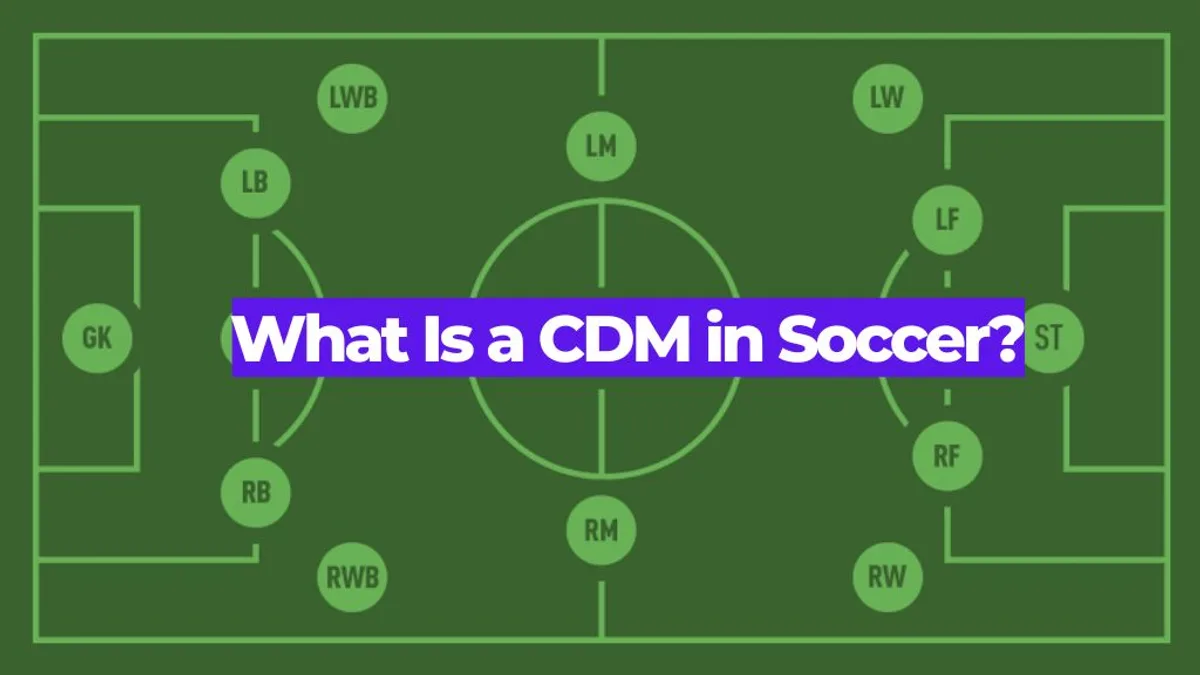
In a typical 4-3-3 or 4-2-3-1, the CDM sits between the centre-backs and the more advanced midfielders. A 4-2-3-1 usually splits the job between two holding midfielders; a 4-3-3 built around a single pivot leaves one player to anchor it alone. In squad sheets and football video games, you’ll see it shortened to DM or CDM.
A few things define where the role operates:
- Mostly stays in the central defensive and central midfield zones
- Rarely pushes into the opposition’s final third
- In many modern systems, drops between the centre-backs during build-up
- Covers the gaps left when attacking midfielders push forward
Core Responsibilities of a CDM
| Responsibility | Detail |
|---|---|
| Intercepting passes | Reading the game to cut out through balls and switches of play |
| Tackling and winning possession | Winning the ball cleanly through challenges or blocks |
| Defensive cover | Filling in behind attacking midfielders and full-backs who push forward |
| Ball recycling | Distributing possession calmly once won — often simple, accurate passing |
| Aerial duels | Winning headers in the midfield zone, particularly from opposition clearances |
| Organising the shape | Communicating defensive structure to teammates around them |
The “Makelele Role”
Claude Makelele’s name became shorthand for the position itself. His move to Chelsea in 2003 exposed just how much defensive structure Real Madrid had been getting from a player who rarely scored and rarely made headlines, which is partly why the term “Makelele role” stuck around in tactical writing.
What made him effective wasn’t athleticism. It was being in the right spot before the danger arrived, winning the ball without fouling, and getting it to a more creative teammate within a touch or two. Unglamorous work, but the kind that’s obvious the moment it’s missing.
Key Qualities of an Elite CDM
A few traits tend to separate the good ones from everyone else:
- Positional awareness — reading where the danger is heading before it gets there
- Composure — staying calm on the ball even under immediate pressure
- Passing range — switching play accurately from one side of the pitch to the other
- Physical presence — strong enough to hold position in midfield duels
- Defensive intelligence — knowing when to press, when to sit, when to cover a teammate
Famous CDMs in Football History
A handful of players have defined what this role can look like at the top level:
- Sergio Busquets (Spain / Barcelona) — controlled tempo from deep so consistently that Spain’s tiki-taka system was effectively built around him
- Casemiro (Brazil / Real Madrid) — a more combative version of the role, central to Real Madrid’s run of Champions League titles in the 2010s
- Fernandinho (Brazil / Manchester City) — gave Pep Guardiola’s possession-heavy teams a defensive foundation they otherwise lacked
- Gilberto Silva (Brazil / Arsenal) — quiet but essential to Arsenal’s unbeaten 2003-04 Invincibles season
- Yaya Toure (Ivory Coast / Manchester City) — started as a CDM before evolving into a box-to-box midfielder, proof the role can be a stage in a career rather than a permanent label
CDM vs. Box-to-Box Midfielder
People often lump the CDM in with the box-to-box midfielder (usually labelled CM), but the anchor function is what separates them. A true CDM rarely strays from the holding position, while a box-to-box player is expected to join the attack regularly. Plenty of players start as CDMs and shift into a more attacking role as their game develops.
Frequently asked questions
What does CDM mean in soccer?+
CDM stands for central defensive midfielder. It refers to a player in the centre of the pitch whose primary responsibilities are defensive — intercepting passes, breaking up opposition attacks, and protecting the back four or back three.
What is the difference between a CDM and a CM in soccer?+
A CM (central midfielder) is expected to contribute equally to attack and defence, operating across a wide vertical range of the pitch. A CDM sits deeper, prioritising defensive duties and rarely advancing into the final third unless play demands it.
Who are some of the best CDMs in football history?+
Players widely regarded as elite CDMs include Claude Makelele (France/Chelsea), Sergio Busquets (Spain/Barcelona), Casemiro (Brazil/Real Madrid), Fernandinho (Brazil/Manchester City), and Gilberto Silva (Brazil/Arsenal).
Sources
Play & tools
Free browser games and tools — no account, no download.
- Play 38-0 — Sign a 4-4-2 of all-time football legends and chase a perfect 38-0 league season — perfect, not just unbeaten.
- Explore all our games →
Related football guides
View all →
Inverted Fullback Explained: What It Means in Soccer Tactics
What is an inverted fullback in soccer? Learn how the role works, why Pep Guardiola popularized it, and which players do it best.
Offensive Positions in Football Explained: Every Role on the Unit
Offensive positions in football explained: QB, RB/FB, WR, TE, and the five offensive line spots (LT, LG, C, RG, RT) with duties and alignment.
Football Positions Explained: Every Offense, Defense & Special Teams Role
Football positions explained: every offense, defense, and special teams role in American football, what each one does, and how they fit together.
Quarterback Position in Football: Role, Skills, and Responsibilities Explained
The quarterback position leads the offense, calling plays, taking the snap, and throwing or handing off the ball. Learn the QB's full job in football.
What Is a Cornerback in Football? Position, Role & Skills Explained
A cornerback in football is the defensive back who covers wide receivers in man or zone coverage. Learn the role, skills, and famous CBs.
What Is a Linebacker in Football? Position, Roles & Types Explained
A linebacker (LB) is a defensive player who lines up behind the line to stop the run, cover receivers, and blitz the quarterback. Full breakdown here.