
What Is Seeding in Tennis? How Seeds Work
On this page6
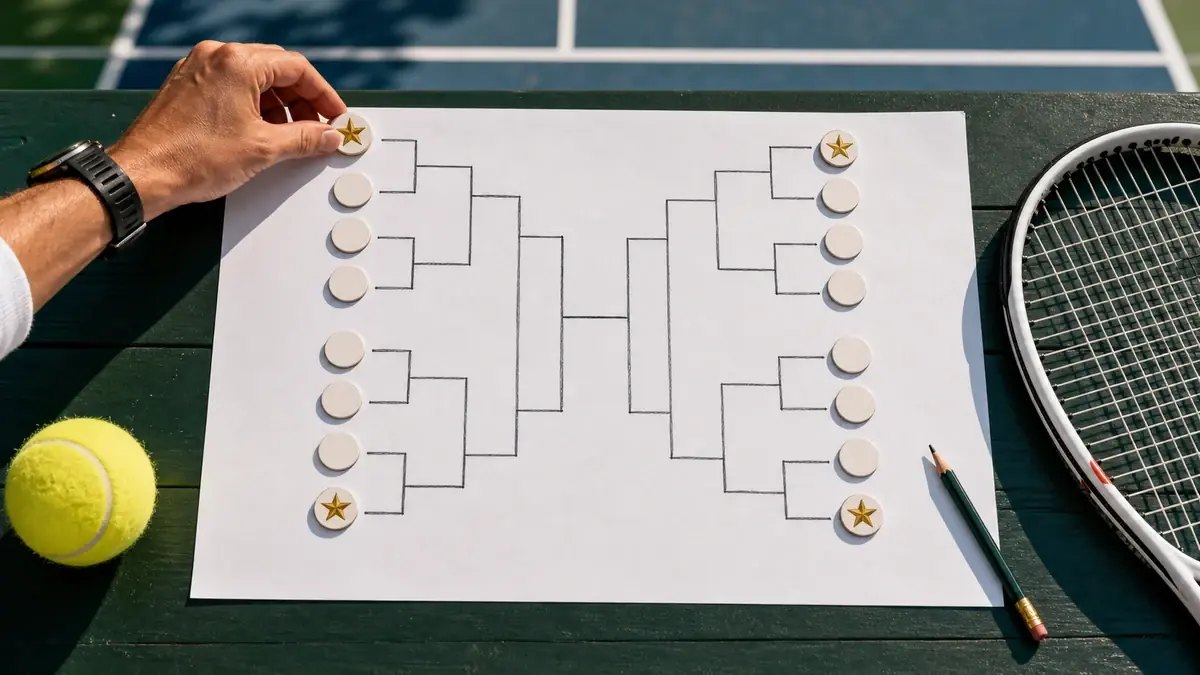
Seeding in tennis places the highest-ranked players at fixed points in the draw so they cannot meet until the later rounds. The world number one becomes the number one seed, the number two ranked player becomes the second seed, and so on down the list. The draw is then arranged to spread those seeds as far apart as possible, keeping the marquee matchups for the quarter-finals, semis and final rather than letting two top players collide in round one.
What is seeding in tennis?
A tennis draw is a bracket. Without seeding, names would be pulled at random and the world’s two best players could meet in the first match. Seeding stops that. It reserves numbered slots for the strongest entrants and positions them so they only run into each other deep in the event.
The purpose is twofold: reward the players who earned a high ranking, and protect the tournament’s biggest matchups for when they matter most. A first-round clash between the top two seeds would be a waste for everyone, so the system pushes their earliest possible meeting all the way to the final.
Seeding does not change how anyone plays. It only decides where in the bracket they start, and who they can and cannot face round by round.
How are tennis seeds determined?
Seeds come straight from the official rankings. The men’s draw uses the ATP rankings and the women’s draw uses the WTA rankings, each frozen at a cut-off date roughly a week before the tournament starts. Players are then seeded in that ranking order: the highest-ranked entrant is the top seed, the next is the second seed, and the list runs down from there.
One detail trips people up: seeds follow ranking among the players who actually entered, not the global ranking in isolation. If the world number three skips an event, the number four ranked entrant becomes the third seed. The seed number tracks position in the field, not the raw ranking number.
Grand Slams now base their singles seedings on the applicable official rankings for both draws. Wimbledon was the notable exception: for years it used a formula that adjusted the men’s seeds to reward recent grass-court results, so a strong grass player could be seeded above their ranking. Wimbledon dropped that formula in 2021. Each Grand Slam still remains the final authority on its own seed selection and any ties, but in practice all four now follow ranking order.
How many seeds are there at a Grand Slam?
Grand Slam singles draws hold 128 players, and 32 of them are seeded, in both the men’s and women’s events. So a quarter of the field carries a seed. The other 96 are unseeded, including qualifiers and wildcards, and they fill the gaps between the protected slots.
Smaller tournaments seed fewer players, scaled to draw size. Here is the usual pattern.
| Draw size | Typical seeds | Example events |
|---|---|---|
| 128 | 32 | Grand Slams (Wimbledon, US Open) |
| 96 | 32 | Larger Masters 1000 / WTA 1000 |
| 56–64 | 16 | Many tour-level 500 and 1000 events |
| 32 | 8 | Smaller ATP/WTA tour stops |
| 16 | 4 | Compact draws and some finals events |
Many conventional draws seed roughly a quarter of the field, though it is not a fixed ratio: a 96-player event commonly uses 32 seeds, which is closer to one in three. The point is to keep enough top players protected that the marquee names survive to the second week.
What does being the number 1 seed actually guarantee?
Less than most people expect. The top seed is placed at the head of the draw and is graded away from the other seeds: no other seed in round one, no top-eight seed before the quarter-finals, and no top-four seed before the semi-finals. Crucially, though, the number one seed is not guaranteed to face the number two seed in the final. The top two seeds are simply placed in opposite halves so they cannot meet before the final — but the number one’s final opponent is whoever emerges from the other half, which can be the second seed, another seed, or an unseeded player.
The graded protection works by seed group. In a 128-player Grand Slam draw, the earliest round in which each group can meet the number one seed looks like this:
| Seed / group | Earliest possible meeting with the No. 1 seed |
|---|---|
| No. 2 seed | Final |
| Seeds 3–4 | Semi-final |
| Seeds 5–8 | Quarter-final |
| Seeds 9–16 | Fourth round |
| Seeds 17–32 | Third round |
| Unseeded player | First round |
What the top seed does not get is an easy path. At a Grand Slam there is no first-round bye, so the top seed still opens against a full opponent, sometimes a dangerous unseeded player or an in-form qualifier. Seeding shields you from other seeds, not from everyone. Plenty of number one seeds have lost early to an unseeded opponent who simply played the match of their life.
Can a lower-ranked player be seeded higher than their ranking?
Yes, and it happens most tournaments. If higher-ranked players withdraw before the seed cut-off, everyone beneath them slides up a place. A player ranked tenth can end up as the eighth seed if two players above them skip the event. The seed reflects the field that turned up, not the abstract ranking table.
Withdrawals after the draw is made are handled by timing, and this is where people often get it wrong. At a Grand Slam, if a seed withdraws after the draw but before the order of play for the first day is released, the seeds below can still be moved up according to the Grand Slam replacement rules — for example, the fifth seed can be shifted into a vacated top-four seed position. Once the first day’s order of play has been published, that window closes: a later vacancy is filled by an eligible lucky loser instead, without reshuffling the seeds. So “seeds are fixed once the draw is out” is only half true — the real cut-off is the first order of play, and procedures can differ outside the majors.
If you are still getting comfortable with how a match itself is scored, our guide to how many sets there are in tennis pairs well with this one, and what a grand slam actually means explains why these four events carry the deepest seeding of all.
Why seeding matters to how you watch
Once you understand seeds, a draw sheet reads differently. You can look at a bracket on day one and trace the collision course: which two seeds are set to meet in the quarters, which quarter looks brutal, which top seed got a kind draw. Half the drama of the first week is watching whether the seeds hold or an unseeded run blows the bracket open.
That is the quiet payoff of the system. Seeding does not decide who wins, but it shapes the story of the whole fortnight, and knowing how it works lets you read that story from the opening round.
Frequently asked questions
Are a player's seed and their ranking the same thing?+
No. A ranking is a player's global position on the ATP or WTA list. A seed is their position among the players who actually entered a given tournament. If higher-ranked players skip the event, a lower-ranked entrant moves up, so a world number ten can be the eighth seed. The seed tracks the field that turned up, not the ranking table.
Can two seeded players meet in the first round?+
No. The whole point of seeding is to keep seeds apart early, so no two seeds can be drawn against each other in round one. The earliest any seed can face the top seed is the third round (for seeds 17–32); the number two seed cannot meet the number one until the final.
What happens if a seeded player withdraws after the draw?+
It depends on timing. At a Grand Slam, if a seed withdraws after the draw but before the first day's order of play is released, the seeds below can be moved up under the replacement rules. Once that order of play is published, a later vacancy is filled by an eligible lucky loser instead, without reshuffling the seeds.
Are qualifiers or wildcards ever seeded?+
Rarely. Seeds go to the highest-ranked players in the main draw, and qualifiers and wildcards are usually ranked well below the seed cut-off, so they enter unseeded. In theory a very high-ranked player who had to take a wildcard could still be seeded, but in normal draws qualifiers and wildcards fill the unseeded slots.
Do doubles tournaments use the same seeding system?+
The principle is the same — top teams are seeded and spread across the draw — but doubles seeds are set from the doubles rankings (often a team's combined or individual doubles ranking), not the singles list, and doubles draws are smaller, so far fewer teams are seeded.
Why do Grand Slams seed exactly 32 players?+
With a 128-player draw, 32 seeds is enough to protect the top eighth of the field while leaving 96 slots for everyone else, including qualifiers and wildcards. Before 2019, Grand Slams used 32 seeds too; the number balances protecting marquee names against still giving unseeded players a real path deep into the event.
Sources
Play & tools
Free browser games and tools — no account, no download.
- Play today's Sports Connections — Today's Sports Connections — daily hints, answers, and play the grid.
- Play Guess the NFL Player — A new mystery NFL player every day. Eight guesses, with a clue on each — plus free unlimited mode.
- Explore all our games →
Related tennis guides
View all →
How Does a Tiebreak Work in Tennis?
A tennis tiebreak decides a set locked at 6-6. First to 7 points wins, but you must lead by two. Here's scoring, serving order, and when tiebreaks happen.
How Does Tennis Scoring Work? Points, Games, Sets Explained
Tennis scoring runs 15, 30, 40, game; games build into sets and sets into a match. See a clear breakdown of how tennis scoring works at every level.
Why Do Tennis Players Change Ends?
Tennis players change ends to keep conditions fair when sun, wind, court wear and other environmental factors affect play.
What Is a Bagel in Tennis? 6-0 Sets Explained
A bagel in tennis means winning a set 6-0. Learn the term's origin, what a double bagel and golden set are, and how rare each one is.
Fault vs Double Fault in Tennis: What's the Difference?
A fault is one missed serve; a double fault is two in a row, which hands the point to your opponent. Here's exactly how serving faults work.
What Is a Let in Tennis? Rules and When It's Replayed
A let in tennis replays a serve or point. Learn when it applies, how first and second serves restart, and when a net cord stays live.