
How Does a Tiebreak Work in Tennis?
On this page5
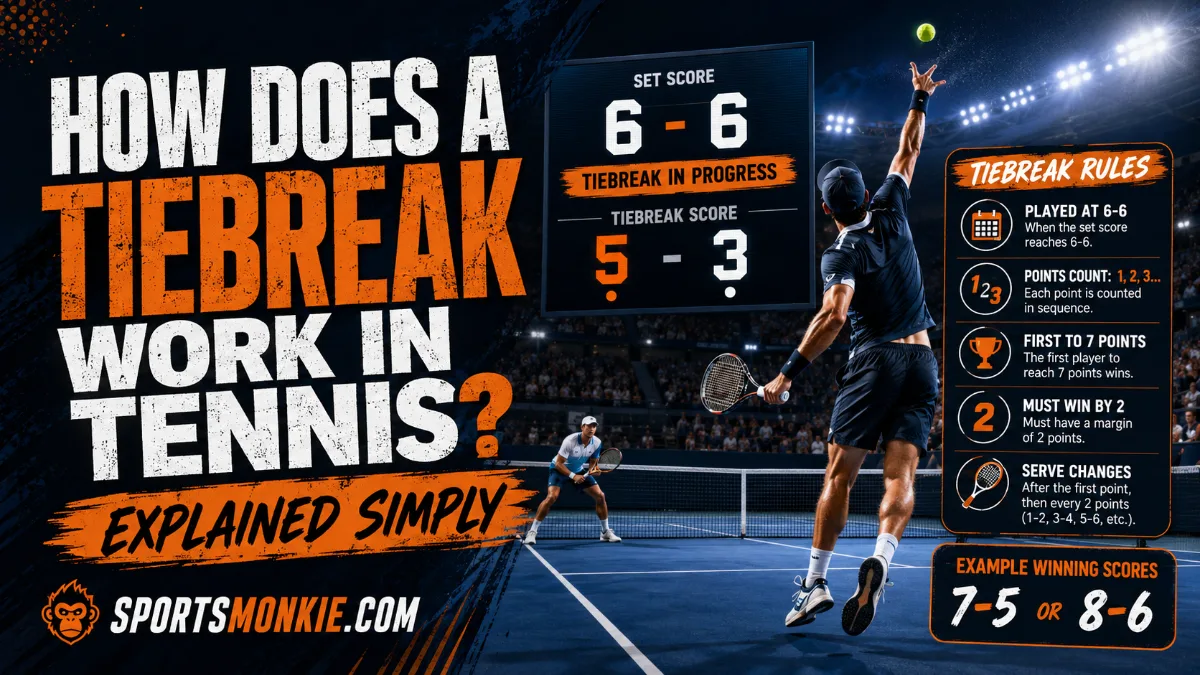
A tiebreak decides a set locked at 6-6. The first player to 7 points wins, provided they lead by two, so it can end 7-3 or 7-5 but continues past 6-6 until someone opens a two-point gap. The player due to serve takes the first point alone, then service alternates every two points, and the players change ends every six points. The set is recorded as 7-6.
Tennis sets can, in theory, run forever, since you normally have to win a set by two clear games. The tiebreak exists to stop that.
When a tiebreak happens
A standard tiebreak is triggered when a set reaches 6-6. Instead of playing on to 8-6, 9-7 and beyond, the two players contest a single tiebreak game. Whoever wins it takes the set 7-6.
The scoring
The tiebreak is scored in plain numbers, not the usual 15-30-40. The rules are simple:
- First player to 7 points wins the tiebreak.
- You must win by a margin of two.
So a tiebreak can finish 7-3 or 7-5. But if it reaches 6-6, it keeps going until someone leads by two: 8-6, 9-7, 11-9, and so on. Long tiebreaks happen when neither player can build a two-point cushion.
Who serves, and when players switch ends
Serving in a tiebreak follows a set pattern:
| Point(s) | Server |
|---|---|
| Point 1 | The player due to serve next serves one point |
| Points 2-3 | The other player serves two points |
| Then | Service keeps alternating every two points |
Players also change ends every six points during the tiebreak, to keep any advantage from sun or wind fair.
Match tiebreaks and final-set tiebreaks
Not every tiebreak stops at seven. A longer 10-point tiebreak (first to 10, win by two) is widely used to decide a final set or, in doubles, to replace a whole third set. As of 2026, the four Grand Slams use a 10-point tiebreak at 6-6 in the deciding set, giving a consistent way to end the longest matches.
Where the tiebreak came from
The tiebreak is younger than most fans assume, and it was one man’s crusade. Jimmy Van Alen, an American promoter, spent years pushing scoring reforms that the tennis establishment found vulgar, and the tiebreak was the one that stuck. The US Open adopted it in 1970, initially in a brutal sudden-death nine-point format where one point decided the set at 4-4.
The reason it was needed is simple arithmetic. Requiring a two-game margin means a set has no ceiling, and matches routinely ran past any broadcast window. Wimbledon held out longest on the final set, using an advantage set until 2019, which is how Isner and Mahut ended up playing a 70-68 fifth set over three days in 2010. That match, more than any argument, ended the debate.
The idea behind every version is the same: a fast, fair way to break a deadlock so a set, or a whole match, doesn’t run on without end.
If you found this useful, our breakdown of What Is a Match Point in Tennis? Rules Explained covers related ground.
Frequently asked questions
How many points do you need to win a tiebreak?+
You need at least seven points to win a standard tiebreak, and you must win by a margin of two. So a tiebreak can end 7-5, but if it reaches 6-6 it continues until one player leads by two, for example 8-6 or 10-8. There is no upper limit.
Who serves first in a tiebreak?+
The player whose turn it is to serve next serves the first point of the tiebreak. After that single point, service alternates every two points. The pattern means each player serves one point from each end before the change, keeping the serve advantage balanced.
When is a tiebreak played?+
A tiebreak is played when a set reaches six games all. It settles the set instead of playing on until someone leads by two games, and the set is recorded as 7-6. All four Grand Slams now also use a 10-point tiebreak at 6-6 in the deciding set.
Do you change ends during a tiebreak?+
Yes, every six points, so after points 6, 12, 18 and so on. The change stops either player being stuck facing the sun or into the wind for the whole tiebreak. Players do not sit down at these changeovers, unlike normal end changes between games.
What is a match tiebreak or super tiebreak?+
A first-to-10 tiebreak, win by two, played instead of a full deciding set. It is standard in doubles on the ATP and WTA tours and common in college and recreational tennis. Since 2022 all four Grand Slams use a 10-point tiebreak at 6-6 in the final set.
Why was the tiebreak invented?+
To stop sets running indefinitely. American Jimmy Van Alen devised it in the 1960s, and the US Open adopted it in 1970. Before that, a set could only end on a two-game margin, producing marathon matches that broke broadcast schedules and exhausted players.
Sources
Play & tools
Free browser games and tools — no account, no download.
- Play today's Sports Connections — Today's Sports Connections — daily hints, answers, and play the grid.
- Play Guess the NFL Player — A new mystery NFL player every day. Eight guesses, with a clue on each — plus free unlimited mode.
- Explore all our games →
Related tennis guides
View all →
How Does Tennis Scoring Work? Points, Games, Sets Explained
Tennis scoring runs 15, 30, 40, game; games build into sets and sets into a match. See a clear breakdown of how tennis scoring works at every level.
What Is a Break Point in Tennis?
A break point is a point that, if won by the returner, wins the game against the server. Here is what it means, why it matters so much, and related terms.

What Is Deuce in Tennis? Scoring Rules Fully Explained
Deuce in tennis is the 40-40 score where both players are tied and one must win two straight points to win the game. It repeats until someone leads by two.
Why Do Tennis Players Change Ends?
Tennis players change ends to keep conditions fair when sun, wind, court wear and other environmental factors affect play.

What Is a Walkover in Tennis? Rules and Examples
A walkover in tennis happens when a player wins without playing because the opponent withdraws before the match starts. It differs from a retirement.

What Does Ad Mean in Tennis? Advantage Scoring Explained
Ad in tennis means advantage, the point after deuce when one player needs one more to win. Win it to take the game; lose it and the score returns to deuce.