
What Is a Bagel in Tennis? 6-0 Sets Explained
On this page7
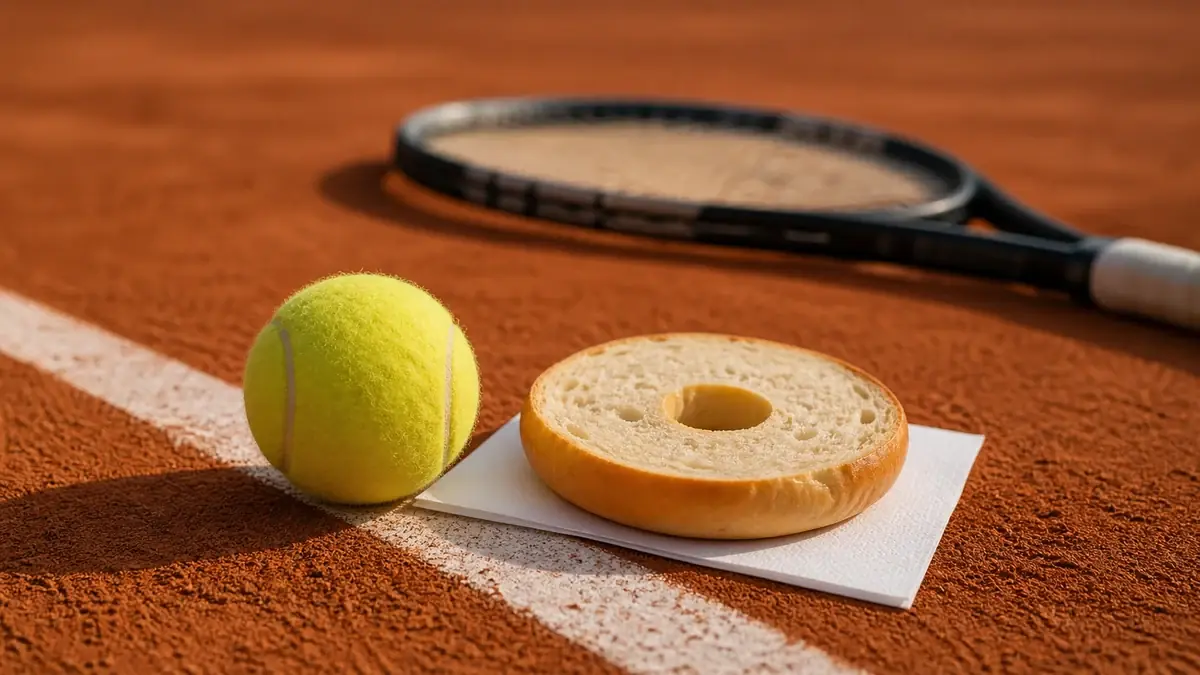
A bagel in tennis means winning a set 6-0, with your opponent taking no games at all. The word is slang: the zero on the scoreboard looks like a round bagel, so a shutout set became “a bagel.” Win both sets 6-0 and you have handed out a “double bagel.” Win a set 6-0 without losing even a single point, and you have done something far rarer called a golden set. None of these appear in the rulebook, but you will hear all three from commentators every tournament.
What does a bagel mean in tennis?
To win a set in tennis you need six games with a two-game margin, so scores like 6-0, 6-1, 6-3 and 6-4 all close out a set. A 6-0 set is the cleanest version: the loser never reaches the board. That whitewash is the bagel.
The official scoring rules from the ITF only ever record the number, 6-0. “Bagel” is what the tennis world layers on top. It is affectionate and a little brutal at once, the kind of word a player uses about a win and a coach avoids about a loss.
One thing worth clearing up: a bagel is about games, not points or sets. A 6-0 set is a bagel even if several games went to deuce and lasted ten minutes each. The loser simply never converted a game. That distinction matters when you get to the golden set below, which is about points.
Where does the word bagel come from?
The visual is the whole joke. A zero is a circle with a hole in the middle, and so is a bagel. Once you see it on a scoreboard the nickname writes itself.
Credit for the tennis usage usually goes to American players Eddie Dibbs and Harold Solomon on the 1970s tour, with the broadcaster Bud Collins doing the most to push it into mainstream commentary. Collins had a gift for tennis slang, and “bagel” stuck in a way most invented terms never do. Decades later it is understood everywhere the sport is watched, from Melbourne to Wimbledon.
What is a double bagel?
A double bagel is a match won 6-0, 6-0. The loser takes no games in either set. In a best-of-three format that finishes the match in two sets, so a double bagel is the most lopsided completed scoreline you will see short of a retirement.
At the professional level a double bagel is genuinely rare, because even an overmatched player usually holds serve once across two sets. It happens more often in mismatches: a top seed against a lucky loser in a first round, or a wildcard entrant out of their depth. When it does happen it makes headlines precisely because holding even one game is normally within reach for anyone ranked inside the top few hundred.
Bagel, double bagel, golden set: how they compare
These three terms get muddled, so here is the clean version. The key is what unit each one counts.
| Term | Score | What the loser wins | How rare |
|---|---|---|---|
| Bagel | 6-0 (one set) | No games in that set | Fairly common, especially early rounds |
| Double bagel | 6-0, 6-0 (match) | No games in the whole match | Rare at pro level |
| Golden set | 6-0 with no points lost | Not a single point | Exceptional, a handful ever |
| Breadstick | 6-1 (one set) | One game | Common; a near-bagel |
A “breadstick” is the sibling term worth knowing. A 6-1 set is a breadstick, the numeral 1 standing in for the thin bread. So a match won 6-0, 6-1 is a “bagel and a breadstick.” Tennis slang has a full bakery once you start looking.
What is a golden set, and how rare is it?
A golden set raises the bar from games to points. It is a 6-0 set in which the winner loses no points at all: six games, four points each, 24 straight points. Not one rally goes the other way.
This is a completely different level of dominance from an ordinary bagel. A normal 6-0 set can still contain long deuce games and lost points; the loser just never closes a game. A golden set demands perfection across every serve and return for the length of a set.
The most famous example in the women’s game is Yaroslava Shvedova, who won a golden set against Sara Errani at Wimbledon in 2012, the first ever recorded in a Grand Slam main draw. On the men’s side the golden set is just as scarce. These are the moments that get replayed, because winning 24 points in a row against a professional is close to a statistical fluke even for the best players.
If you want to see how a golden set is even possible, it helps to understand how tennis scoring works point by point, since the golden set is really a scoring quirk taken to its logical extreme.
Is getting bageled a disgrace?
Not really, and the pros will tell you so. A bagel says more about how well one player served and returned on the day than about the loser being hopeless. Conditions, a bad matchup, a slow start after a rain delay, or simply running into someone in red-hot form can all produce a 6-0 set against a very good player.
You will see former Grand Slam champions drop the occasional bagel set and win the match anyway. The scoreline looks damning in isolation, but a single lopsided set inside a three-set win is forgotten by the trophy ceremony. It stings, it does not define anyone.
Curious about other pieces of the on-court vocabulary? Our tennis glossary covers the terms that confuse newcomers, from what deuce means to why a let is replayed. Start there if a commentator ever leaves you guessing mid-match.
The bottom line on bagels
A bagel is the friendliest-sounding way to describe a brutal 6-0 set. Double it for a 6-0, 6-0 match, and reserve “golden set” for the near-impossible feat of winning without dropping a point. It is slang, not law, but it is slang the entire sport speaks, and knowing it turns a confusing scoreline into an instant read on how one-sided a set really was.
This connects to another question fans ask a lot: Best Tennis Academies in the World.
We dig into a related angle in How Tall Is a Tennis Net? Official Height and Dimensions.
If that interests you, Tennis Shoes for Teens is a good next stop.
Frequently asked questions
What does a bagel mean in tennis?+
A bagel means winning a set 6-0, with the loser taking no games. The name comes from the zero on the scoreboard resembling a bagel's round shape. It is informal slang, not an official term, but commentators and players use it constantly to describe a whitewash set.
What is a double bagel in tennis?+
A double bagel is a match won 6-0, 6-0, meaning the loser fails to win a single game across two full sets. In a best-of-three match that ends the contest. It signals total domination and is uncommon at professional level, where even outmatched players usually hold serve once or twice.
What is a golden set in tennis?+
A golden set is a 6-0 set won without losing a single point, all 24 points in a row. It is far rarer than a normal bagel. Yaroslava Shvedova famously won a golden set against Sara Errani at Wimbledon in 2012, the first ever recorded at a Grand Slam.
Is a bagel an official tennis term?+
No. Bagel is slang with no place in the official rulebook, which simply records the score as 6-0. The term was coined by American players in the 1970s and popularised by commentator Bud Collins. Umpires and scoreboards never say bagel; broadcasters and fans do.
How rare is a bagel in professional tennis?+
Single 6-0 sets happen regularly, especially in early Grand Slam rounds where top seeds face qualifiers. A whole match without conceding a game is much rarer, and a golden set is exceptional, recorded only a handful of times in professional history across the men's and women's tours.
Where does the word bagel come from in tennis?+
The zero in a 6-0 scoreline looks like a bagel, a round bread roll with a hole. American players Eddie Dibbs and Harold Solomon are credited with the tennis usage in the 1970s, and broadcaster Bud Collins spread it to a wider audience through his commentary and writing.
Sources
Play & tools
Free browser games and tools — no account, no download.
- Play today's Sports Connections — Today's Sports Connections — daily hints, answers, and play the grid.
- Play Guess the NFL Player — A new mystery NFL player every day. Eight guesses, with a clue on each — plus free unlimited mode.
- Explore all our games →
Related tennis guides
View all →
What Is a Golden Set in Tennis? The 24-Point Perfect Set
A golden set is a tennis set won without dropping a single point, requiring 24 consecutive points in a standard six-games-to-love set.
How Many Sets Are There in Tennis? A Complete Guide
Most pro tennis matches are best-of-three sets, so the first to win two sets wins. Grand Slam men's singles use best-of-five, needing three sets to win.
How Does Tennis Scoring Work? Points, Games, Sets Explained
Tennis scoring runs 15, 30, 40, game; games build into sets and sets into a match. See a clear breakdown of how tennis scoring works at every level.
Why Do Tennis Players Change Ends?
Tennis players change ends to keep conditions fair when sun, wind, court wear and other environmental factors affect play.
What Is Seeding in Tennis? How Seeds Work
Seeding in tennis ranks top players in a draw so they avoid each other early. Learn how seeds are set, why there are 32, and what a seed guarantees.
Fault vs Double Fault in Tennis: What's the Difference?
A fault is one missed serve; a double fault is two in a row, which hands the point to your opponent. Here's exactly how serving faults work.