
Rugby Positions Explained: All 15
On this page5
A rugby union team fields 15 players, divided into 8 forwards (shirt numbers 1 to 8) and 7 backs (numbers 9 to 15). The forwards are the bigger, stronger players who win the ball in the set-piece and at the breakdown, while the backs are the faster, more elusive players who move the ball and score most of the tries.
The beauty of rugby’s numbering is that it tells you exactly what each player does. Once you learn the numbers, you can read the whole field at a glance. Here is every position, grouped by unit, with the job each one is built to do.
The two units: forwards and backs
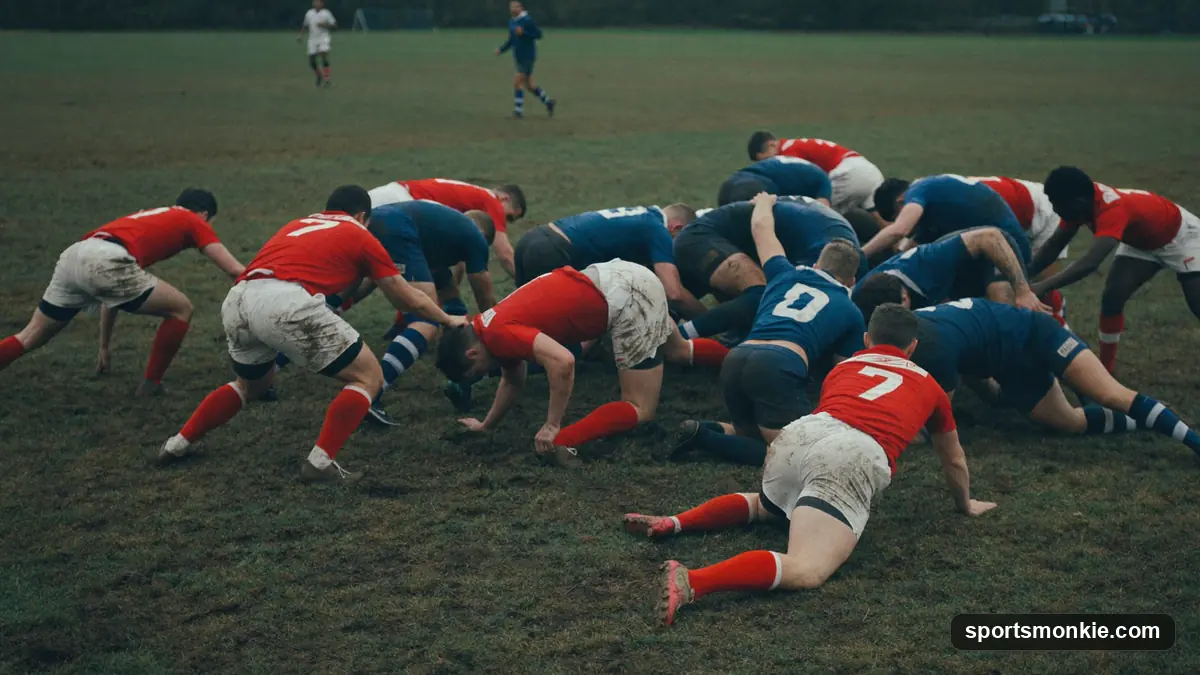
Everything in rugby positional play flows from one split. The forwards (1 to 8) are the “engine room”, heavier players who contest possession in scrums, lineouts, rucks and mauls. The backs (9 to 15) are generally lighter and quicker, tasked with turning that possession into territory and points.
| No. | Position | Unit |
|---|---|---|
| 1 | Loosehead prop | Forwards |
| 2 | Hooker | Forwards |
| 3 | Tighthead prop | Forwards |
| 4 & 5 | Locks (second row) | Forwards |
| 6 | Blindside flanker | Forwards |
| 7 | Openside flanker | Forwards |
| 8 | Number 8 | Forwards |
| 9 | Scrum-half | Backs |
| 10 | Fly-half | Backs |
| 11 | Left wing | Backs |
| 12 | Inside centre | Backs |
| 13 | Outside centre | Backs |
| 14 | Right wing | Backs |
| 15 | Fullback | Backs |
The table is the map. From here, it is just a matter of understanding what each group is trying to achieve.
The forwards (1–8): winning the ball
Front row: props and hooker (1, 2, 3)
The two props (1 and 3) and the hooker (2) make up the front row and take the full force of the scrum. The loosehead prop (1) and tighthead prop (3) are among the strongest athletes on the field, holding the scrum steady, while the hooker (2) “hooks” the ball back with his foot and usually throws the ball into the lineout. These are the most physically punishing jobs in the game.
Second row: the locks (4, 5)
The two locks, or second-rowers, are typically the tallest players on the team. They provide the power push in the scrum and are the primary targets in the lineout, lifted into the air to catch the throw. Height, strength and stamina define them.
Back row: flankers and number 8 (6, 7, 8)
The back row is the most mobile part of the pack. The blindside flanker (6) and openside flanker (7) are relentless tacklers and breakdown specialists, with the openside in particular hunting to win turnovers. The number 8 binds at the back of the scrum, carries the ball powerfully and links the forwards to the backs. They are forwards with more of a ball-carrying, roaming brief.
The backs (9–15): using the ball
Halfbacks: scrum-half and fly-half (9, 10)
The scrum-half (9) is the link between forwards and backs, feeding the ball out of scrums and rucks with quick, accurate passes. The fly-half (10) is the tactical director, the player who decides whether to pass, kick or run, and often handles the goal-kicking. Many coaches consider the fly-half the most important decision-maker on the field.
Centres: inside and outside (12, 13)
The inside centre (12) and outside centre (13) combine power and pace in midfield. They break the defensive line, create space for the players outside them, and are crucial tacklers in defense. The 12 is often a strong ball-carrier and distributor; the 13 tends to be quicker and more elusive.
Back three: wings and fullback (11, 14, 15)
The wings (11 and 14) are the team’s fastest players, positioned on the edges to finish moves and score tries. The fullback (15) is the last line of defense, fielding kicks, launching counterattacks and covering the space behind the defensive line. Speed, safe hands under a high ball and reliable tackling define this back three.
How to read a game using the numbers
Because the numbers are standardized, you can instantly tell a forward from a back and even guess a player’s build from his shirt. Big body in the 1–8 range? A forward doing the heavy lifting. A slighter, sprinting player wearing 11 or 14? A wing chasing a try. This shorthand is one of the things that makes rugby easy to follow once you know the code.
If you are new to the sport, the positions make more sense alongside the flow of a match, our guide to how long a rugby match lasts sets the tempo, and what a knock-on is in rugby explains one of the most common stoppages. For a fascinating comparison of roles, rugby versus American football shows how two collision sports divide labor very differently, and rugby union versus rugby league explains why the two rugby codes field different numbers of players.
The short version
A rugby union team has 15 positions: 8 forwards (numbers 1 to 8) who win the ball in scrums, lineouts and rucks, and 7 backs (numbers 9 to 15) who move it and score. The front row and locks provide power, the back row adds mobility, the halfbacks link play, the centres break the line, and the wings and fullback supply the pace and finishing.
Frequently asked questions
How many positions are there in rugby union?+
Rugby union has 15 positions, one for each player on the field, numbered 1 through 15. They divide into 8 forwards (numbers 1 to 8) and 7 backs (numbers 9 to 15). The forwards are the heavier players who contest the ball in scrums, lineouts and rucks, while the backs are the faster, more elusive players who move the ball and score most of the tries. Each number maps to a specific role.
What's the hardest position to play in rugby?+
Opinions differ, but many players and coaches point to the front row, especially the props and hooker, as the most physically punishing, because those players absorb enormous forces in every scrum. Others argue the fly-half (number 10) is the hardest mentally, since he directs the attack, makes the key decisions and must kick, pass and tackle under constant pressure. There is no single answer: the front row is the toughest physically, the fly-half the most demanding tactically.
What is the difference between forwards and backs?+
Forwards wear numbers 1 to 8 and are typically the bigger, stronger players whose job is to win possession, in scrums, lineouts, rucks and mauls, and to carry the ball into contact. Backs wear numbers 9 to 15 and are usually faster and more agile, responsible for moving the ball wide, creating space and finishing off attacks with tries. In simple terms, forwards win the ball and backs use it, though modern rugby blurs the line and asks everyone to do a bit of both.
Which rugby position is the fastest?+
The wings (numbers 11 and 14) are generally the fastest players on a rugby team. They play out on the edges of the field, where their main job is to finish attacking moves and score tries in space, so raw speed is their defining trait. The fullback (number 15) and outside centre are usually quick too, but the wings are the recognised speedsters, picked largely for their pace and finishing ability.
Sources
Play & tools
Free browser games and tools — no account, no download.
- Play today's Sports Connections — Today's Sports Connections — daily hints, answers, and play the grid.
- Play Guess the NFL Player — A new mystery NFL player every day. Eight guesses, with a clue on each — plus free unlimited mode.
- Explore all our games →
Related guides
What Is a Scrum in Rugby?
A scrum restarts play after a minor infringement: 8 forwards from each team bind together and push for the ball. How it works and why, explained clearly.
How Many Points Is a Try in Rugby?
A try in rugby union is worth 5 points, plus a 2-point conversion kick. All the ways to score in rugby, with a full points breakdown, explained clearly.
Rugby Union vs Rugby League
Rugby union has 15 players and contests possession at rucks; rugby league has 13 and uses a six-tackle set. The key differences between the two codes.
How Long Is a Rugby Match? Real Length
A rugby match is 80 minutes of play, two 40-minute halves plus a halftime break. With stoppages the real elapsed time is usually about 100 minutes.
Rugby World Cup 2027: Australia, Format
The 2027 Rugby World Cup is in Australia and, for the first time, features 24 teams in a new format. Host, dates, past winners and qualification.
Best Female Rugby Players of All Time: Union & Sevens
The best female rugby players ranked across Rugby Union and Sevens, from Portia Woodman-Wickliffe's try record to Emily Scarratt, Sarah Hunter and Ellie Kildunne.