
What Is a Knock-On in Rugby? Rule Explained
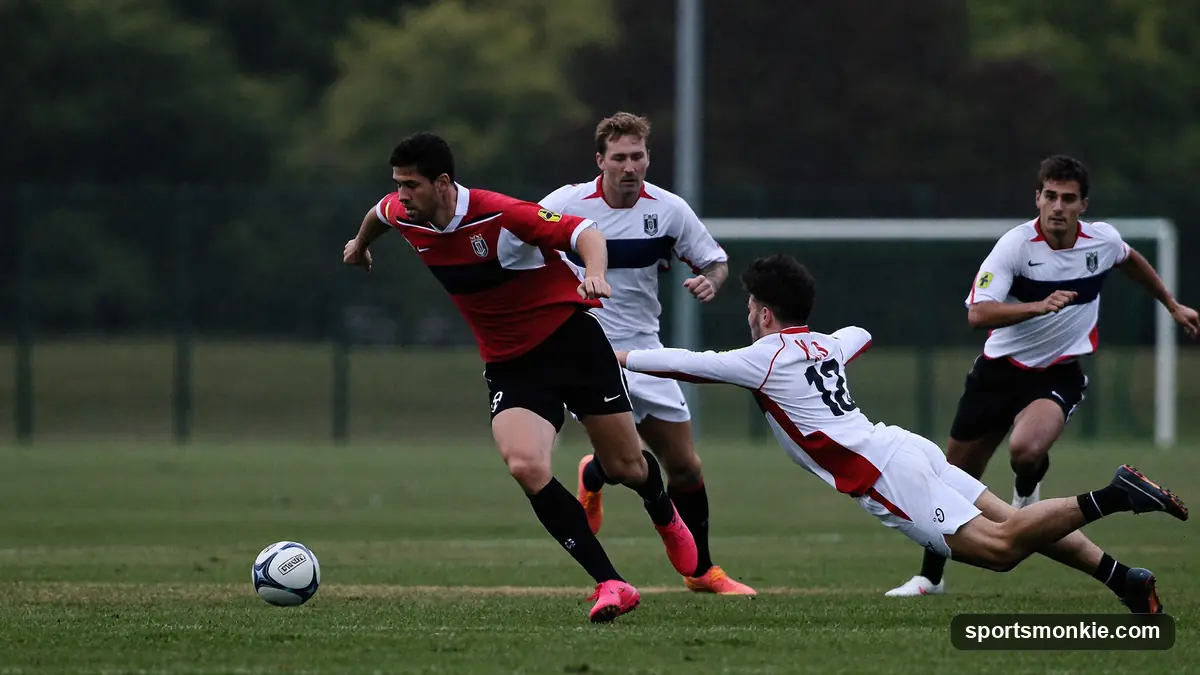
On this page6
A knock-on in rugby is when a player loses possession of the ball and it goes forward, toward the opponent’s dead-ball line, off their hand or arm, then touches the ground or another player before being recovered. In plain terms, it is a fumble that travels the wrong way.
It is one of the most frequent stoppages in the sport, and it trips up newcomers because “forward” in rugby has a specific meaning and because it is easily confused with a forward pass. Here is exactly what counts as a knock-on, what does not, how it differs from a throw-forward, and what happens next.
The definition, precisely
Under World Rugby’s Laws of the Game, a knock-on occurs when a player, in the act of playing the ball, loses possession of it and it goes forward, or when a player hits the ball forward with the hand or arm, and the ball then touches the ground or another player before the original player can regather it.
Two parts of that definition matter most:
- “Forward” means toward the opponents’ dead-ball line. Losing the ball backward is not a knock-on, which is why players are coached to always drop or spill the ball behind them if they must lose it.
- The ball must touch the ground or another player. If you fumble the ball forward but catch it yourself before it touches anything, it is not a knock-on.
That second point surprises many fans: a player can juggle the ball forward and stay legal, as long as they gather it before it hits the ground or an opponent.
Knock-on vs forward pass vs charge-down
Because these situations look similar in real time, it helps to separate them clearly.
| Situation | What happens | Is it an offence? | Typical sanction |
|---|---|---|---|
| Knock-on | Ball lost forward off hand/arm, hits ground or player | Yes (if accidental) | Scrum to opposition |
| Throw-forward (forward pass) | Ball deliberately passed/thrown forward | Yes | Scrum to opposition |
| Charge-down | Ball blocked off an opponent’s kick | No | Play continues |
| Deliberate knock-on | Player intentionally slaps ball forward | Yes | Penalty, possible card |
The charge-down is the key exception people forget: if you block an opponent’s kick with your hands or body and the ball goes forward off you, that is not a knock-on, and play carries on. It is treated as a legitimate defensive act rather than a loss of possession.
What happens after a knock-on
For an ordinary, accidental knock-on, the referee stops play and awards a scrum to the non-offending team at the spot of the infringement, and that team feeds the ball into the scrum. This is the single most common way scrums originate in a match.
But the scrum is not automatic. If the team that did not knock on gains an advantage from the loose ball, perhaps they scoop it up and break away, the referee will play advantage and let the game continue rather than stopping it for a scrum. Only if no advantage materialises does play come back for the scrum. Understanding these stoppages helps explain why a match runs the way it does, something our guide to how long a rugby match is puts in context.
Accidental vs deliberate
The sanction changes sharply if a knock-on is deliberate. If a player intentionally knocks or slaps the ball forward, to disrupt the opposition or kill an attack, it is treated as foul play rather than a simple error. The referee awards a penalty kick, not a scrum, and if the deliberate knock-on denied the other team a probable try, the offending player can be shown a yellow card and sent to the sin bin.
This distinction matters because a deliberate knock-on is often a cynical attempt to stop a promising move, so the laws punish it much more firmly than an honest fumble.
Knock-ons in league vs union
It is worth noting that the two main codes of rugby handle a knock-on slightly differently. In rugby union, the sanction for an accidental knock-on is a scrum, as described above. In rugby league, an accidental knock-on also results in a scrum, but the codes differ in how their scrums work and how often they occur, since league’s overall structure around possession is built on a set number of tackles rather than the contest for the ball that defines union.
What stays constant across both codes is the core definition: losing the ball forward off the hand or arm so that it touches the ground or another player. The “forward” direction and the hand-or-arm requirement are the same, and in both codes a deliberate knock-on is treated as a more serious, penalisable act rather than a routine error. So while the downstream mechanics vary, the offence itself is recognisable in any rugby match.
Why knock-ons matter so much
Handling errors decide rugby matches. Because the ball must be passed backward and controlled under heavy contact, ball security is a core skill, and a knock-on hands momentum and possession straight to the opposition via the scrum. Teams that minimise knock-ons keep the ball alive, string phases together and wear defences down.
For anyone coming to the sport from gridiron, the ball-handling rules are one of the biggest adjustments, a contrast our rugby vs American football comparison explores in detail. And ball security under pressure is exactly the kind of skill that separates the elite professionals featured in our look at the highest-paid rugby players.
The short version: a knock-on is losing the ball forward off the hand or arm so that it hits the ground or another player. It differs from a forward pass, which is a deliberate throw, and from a legal charge-down. Accidental knock-ons give the opposition a scrum unless advantage is played, while deliberate ones bring a penalty and possibly a card.
Frequently asked questions
What does a knock-on in rugby mean?+
A knock-on means a player has lost the ball forward off their hand or arm, and it has then hit the ground or another player before being regathered. 'Forward' here means toward the opponent's dead-ball line. It is essentially a fumble that goes the wrong way. Dropping the ball backward is not a knock-on, and neither is knocking it forward and catching it again before it touches anything.
What is the difference between a forward pass and a knock-on?+
A forward pass, properly called a throw-forward, is when a player deliberately passes or throws the ball forward toward the opponent's dead-ball line. A knock-on is when a player accidentally loses the ball forward off the hand or arm. The key difference is intent and action: a forward pass is a throw, a knock-on is a fumble or drop. Both are penalised, usually with a scrum to the other team.
What happens after a knock-on?+
For an accidental knock-on, play stops and the opposing team is awarded a scrum at the place of the infringement, with the non-offending team feeding the ball in. However, if the other team gains an advantage from the loose ball, the referee will let play continue rather than stop it. So the immediate outcome is usually a scrum, but only if no advantage is played first.
Is a knock-on always a scrum?+
No. An accidental knock-on normally results in a scrum, but not always. If the non-offending team gains an advantage, the referee plays on instead of awarding the scrum. And a deliberate knock-on, where a player intentionally slaps the ball forward, is a more serious offence punished with a penalty kick rather than a scrum, and can draw a yellow card if it stops a likely try.
Sources
Play & tools
Free browser games and tools — no account, no download.
- Play today's Sports Connections — Today's Sports Connections — daily hints, answers, and play the grid.
- Play Guess the NFL Player — A new mystery NFL player every day. Eight guesses, with a clue on each — plus free unlimited mode.
- Explore all our games →
Related guides
What Is a Scrum in Rugby?
A scrum restarts play after a minor infringement: 8 forwards from each team bind together and push for the ball. How it works and why, explained clearly.
How Long Is a Rugby Match? Real Length
A rugby match is 80 minutes of play, two 40-minute halves plus a halftime break. With stoppages the real elapsed time is usually about 100 minutes.
How Many Points Is a Try in Rugby?
A try in rugby union is worth 5 points, plus a 2-point conversion kick. All the ways to score in rugby, with a full points breakdown, explained clearly.
Rugby Sevens Rules, Explained
Rugby sevens is seven a side on a full-size pitch, two seven-minute halves, under World Rugby's abbreviated laws. Scoring, scrums, cards and how it differs from 15s.
Rugby Union vs Rugby League
Rugby union has 15 players and contests possession at rucks; rugby league has 13 and uses a six-tackle set. The key differences between the two codes.
Rugby World Cup 2027: Australia, Format
The 2027 Rugby World Cup is in Australia and, for the first time, features 24 teams in a new format. Host, dates, past winners and qualification.