
How Long Is a Rugby Match? Real Length

On this page7
A rugby match is 80 minutes of playing time, split into two 40-minute halves with a halftime break in between. Once you add the interval and the stoppages the referee builds into each half, the real elapsed time from kickoff to final whistle is usually around 100 minutes.
That gap between “playing time” and “real time” is the single most useful thing to understand about rugby’s clock. The game is not 80 continuous minutes on your watch, but nor does it run a fixed extra allowance the way soccer does. Here is exactly how the clock works, how long a match really takes, and how the different codes and formats compare.
The 80-minute structure
Standard rugby union, the fifteen-a-side game played in the Six Nations, the Rugby Championship and the World Cup, uses a simple two-half structure.
- Two halves of 40 minutes each, for 80 minutes of playing time.
- A halftime interval of up to 15 minutes, though it is often shorter.
- Teams switch ends at halftime.
The Six Nations, Premiership, United Rugby Championship and every World Cup match all use this same 80-minute format. When people ask how long a Six Nations game is, the answer is identical: 80 minutes of play.
Why the real length is closer to 100 minutes
Rugby’s clock behaves differently from soccer’s. The referee, and the official timekeeper, stop the clock for a range of interruptions.
- Injuries and treatment on the field.
- Television match official (TMO) reviews of tries and foul play.
- Kicks at goal in some competitions.
- Scrums being reset and other lengthy stoppages.
On top of that, a half does not end the instant the clock hits 40:00. Play continues until the ball next becomes dead, so a team trailing late can keep possession and attack past the buzzer until they lose the ball or score. Add the halftime interval to all of this and a televised match typically runs about an hour and 40 minutes, sometimes closer to two hours when there are many reviews.
Match lengths compared
Different rugby formats change the numbers considerably, which is worth knowing before you sit down to watch.
| Format | Playing time | Structure |
|---|---|---|
| Rugby union (standard) | 80 minutes | Two 40-minute halves |
| Rugby league | 80 minutes | Two 40-minute halves |
| Knockout extra time | 20 minutes | Two 10-minute halves |
| Rugby sevens | 14 minutes | Two 7-minute halves |
| Sevens tournament final | 20 minutes | Two 10-minute halves |
Extra time only appears in knockout matches that are level at full time, and even then only in tournaments that cannot end in a draw. Most league and championship games simply finish tied if the scores are level after 80 minutes.
The 20-minute red card and other law updates
Rugby’s laws evolve, and one recent change affects how a match plays out after serious foul play. Under the 20-minute red card, a player sent off for certain offenses can be replaced by a teammate after 20 minutes, so his side is not reduced to fourteen players for the remainder of the game. The offending player is still gone for good; only the numerical gap is restored. World Rugby introduced it to balance player safety with keeping matches competitive, and it has moved from trial toward wider use.
This is the kind of detail that changes the feel of the closing stages, since a red card no longer automatically settles a tight contest.
Rugby time compared with other sports
Rugby’s roughly 100 minutes of real time sits in the middle of the major team sports. A soccer match is 90 minutes of play plus stoppage time, usually running close to two hours in real time. An NFL game has only about 60 minutes on the clock but stretches past three hours because of frequent stoppages, replays and commercials. Rugby, by contrast, keeps play flowing for long stretches, so its 80 minutes of action feels denser than the raw number suggests.
That flow is part of the appeal. Outside of set pieces and the occasional TMO review, the ball is in play a high proportion of the time, and players cannot stop the clock at will. It is one reason a rugby match rarely drags even though the real elapsed time is longer than the 80 minutes on the whistle.
Planning your viewing time
If you are new to the sport and setting aside time to watch, the practical rule is straightforward: budget about two hours from kickoff. That covers the two 40-minute halves, the halftime interval, and the stoppage time that referees add within each half. Knockout matches that could go to extra time need a longer window, since two further 10-minute periods, and in rare cases a kicking competition, can extend the afternoon. For league and championship fixtures, though, a draw is allowed and there is no extra time, so two hours is almost always enough.
Watching the whole occasion
If you are planning your evening around a match, budget roughly two hours from kickoff to leave room for stoppages and the post-match. For the sport’s showpiece and its format, see our guide to the Rugby World Cup 2027 in Australia. And to follow the athletes themselves, browse the best female rugby players and the highest-paid rugby players. The short version: rugby is 80 minutes of play across two 40-minute halves, but the real clock, with halftime and stoppages, runs closer to 100 minutes.
Frequently asked questions
Is rugby 80 or 90 minutes?+
The playing time is 80 minutes, not 90; the 90-minute figure belongs to soccer. Rugby's two halves are 40 minutes each. The confusion comes from real elapsed time, since with the halftime interval and stoppages a rugby broadcast often runs close to an hour and 40 minutes.
What is the 20-minute red card rule in rugby?+
It is a law under which a player shown a red card for certain offenses can be replaced by a teammate after 20 minutes, so the team is not left a man short for the whole game. World Rugby has trialed and adopted it to keep matches competitive while still punishing foul play. The offending player still takes no further part.
Does the clock stop in rugby?+
Yes, more than in soccer. The referee stops the clock for injuries, for the television match official to review incidents and sometimes for kicks at goal. Play at the end of each half also continues past the 40-minute mark until the ball becomes dead, so a half rarely ends exactly on the buzzer.
How long is a rugby sevens match?+
Far shorter than the fifteen-a-side game. Rugby sevens matches are two seven-minute halves, so 14 minutes of play in total, with tournament finals sometimes extended to ten-minute halves. The compressed format is what lets sevens tournaments run through many matches in a single day.
Sources
Play & tools
Free browser games and tools — no account, no download.
- Play today's Sports Connections — Today's Sports Connections — daily hints, answers, and play the grid.
- Play Guess the NFL Player — A new mystery NFL player every day. Eight guesses, with a clue on each — plus free unlimited mode.
- Explore all our games →
Related guides
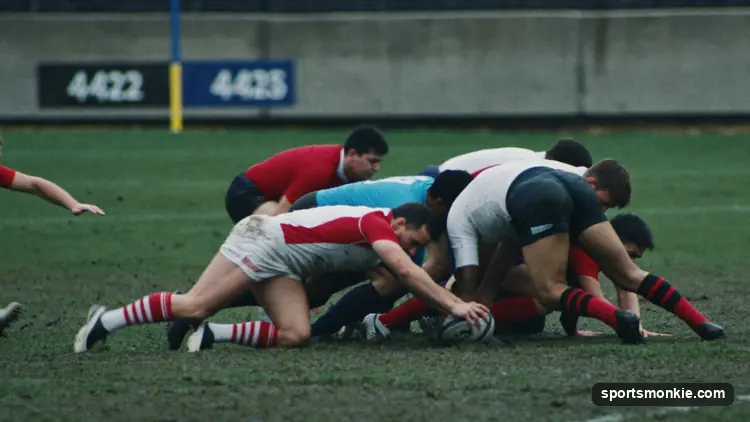
Rugby World Cup 2027: Australia, Format
The 2027 Rugby World Cup is in Australia and, for the first time, features 24 teams in a new format. Host, dates, past winners and qualification.

How Many Points Is a Try in Rugby?
A try in rugby union is worth 5 points, plus a 2-point conversion kick. All the ways to score in rugby, with a full points breakdown, explained clearly.
Rugby Union vs Rugby League
Rugby union has 15 players and contests possession at rucks; rugby league has 13 and uses a six-tackle set. The key differences between the two codes.
What Is a Knock-On in Rugby? Rule Explained
A knock-on in rugby is when a player loses the ball forward off the hand or arm. What counts, the difference from a forward pass, and the sanction.
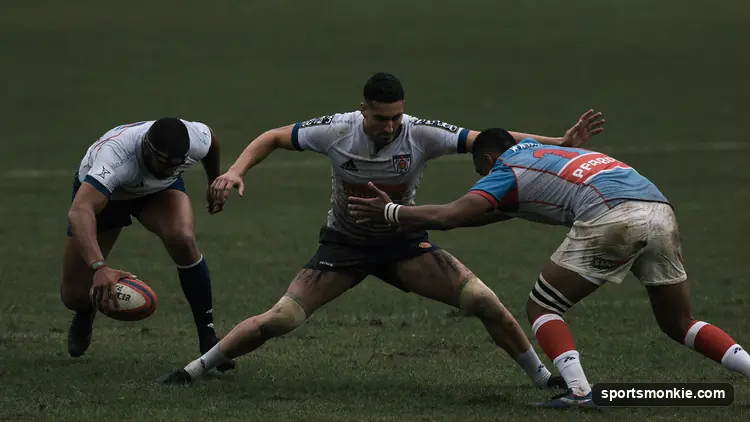
What Is a Scrum in Rugby?
A scrum restarts play after a minor infringement: 8 forwards from each team bind together and push for the ball. How it works and why, explained clearly.
Rugby Positions Explained: All 15
A rugby union team has 15 players: 8 forwards and 7 backs. Every position's number, name and job, from prop to fullback, explained clearly.