
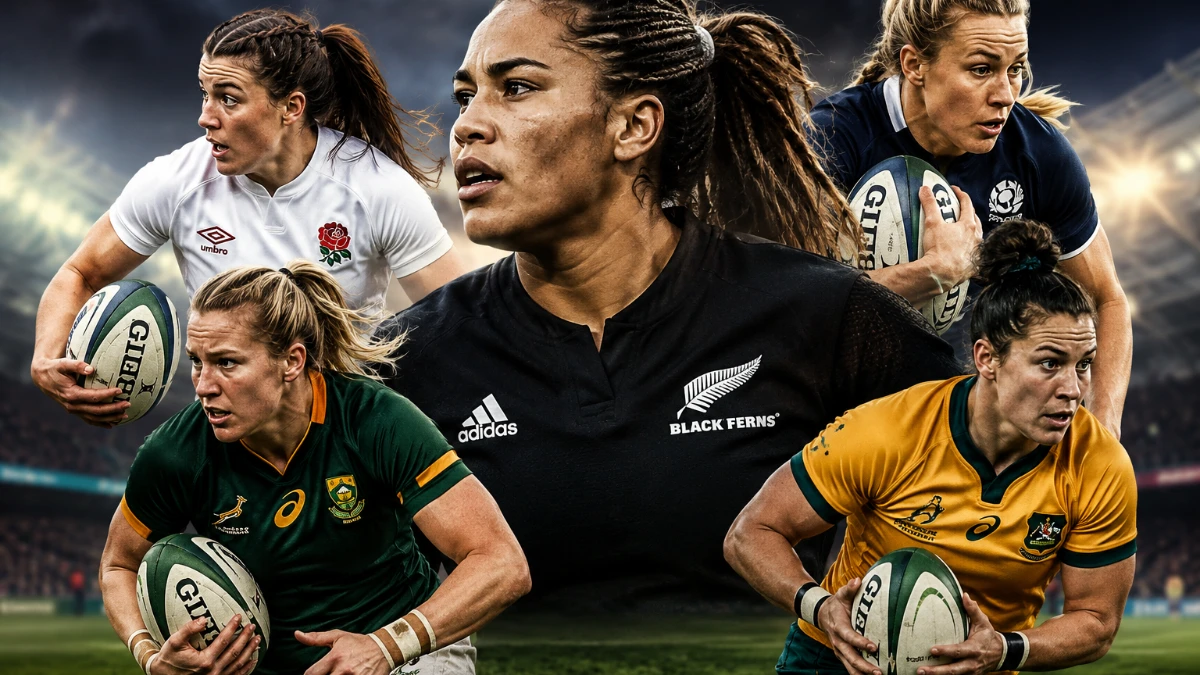
Best Female Rugby Players of All Time: Union & Sevens
On this page12
- 01The greatest female rugby players at a glance
- 02Portia Woodman-Wickliffe (New Zealand, wing)
- 03Emily Scarratt (England, centre)
- 04Sarah Hunter (England, No. 8)
- 05Ellie Kildunne (England, full-back)
- 06Michaela Blyde (New Zealand, wing)
- 07Fiao'o Fa'amausili (New Zealand, hooker)
- 08Magali Harvey (Canada, fly-half)
- 09How we ranked these players
- 10Union vs. Sevens: two different tests
- 11Why New Zealand and England dominate the list
- 12How the modern era reshaped the game
Ranked by peak dominance first, then career decoration (World Cups, Olympic medals, major individual awards) and cross-format impact. Players who reshaped both 15s and Sevens are weighted above single-format specialists, and head-to-head honors break ties where the résumés are close.
The greatest female rugby players at a glance
| Rank | Player | Country | Strongest legacy |
|---|---|---|---|
| 1 | Portia Woodman-Wickliffe | New Zealand | Union and Sevens record-breaker |
| 2 | Emily Scarratt | England | Elite international scoring |
| 3 | Sarah Hunter | England | Most-capped Red Rose |
| 4 | Ellie Kildunne | England | World Player of the Year peak |
| 5 | Michaela Blyde | New Zealand | Sevens finishing specialist |
| 6 | Fiao'o Fa'amausili | New Zealand | Black Ferns leadership |
| 7 | Magali Harvey | Canada | Canadian breakthrough star |
- Two-format record-breaker
Portia Woodman-Wickliffe (New Zealand, wing)
Woodman-Wickliffe is the only player on this list who dominated 15s and Sevens at once, which is why she tops it. In May 2024 she became the first woman to reach 250 tries on the World Rugby Sevens Series, a finishing record no rival is close to, and she paired it with two Olympic sevens golds at Tokyo 2020 and Paris 2024.
She ranks above the 15s specialists below her because her scoring translated across codes: a Rugby World Cup winner in the 15-a-side game and a Sevens World Series force in the same era. She retired from Sevens after Paris 2024, then returned from retirement for a farewell run at the 2025 Rugby World Cup.
Country: New Zealand · Format: Sevens & Union · Feat: first woman to 250 Sevens Series tries · Olympics: gold 2020 & 2024
- England's scoring machine
Emily Scarratt (England, centre)
Scarratt is England's all-time leading points-scorer, retiring with 754 international points from 54 tries, 158 conversions and 56 penalties. She was player of the match in the 2014 World Cup final win over Canada and won the title again in 2025.
In 2025 she became the first English player of either gender to appear at five Rugby World Cups (2010, 2014, 2017, 2022, 2025). She sits above Sarah Hunter here on scoring output and two winners' medals; Hunter's edge is caps and captaincy, which keeps the two close.
Country: England · Position: centre · Points: 754 (record) · Milestone: first English player at five World Cups
- Most-capped Red Rose
Sarah Hunter (England, No. 8)
Hunter is England's most-capped player of all time with 141 Tests, and she captained the Red Roses to the 2014 World Cup title. Her leadership at the back of the scrum defined a decade of England forward play across multiple Grand Slams and four World Cup finals.
She retired in 2023 after a farewell Test in her hometown of Newcastle and moved straight into coaching with England. She ranks just behind Scarratt because her value was leadership and set-piece dominance rather than the scoring column, a contribution that rarely shows up in headline stats.
Country: England · Position: No. 8 · Caps: 141 (England record) · Honor: 2014 World Cup-winning captain
- Reigning World Player of the Year
Ellie Kildunne (England, full-back)
Kildunne is the face of the modern game after being named World Rugby Women's 15s Player of the Year for 2024, when she scored 14 tries in only 10 Tests during England's perfect unbeaten campaign. She then scored in the 2025 World Cup final win over Canada.
She ranks below the established greats on career length rather than talent — her trophy case is still filling. Among active players she has the strongest individual-award case, and her attacking range from full-back is the template the next generation is chasing.
Country: England · Position: full-back · Award: 2024 World Player of the Year (15s) · 2024: 14 tries in 10 Tests
- Sevens finishing specialist
Michaela Blyde (New Zealand, wing)
Blyde was the first woman to win back-to-back World Rugby Sevens Player of the Year awards, in 2017 and 2018, and she backed the individual honors with Olympic golds at Tokyo 2020 and Paris 2024. She scored one of New Zealand's decisive tries in the 19-12 Paris final win over Canada.
She ranks below Kildunne because her impact is concentrated in one format, but as a pure Sevens finisher she carried New Zealand's wide play after Woodman-Wickliffe shifted toward 15s. Her pace and support lines made her the Black Ferns Sevens' most reliable scorer of the late 2010s.
Country: New Zealand · Format: Sevens · Award: back-to-back Sevens Player of the Year (2017-18) · Olympics: gold 2020 & 2024
- Black Ferns leader
Fiao'o Fa'amausili (New Zealand, hooker)
Fa'amausili captained the Black Ferns to the 2017 Rugby World Cup title and was a fixture of New Zealand's set-piece through the early professional era. As a hooker she anchored the lineout and scrum that underpinned New Zealand's dominance before England's recent surge.
She ranks here as a leadership and forward-play pick rather than a statistical one. Her captaincy bridged the amateur and professional eras of the Black Ferns, and her long international career made her one of New Zealand's most experienced forwards.
Country: New Zealand · Position: hooker · Honor: 2017 World Cup-winning captain · Role: lineout and scrum anchor
- Canada's trailblazer
Magali Harvey (Canada, fly-half)
Harvey was the 2014 World Rugby Women's Player of the Year, the first Canadian to win the award, after driving Canada to the 2014 World Cup final where they lost 21-9 to England. Her goal-kicking and long-range running made her Canada's biggest attacking weapon.
She rounds out the list as the player who helped establish Canada as a genuine top-tier nation across both 15s and Sevens. That groundwork paid off a decade later when Canada reached the 2025 World Cup final, showing how much the gap at the top has narrowed.
Country: Canada · Position: fly-half · Award: 2014 World Rugby Player of the Year · Legacy: put Canada in the top tier
Reader interaction
Build your ranking
Drag the names into the order you think is right — or use the arrows — then submit to see how your list compares with everyone else's.
- Portia Woodman-Wickliffe (New Zealand, wing)
- Emily Scarratt (England, centre)
- Sarah Hunter (England, No. 8)
- Ellie Kildunne (England, full-back)
- Michaela Blyde (New Zealand, wing)
- Fiao'o Fa'amausili (New Zealand, hooker)
- Magali Harvey (Canada, fly-half)
Audience ranking
How everyone ranked them
Built from reader rankings using position-based points.
The ranked cards above are the list. The sections below explain how the order was built and add the format and era context that makes each résumé easier to compare.
How we ranked these players
We weighted peak dominance most heavily — how far a player stood above her peers at her best — then career decoration and cross-format impact. World Cup titles, Olympic medals, and major individual awards (World Rugby Player of the Year, Sevens Player of the Year) carry the most weight because they are contested against the whole global pool.
Cross-format excellence is the tiebreaker that lifts Portia Woodman-Wickliffe to the top: dominating both 15s and Sevens is rarer and harder than mastering one. Where two 15s résumés were close, head-to-head honors decided the order, which is why Emily Scarratt’s scoring record and two titles edge Sarah Hunter’s caps and captaincy.
Union vs. Sevens: two different tests
Greatness in women’s rugby is measured across two formats that reward almost opposite skill sets.
| Format | Players | Match length | Stage | Rewards |
|---|---|---|---|---|
| Rugby Union (15s) | 15 per side | Two 40-min halves | World Cup, Six Nations | Set-piece, endurance, tactical depth |
| Rugby Sevens | 7 per side | Two 7-min halves | Olympic Games, World Series | Pace, footwork, open-field finishing |
A 15s specialist like Sarah Hunter is judged on scrum, lineout, and leadership over 80 minutes. A Sevens finisher like Michaela Blyde is judged on acceleration and support lines in wide channels. Players who crossed over — Woodman-Wickliffe most of all — get extra credit here precisely because the two games ask for different things.
Why New Zealand and England dominate the list
Five of the seven names come from New Zealand or England, and that is not an accident. The Black Ferns own six World Cup titles and back-to-back Olympic sevens golds; England’s Red Roses have built the deepest professional pipeline through the Premiership Women’s Rugby (PWR) league and won the 2025 World Cup at home.
Sustained funding and a full domestic season let these unions develop players across a decade, which is exactly what a list ranked on peak-plus-longevity rewards. Emily Scarratt’s five World Cups and Sarah Hunter’s 141 caps are only possible inside a system that keeps elite players in the game that long.
How the modern era reshaped the game
The women’s game changed fastest between 2016 and 2026. Olympic Sevens inclusion in 2016 pulled in new funding and audiences, and the 2025 World Cup final drew a record crowd of nearly 82,000 at Twickenham — a number unthinkable a decade earlier.
Canada’s run to that 2025 final, powered by the pipeline Magali Harvey helped start, is the clearest sign the gap at the top is closing. With records now falling every World Cup and Olympic cycle, this ranking will keep shifting as the next generation, led by Ellie Kildunne, adds to its trophy case.
We dig into a related angle in Good-Looking Female Volleyball Players, and you can see how rugby stacks up globally in Least Popular Sports in the World.
Frequently asked questions
Who is considered the best female rugby player of all time?+
There is no single consensus pick, but Portia Woodman-Wickliffe (New Zealand) has the strongest all-around claim: she holds the all-time Sevens Series try record, won two Olympic golds, and also won a 15-a-side World Cup. In the 15s game specifically, England's Emily Scarratt, Sarah Hunter, and reigning World Player of the Year Ellie Kildunne are the names most often cited by coaches and commentators.
Which country has won the most Women's Rugby World Cups?+
New Zealand's Black Ferns lead with six titles, most recently in 2021 (played in 2022). England are next with three, including a home win at the 2025 tournament, their first title since 2014. Between them the two nations have won every Women's Rugby World Cup except the inaugural 1991 edition, which the United States won, underlining how top-heavy the sport has historically been.
Who won the 2025 Women's Rugby World Cup?+
England's Red Roses won the 2025 Women's Rugby World Cup, beating Canada 33-13 in the final at Twickenham on 27 September 2025. The match drew a record women's rugby crowd of nearly 82,000. It was England's first world title since 2014 and their third overall, and it also served as Portia Woodman-Wickliffe's farewell tournament for New Zealand.
Why is Portia Woodman-Wickliffe ranked number one?+
Because she is the only player on this list who dominated both formats at the highest level. She holds the World Rugby Sevens Series try record, becoming the first woman to reach 250 in May 2024, and won Olympic sevens gold at both Tokyo 2020 and Paris 2024. She also won a 15-a-side World Cup, a cross-code résumé no rival on this list matches.
How do women's Rugby Union and Rugby Sevens differ?+
Rugby Union is the 15-a-side format played over two 40-minute halves, contested at the Rugby World Cup and Six Nations. Rugby Sevens is a faster 7-a-side game with seven-minute halves, featured at the Olympic Games. Sevens rewards raw pace and footwork in open space, while 15s demands set-piece work, endurance, and tactical depth. Several greats, like Woodman-Wickliffe, excelled at both.
When did women's rugby join the Olympics?+
Women's Rugby Sevens debuted at the Rio 2016 Games, where Australia won the first gold medal and New Zealand took silver. New Zealand then claimed back-to-back titles at Tokyo 2020 (held in 2021) and Paris 2024, beating Canada 19-12 in the Paris final. Olympic inclusion has been one of the biggest drivers of the women's game's global growth and funding since 2016.
Sources
Play & tools
Free browser games and tools — no account, no download.
- Play today's Sports Connections — Today's Sports Connections — daily hints, answers, and play the grid.
- Play Guess the NFL Player — A new mystery NFL player every day. Eight guesses, with a clue on each — plus free unlimited mode.
- Explore all our games →
Related records & rankings guides
View all →
Rugby Sevens Rules, Explained
Rugby sevens is seven a side on a full-size pitch, two seven-minute halves, under World Rugby's abbreviated laws. Scoring, scrums, cards and how it differs from 15s.
Rugby Union vs Rugby League
Rugby union has 15 players and contests possession at rucks; rugby league has 13 and uses a six-tackle set. The key differences between the two codes.

How Long Is a Rugby Match? Real Length
A rugby match is 80 minutes of play, two 40-minute halves plus a halftime break. With stoppages the real elapsed time is usually about 100 minutes.
How Many Points Is a Try in Rugby?
A try in rugby union is worth 5 points, plus a 2-point conversion kick. All the ways to score in rugby, with a full points breakdown, explained clearly.
Rugby Positions Explained: All 15
A rugby union team has 15 players: 8 forwards and 7 backs. Every position's number, name and job, from prop to fullback, explained clearly.
Rugby World Cup 2027: Australia, Format
The 2027 Rugby World Cup is in Australia and, for the first time, features 24 teams in a new format. Host, dates, past winners and qualification.