
Lacrosse Helmet Sizing: How to Get the Right Fit
On this page8
- 01How to measure your head for a lacrosse helmet
- 02Lacrosse helmet size by head circumference
- 03Fitting the helmet once it is on
- 04Should you size up or down?
- 05Chin strap and final adjustment
- 06Common sizing mistakes to avoid
- 07Women’s lacrosse uses eyewear, not helmets
- 08Youth versus adult, and when to replace
Sizing a lacrosse helmet starts with one number: your head circumference, measured with a soft tape about an inch above the eyebrows. Match that number to the specific manufacturer’s chart, because Cascade and Warrior do not use identical ranges, then fine-tune with the helmet’s internal fit system. A correct helmet sits level, grips evenly all around, and does not rock. Because sanctioned play requires a NOCSAE-certified helmet, fit is not just comfort, it is part of the safety standard.
How to measure your head for a lacrosse helmet
Take a flexible fabric tape measure and wrap it around the widest part of your head, roughly a finger’s width above your eyebrows and just above the ears. Keep the tape level front to back and read the circumference in inches or centimeters. Measure two or three times and use the largest consistent reading, since a helmet that fits your true widest point will not pinch.
Do not shortcut this with your hat size. Hat sizing rounds and varies by brand, while helmet charts are keyed to a real circumference. If you are buying for a growing child, measure the day you order rather than trusting last season’s number.
Lacrosse helmet size by head circumference
Use this as a starting reference, then confirm against the exact model’s chart before buying. Manufacturers publish their own ranges, and adjustable helmets deliberately span several of these bands within one shell.
| Head circumference | General size | Typical fit |
|---|---|---|
| Under 20.5 in (52 cm) | Youth / small | Younger players, adjustable shells |
| 20.5–21.5 in (52–55 cm) | Small–Medium | Older youth to smaller adult |
| 21.5–22.5 in (55–57 cm) | Medium | Most teen and adult players |
| 22.5–23.5 in (57–60 cm) | Medium–Large | Larger adult heads |
| Over 23.5 in (60 cm) | Large / XL | Confirm model offers this range |
The bands overlap on purpose. Many current helmets, such as the adjustable Cascade and Warrior lines, ship in a single shell that covers a wide range and dials in with an internal system, so your measurement points you to a model as much as to a letter size.
Fitting the helmet once it is on
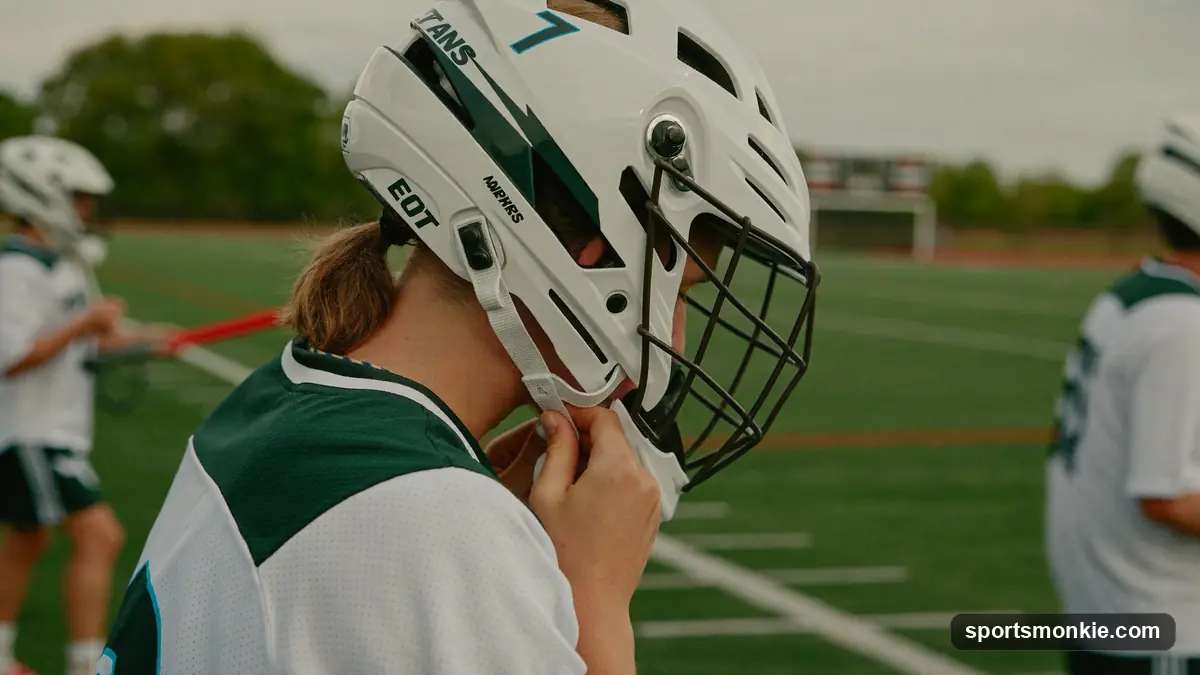
A measured size gets you the right shell; the fit check confirms it. Put the helmet on level, low enough that the front rim sits about one to two finger-widths above your eyebrows, not tilted back like a cap. Tighten the internal fit system or seat the pads until the helmet grips evenly around the crown and sides.
Then run three quick tests. Push the front up and down: the helmet should move your eyebrows with it, not slide independently. Rotate it side to side: your skin should move, not the shell. Shake your head: nothing should shift or wobble. If the helmet rocks or spins freely, it is too big; if you feel sharp pressure points or a headache after a few minutes, it is too small or unevenly padded.
Should you size up or down?
Fit to your measurement first. When you land between two sizes, try the smaller shell before the larger one. A slightly snug helmet with an adjustable system can be loosened into a good fit, but an oversized shell that already rocks cannot be padded back to safe, and a helmet that moves in a collision is not doing its job. The goal is firm and even everywhere, with no gaps you can slide a finger into and no hot spots.
Chin strap and final adjustment
The chin strap is what keeps a correctly sized helmet in place. Buckle it so the cup sits centered on your chin and you can fit about one finger between the strap and your throat. Too loose and the helmet can ride up on impact; too tight and it is uncomfortable enough that players stop wearing it snug. Re-check strap tension every few sessions, especially for kids, whose settings drift as they adjust the helmet themselves.
Common sizing mistakes to avoid
Three errors show up again and again. The first is buying to hat size instead of a measured circumference, which leaves players a full size off. The second is sizing a child’s helmet up to grow into, trading present safety for a season of use; buy an adjustable model at the current measurement and dial it out as they grow. The third is ignoring the fit test after a growth spurt or a hard hit, since a helmet that once fit can loosen or lose padding integrity.
One more worth naming: over-tightening the fit dial to compensate for a shell that is genuinely too big. If the helmet only feels secure when it is cranked to the point of a headache, the shell is the wrong size, not the setting. Go down a shell rather than fight it.
Women’s lacrosse uses eyewear, not helmets
Worth clarifying, because it confuses new parents: women’s field lacrosse does not require a hard helmet. The no-contact women’s game mandates protective goggles and a mouthguard instead, with headgear optional under current rules. So the sizing process here applies to boys’ and men’s field lacrosse and to goalies of both games. If you are shopping for a daughter in the field game, you are sizing goggles for a snug, non-slipping fit, not a NOCSAE helmet.
Youth versus adult, and when to replace
Youth and adult lines can overlap in circumference but differ in shell length and padding, so a youth XL is not automatically an adult small. If a player is on the border, try both lines rather than assuming they swap. For a growing child, buy an adjustable model at the current measurement rather than a size up to grow into, because a loose helmet now is a safety compromise now.
Replace a helmet after any significant impact that cracks the shell or crushes padding, and follow the manufacturer’s stated service life, as certification is tied to a helmet’s condition, not just its original stamp. A helmet that no longer fits after a growth spurt is effectively expired too.
Once the head is protected, the rest of the kit follows a similar fit-first logic. If you are building out a first setup, our guides to the best lacrosse mesh and picking a defenseman’s long pole cover the next decisions, and new players should pair the gear with our lacrosse drills for beginners to get comfortable in it.
Freshness note: NOCSAE certification requirements and manufacturer size charts can change by season. Confirm the exact ranges on the current Cascade and Warrior model pages before buying, and re-check NOCSAE standard revisions.
Frequently asked questions
How do I know my lacrosse helmet size?+
Wrap a soft tape measure around the widest part of your head, roughly an inch above your eyebrows and ears, and note the circumference in inches or centimeters. Compare that number to the specific helmet maker's size chart, since Cascade and Warrior use different ranges. Buy to the measurement, not to your usual hat size.
Are lacrosse helmets one size fits all?+
No, but many modern helmets cover a range with an internal adjustment dial or pads. A model like the Cascade S or Warrior Burn may come in one shell size that fits a band of head circumferences, while youth helmets and some adult lines offer distinct S/M/L shells. Always check the chart for the exact model.
Should I size a lacrosse helmet up or down?+
Neither by default: fit to your measured circumference. If you fall between two sizes, try the smaller shell first, because a helmet that is slightly snug can be dialed looser with the fit system, while an oversized shell that rocks cannot be made safe. It should feel firm all around with no pressure points.
Is a youth XL the same as an adult small?+
Not necessarily. Youth and adult lines can overlap in circumference but differ in shell shape, padding depth, and how low they sit. A youth XL and adult small may cover similar head sizes, yet the adult shell is often built for a longer, more oval head. Try both, or measure and match each line's own chart rather than assuming they swap.
Does a lacrosse helmet need to be NOCSAE certified?+
Yes. Sanctioned boys' and men's field lacrosse requires a helmet meeting the NOCSAE standard, and a helmet only holds that certification when it fits and is worn as designed. A poorly fitted or heavily modified helmet can fall outside the certified condition, so correct sizing is part of the safety standard, not just comfort.
Sources
Play & tools
Free browser games and tools — no account, no download.
- Play today's Sports Connections — Today's Sports Connections — daily hints, answers, and play the grid.
- Play Guess the NFL Player — A new mystery NFL player every day. Eight guesses, with a clue on each — plus free unlimited mode.
- Explore all our games →
Related guides
Lacrosse Equipment List: Everything You Need to Play
The full lacrosse equipment list: a men's player needs a helmet, gloves, and pads; a girls' player needs eyewear, a mouthguard, and a stick. Checklist inside.
Lacrosse Gloves vs Hockey Gloves: Can You Swap Them?
Lacrosse gloves vs hockey gloves: you shouldn't swap them. Here's why cuff length, mobility, and protection make each glove wrong for the other sport.
Men's vs Women's Lacrosse: Every Major Difference
Men's vs women's lacrosse differ in players, checking, equipment, field, and stick rules. Here's every major difference in one clear breakdown.
What Are Lacrosse Balls Made Of? Material, Size and Weight
Lacrosse balls are made of solid vulcanized rubber, weigh 5 to 5.25 oz, and measure 7.75 to 8 inches around. Here is the full spec and why they're so hard.
The Top Lacrosse Gear Brands
A guide to the established lacrosse brands, from STX, Warrior and Maverik to Nike, ECD and Cascade, and what each is best known for making.
Ski Boot Sizing: How to Get the Right Fit
Ski boots are sized in Mondopoint (your foot length in cm). Learn to measure your Mondo size, pick flex and last width, and run the shell fit test.