
Ski Boot Sizing: How to Get the Right Fit
On this page8
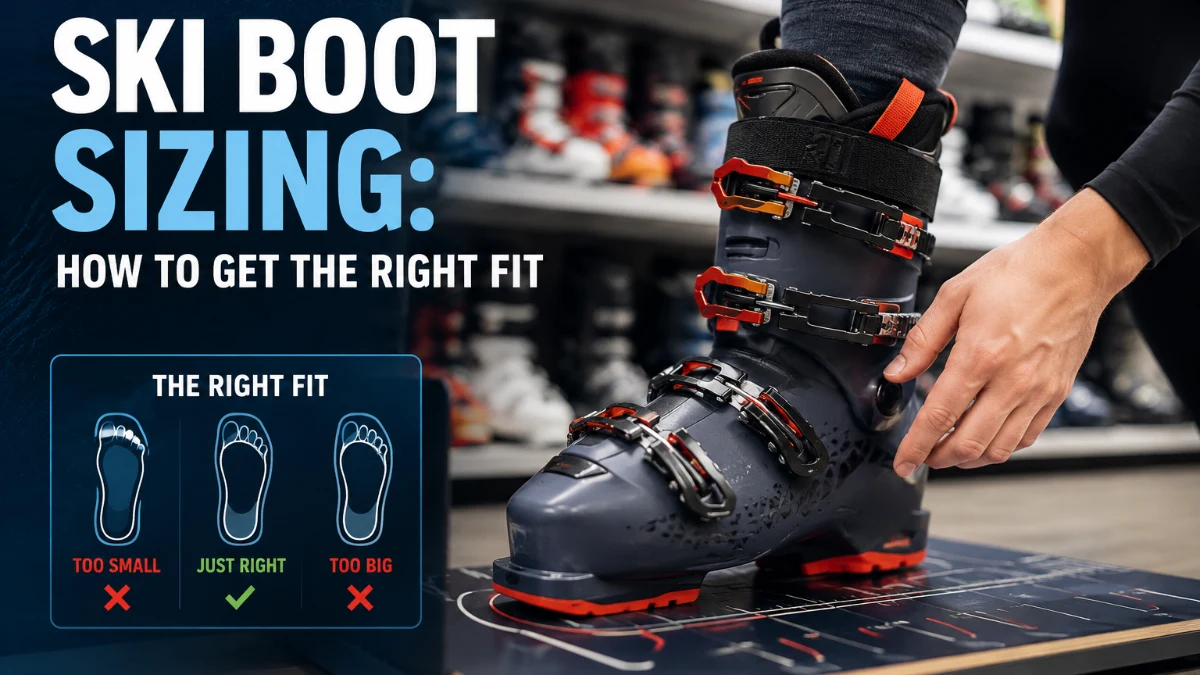
Ski boots are sized in Mondopoint, a system based on the length of your foot in centimeters rather than US or EU shoe numbers. To find yours, put on a thin ski sock, stand with your heel to a wall, and measure to the tip of your longest toe. That measurement, taken from your longer foot, is your starting size. From there you choose a flex index and last width, and confirm the fit is snug with your toes just brushing the front.
What is Mondopoint sizing?
Unlike sneakers, ski boots are not labeled in US, UK, or EU sizes. They use Mondopoint, which is simply your foot length in centimeters. A 27 cm foot corresponds to a 27.0 Mondo boot. Both Salomon and Atomic build their alpine boots on this scale, so a Mondo 26 is designed for a 26 cm foot regardless of the badge on the box. Because it is a real measurement, Mondopoint is consistent across countries. Internal fit still varies between manufacturers, though, so a 27.5 in one brand can feel different from a 27.5 in another.
How do I measure my Mondopoint size?
Wear a thin, form-fitting ski sock, not a bulky athletic one. Place a sheet of paper against a wall, stand with your heel touching the wall and your weight evenly distributed, then mark the tip of your longest toe. Measure that distance in centimeters. Atomic recommends doing both feet and using the longer measurement, since most people have one foot slightly bigger than the other. Do not round down to shave off a half size at this stage; measure honestly, then decide how to size from there.
Ski boot size chart: Mondopoint to US, UK, EU
Mondo sizes convert roughly to familiar shoe numbers, but always fit by Mondo, not by your street-shoe size.
| Mondopoint | US Men | US Women | UK | EU |
|---|---|---|---|---|
| 24.5 | 6.5 | 8 | 5.5 | 38.5 |
| 25.5 | 7.5 | 9 | 6.5 | 40 |
| 26.5 | 8.5 | 10 | 7.5 | 41 |
| 27.5 | 9.5 | 11 | 8.5 | 42.5 |
| 28.5 | 10.5 | 12 | 9.5 | 44 |
A detail worth knowing: a full and half size, such as 26.0 and 26.5, usually share the same plastic shell, with a thicker liner taking up the space in the smaller number, a point Atomic makes in its sizing guide. That is why a strong skier can drop half a size for a tighter feel without changing the actual shell. Conversions are approximate and differ slightly by brand.
What flex index should I choose?
Flex index rates how hard the boot is to bend forward, running from roughly 60 (soft) to 150 (race stiff). There is no standardized way to measure it, so Atomic notes that the same number is not necessarily identical between manufacturers. Treat flex as a guide to compare boots within one brand, and match it to your ability, weight, and how you actually size relative to your Mondo measurement.
| Skill level | Men’s flex | Women’s flex | How to size vs. Mondo |
|---|---|---|---|
| Beginner | 65–80 | 50–60 | At your true Mondo size |
| Intermediate | 85–100 | 65–80 | True size or half size down |
| Advanced | 100–120 | 85–100 | Half size down, snug |
| Expert / racer | 120–150 | 100–130 | Up to a full size down |
My recommendation: do not chase a high flex number you cannot drive. A lighter or newer skier in a 130 boot barely flexes it, which kills feel and control. Softer, on the other hand, is easy to over-flex at speed. Pick for where you ski today, not where you hope to be next season. If you are still finding your feet, our guide to beginner skiing covers how technique and gear grow together.
What is last width, and does it matter?
Last width is the boot’s width at the widest part of the forefoot, measured in millimeters on a reference shell. Per evo, lasts run from about 97 mm to 106 mm: narrow (low-volume) sits under 100 mm, medium is around 100 to 101 mm, and wide (high-volume) runs 102 mm and up. Match the last to the actual shape of your foot, not only its length. A wide foot crammed into a 98 mm race last will go numb by lunch; a narrow foot swimming in a 104 mm last will never lock in. Width is where most off-the-rack fit problems start, and it matters as much as the Mondo number.
How should a ski boot fit?
A properly sized boot feels snug and secure everywhere. Standing tall, your toes should lightly brush the front of the boot. When you flex forward into a skiing stance, your toes pull back off the front and your heel stays locked in the heel pocket with minimal lift. REI is blunt about the trade-off: less space means more performance and less comfort, and a liner packs out with use. A boot that feels comfortably roomy in the shop will almost certainly be too big by mid-season.
The shell fit test
To sanity-check the plastic itself, pull the liner out, slide your bare foot into the empty shell, and push your toes forward until they touch the front. Then measure the gap behind your heel:
- Under 1 cm (about one finger): a very tight, expert/race fit.
- 1 to 2 cm (one to two fingers): the sweet spot for most skiers.
- Over 2 cm (two-plus fingers): the shell is too big; drop a size.
This shell test is the single most reliable check you can do, and it is the step casual buyers skip most often. It reads the actual shell, not the plush liner that flatters an oversized boot in the store.
What do ski boots cost?
Fit matters more than price, but budget shapes your options. New adult alpine boots generally run $200 to $800 in the US (roughly £180 to £600 in the UK). Entry-level and beginner boots land around $150 to $300, mid-range intermediate boots $350 to $500, and expert or BOA-equipped performance boots $550 and up, with a few top-tier models such as the Fischer RC4 Pro topping $1,000. Kids’ boots are cheaper at roughly $100 to $300. Whatever the price, a well-fitted mid-range boot outperforms an expensive one that fits poorly.
If you are gearing up for a first season and still weighing lessons, gear, and lift passes, start with our beginner ski lessons guide to plan the whole cost, then build your kit around a boot that actually fits.
Common ski boot sizing mistakes
The most frequent error is buying for showroom comfort and ending up half a size too large. Others include ignoring last width for a wide or narrow foot, chasing a flex number beyond your ability, measuring in thick socks, and sizing to street-shoe numbers instead of a real Mondo measurement. For a first pair, or any difficult foot shape, a professional bootfitter who can shell-check, mold the liner, and punch trouble spots is the surest path to a boot that performs.
For more gear-fit walkthroughs, explore our full winter sports hub, where we break down skis, bindings, and boots for every level.
It is worth pairing this with our guide to Ski Boot Flex Explained.
Frequently asked questions
How do I find my ski boot size?+
Ski boots use Mondopoint, which is your foot length in centimeters. Put on a thin ski sock, stand with your heel against a wall, mark the tip of your longest toe, and measure the distance in centimeters. That number is your starting Mondo size. Always size to the longer foot, since most people have one that is bigger.
Should ski boots be tight or loose?+
Snug and secure, never loose. Standing upright, your toes should lightly brush the front. When you flex forward into a skiing stance, your toes pull back and your heel stays locked in the heel pocket. A boot that feels roomy and comfortable in the shop will pack out within a few days and become too big.
What is Mondopoint sizing?+
Mondopoint is the international standard for ski boots, based on foot length in centimeters instead of regional shoe sizes. A 27.0 Mondo boot is built for a 27 cm foot. It removes the confusion of US, UK, and EU numbers, though internal fit still varies between brands, so always try before you commit.
What does the flex index on a ski boot mean?+
Flex index rates how stiff a boot is when you push forward, usually from about 60 to 150. Higher numbers are stiffer and more responsive; lower numbers are softer and forgiving. There is no industry standard, so a 100 flex in one brand differs from a 100 in another. Use it to compare models within a single brand.
Can I size down my ski boots?+
Advanced and expert skiers sometimes drop a half size for a tighter, more responsive fit. Because a 26.0 and 26.5 usually share the same plastic shell, with a thicker liner filling the smaller number, going down is low risk for strong skiers. Beginners and intermediates should stay at or near their true Mondo size.
Do I need a professional bootfitter?+
For a first pair, or if you have wide, narrow, or high-volume feet, a bootfitter is worth the money. They confirm shell size, heat-mold the liner, adjust flex, and can grind or punch trouble spots. Because sizing and shape vary between brands, expert fitting often makes the single biggest difference in on-snow comfort.
Sources
Play & tools
Free browser games and tools — no account, no download.
- Play today's Sports Connections — Today's Sports Connections — daily hints, answers, and play the grid.
- Play Guess the NFL Player — A new mystery NFL player every day. Eight guesses, with a clue on each — plus free unlimited mode.
- Explore all our games →
Related winter sports guides
View all →
Ski Boot Flex Explained: Chart by Weight and Ability
Ski boot flex explained: what the number really measures, why it isn't standardized between brands, plus a flex chart by weight and ability level.
Beginner Ski Lessons: Costs and What to Expect
Beginner ski lessons explained: group vs private, real 2026 costs in the US, UK and Australia, what happens on day one, and the gear you need.
What Is the Hammer in Curling?
The hammer in curling is the last-stone advantage: throwing the final rock of an end. How it's decided, why teams protect it, and how it changes hands.
Lacrosse Helmet Sizing: How to Get the Right Fit
Lacrosse helmet sizing starts with measuring head circumference above the brow, then matching it to the maker's chart. Here is how to size and fit a helmet right.
Vail Resorts Ski Lessons: How Pricing Works by Resort
Vail Resorts ski lessons compared: the same lesson structure and Epic Pass discount at every resort, but prices range from about $195 to AUD $499.
Curling Rules Explained for Beginners
Curling is a team sport where players slide stones toward a target. The rules, scoring, sweeping and why players shout, explained simply for beginners.