
Curling Rules Explained for Beginners
On this page8
Curling is a team sport played on ice in which two teams of four take turns sliding heavy granite stones toward a target of concentric circles called the house. Each team throws eight stones per end, and once all 16 are thrown, the team with a stone closest to the centre scores one point for every stone it has nearer the centre than its opponent’s best stone.
That is the whole game in two sentences, but the details, the sweeping, the shouting, the strategy of the last stone, are what make curling the fascinating, chess-on-ice sport it is. Here is how it all works, explained for a complete beginner, based on the framework set out by World Curling, the sport’s international governing body.
The basics: teams, stones and the sheet
Two teams face off on a long, narrow strip of ice called a sheet. Each team has four players, and every player throws two stones per end, alternating with the opposition, so eight stones per team and 16 in total are delivered each end.
At each end of the sheet sits the house, a set of concentric rings with a central spot known as the button. The goal is to get your stones as close to the button as possible while knocking the other team’s stones away. The stone itself is a polished piece of granite with a handle on top; a competition stone weighs roughly 20 kilograms (about 44 pounds).
A game is normally made up of 10 ends (recreational and some events use eight). An end is one full cycle of all 16 stones being thrown, followed by scoring. Think of an end like an inning in baseball or a frame in snooker.
The four roles on a team
Curling teams have defined jobs, and the numbering runs from lead to skip.
| Position | Order of throwing | Main job |
|---|---|---|
| Lead | Throws 1st and 2nd stones | Sets up guards, then sweeps for the rest of the end |
| Second | Throws 3rd and 4th stones | Often plays take-out (hitting) shots, sweeps |
| Third (vice-skip) | Throws 5th and 6th stones | Helps the skip read the ice, holds the broom target when skip throws |
| Skip | Throws last two stones | The captain; calls strategy and stands in the house directing every shot |
The skip is effectively the quarterback of the team, standing in the house, deciding each shot and giving the target line by holding a broom where the thrower should aim.
How a shot works
To deliver a stone, a player pushes off from a foothold called the hack, glides forward in a low crouch, and releases the stone before a line called the hog line. As they let go, they apply a gentle rotation to the handle, which makes the stone slowly curl (curve) as it travels, hence the sport’s name.
Two teammates then walk alongside the moving stone with brushes, ready to sweep. Sweeping momentarily reduces friction on the pebbled ice, which makes the stone travel farther and curl less. By sweeping or not sweeping, the team controls both the distance the stone stops at and the line it follows.
Why the players shout
The noise is pure communication. The thrower and the skip are best placed to judge whether a stone is travelling too fast or too slow, so they shout instructions to the sweepers in real time: calls like “hurry hard” mean sweep as hard as you can, while “whoa” or “up” mean stop sweeping. Because a stone slides for several seconds and a small change in friction changes where it stops, the calls have to be loud and immediate. It looks dramatic, but it is just a team steering a stone by voice.
How scoring works
Scoring in curling is simple once you see it, and it is one of the sport’s quirks that only one team scores in each end.
After all 16 stones have been thrown, you look at the house and find the single stone closest to the button. Whichever team owns that stone is the only team that can score that end. It then scores one point for every one of its own stones that is closer to the button than the opponent’s nearest stone.
So:
- If you have the two closest stones and your opponent has the third-closest, you score 2.
- If your opponent has the single closest stone, you score 0 that end (a “blank” or a score for them).
- A big end of 3, 4 or more is possible but harder to engineer.
Points are added up across all 10 ends, and the team with the higher total at the finish wins. If the score is tied after the final end, an extra end is played.
The hammer: the last-stone advantage
The team that throws the last stone of an end has what is called the hammer, and it is a genuine advantage because the final stone can be used to draw to the button or knock out a rival stone after seeing everything the opponent has done. The hammer is decided at the start (often by a pre-game shot for accuracy), and it then passes to the team that did not score in the previous end. In other words, if you score, you give up the hammer for the next end.
This creates real strategy: a team with the hammer often tries to score two or more, while a team without it may try to “steal” a point or force the opponent to score only one. Understanding the hammer is the key to why teams sometimes deliberately blank an end to keep last-stone advantage.
A few key rules and lines
- The hog line: the thrower must release the stone before this line, or the stone is removed from play.
- The free guard zone: early in an end, stones sitting in front of the house (guards) are protected and cannot simply be knocked out, which encourages more open, tactical play.
- Burning a stone: if a player touches a moving stone, it is a foul and the stone is usually removed or repositioned by the non-offending team.
- Etiquette: curling has a strong tradition of sportsmanship; players call their own fouls and the winners traditionally buy the losers a drink afterward.
Why it rewards strategy over strength
Curling is often described as “chess on ice” because so much of it is about placement, angles and managing the hammer rather than raw power. If you enjoy the tactical side of the winter game, you might also like reading about what the hammer means in more detail, how much a curling stone actually weighs, and the sliders players wear on one shoe to glide out of the hack.
Once you know that each end is a self-contained battle for the button, that only one team scores, and that the shouting is just sweepers being steered by voice, a curling match suddenly makes complete sense.
Frequently asked questions
What are the main rules in curling?+
Two teams of four players each take turns sliding stones down a sheet of ice toward the house, the target of concentric rings. Each team throws eight stones per end (four players throw two stones each, alternating with the opposition), and a standard game lasts 10 ends. After all 16 stones are thrown in an end, only one team scores: it earns one point for every one of its stones that sits closer to the centre than the opponent's nearest stone. Sweepers may brush the ice in front of a moving stone to influence its distance and curl, and the team with more points after the last end wins.
Why do they scream in curling?+
The shouting is communication, not celebration. The player who threw the stone and the skip can judge its speed and line better than the sweepers, so they yell instructions such as 'hurry hard' (sweep fast) or 'whoa' / 'up' (stop sweeping) to control exactly how far the stone travels and how much it curls. Because a stone slides for many seconds and small changes matter, the calls have to be loud and instant, which is why curling sounds so intense.
How does scoring in curling work?+
Scoring happens once per end, after all 16 stones are thrown, and only one team scores in each end. That team scores one point for each of its stones that is closer to the centre of the house (the button) than the closest stone belonging to the other team. So if you have two stones nearer the button than any of your opponent's, you score two; if the closest stone of all is your opponent's, you score zero that end. Points accumulate over the 10 ends, and the higher total wins.
Why do they brush the ice in curling?+
Sweeping momentarily melts a thin film on the pebbled ice, which reduces friction under the stone. That makes the stone travel farther and curl less, so sweepers use it to fine-tune where the stone stops and to keep it on the intended line. Good sweeping can carry a stone several extra feet and straighten its path, which is why it is such a physical and important part of the game rather than just tidying the ice.
Sources
Play & tools
Free browser games and tools — no account, no download.
- Play today's Sports Connections — Today's Sports Connections — daily hints, answers, and play the grid.
- Play Guess the NFL Player — A new mystery NFL player every day. Eight guesses, with a clue on each — plus free unlimited mode.
- Explore all our games →
Related winter sports guides
View all →
What Is the Hammer in Curling?
The hammer in curling is the last-stone advantage: throwing the final rock of an end. How it's decided, why teams protect it, and how it changes hands.
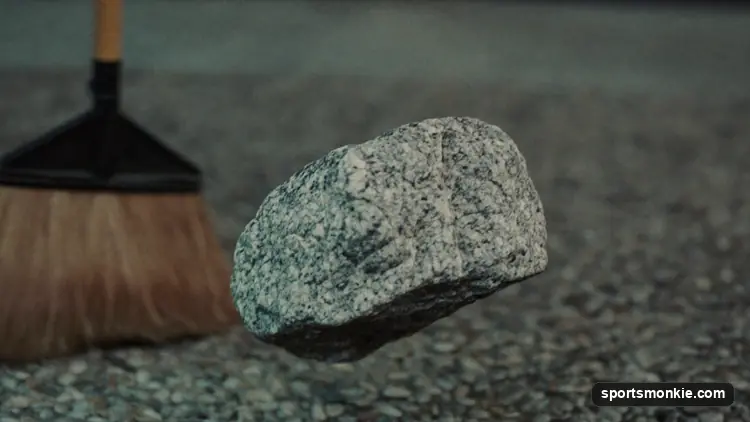
How Much Does a Curling Stone Weigh?
A curling stone weighs between 38 and 44 pounds (17.24 to 19.96 kg), handle included. The granite, the cost and the specs behind the rock, explained.

Snowboard Lessons for Beginners: Cost and What to Expect
Snowboard lessons for beginners: 2026 group vs private prices in the US, UK and Australia, how many lessons to link turns, and why day one is hardest.

Vail Resorts Ski Lessons: How Pricing Works by Resort
Vail Resorts ski lessons compared: the same lesson structure and Epic Pass discount at every resort, but prices range from about $195 to AUD $499.

Ski Boot Sizing: How to Get the Right Fit
Ski boots are sized in Mondopoint (your foot length in cm). Learn to measure your Mondo size, pick flex and last width, and run the shell fit test.

Beginner Ski Lessons: Costs and What to Expect
Beginner ski lessons explained: group vs private, real 2026 costs in the US, UK and Australia, what happens on day one, and the gear you need.