
How Much Does a Curling Stone Weigh?
On this page5
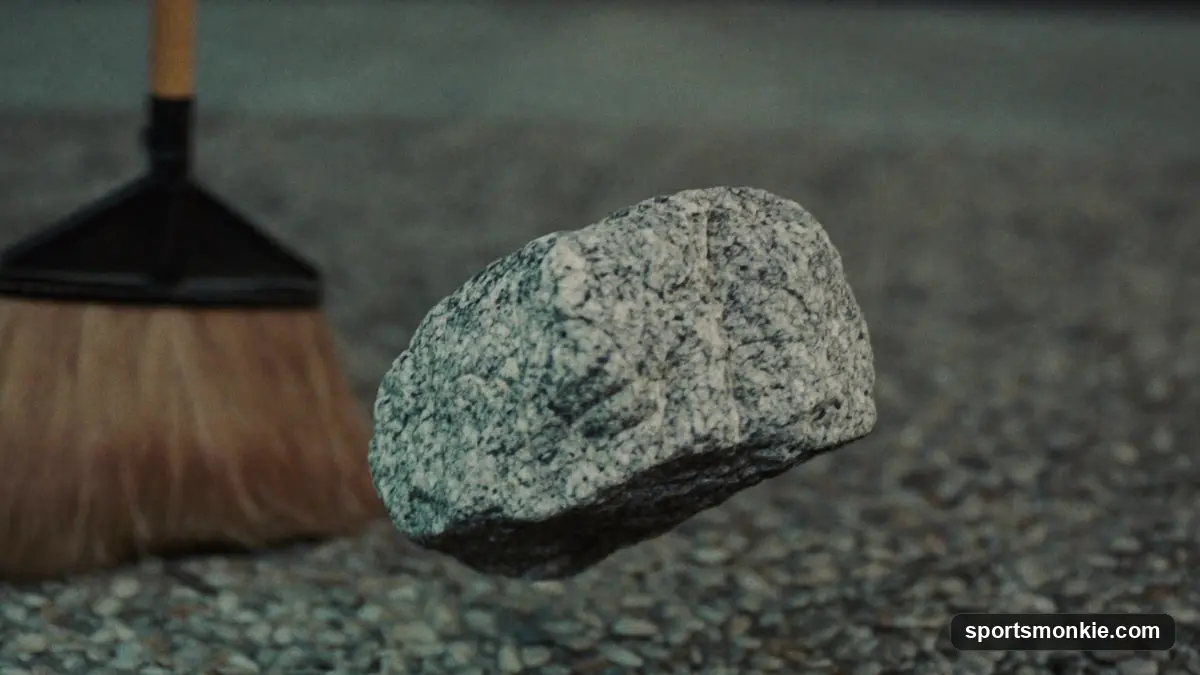
A regulation curling stone weighs between 38 and 44 pounds (17.24 to 19.96 kg), and that figure includes the handle and the bolt that holds it. Most competition stones sit near the top of that range, around 42 pounds (roughly 19 kg).
Those limits come from World Curling, the sport’s governing body, and they cover more than weight. Here are the full specifications, the unusual granite the best stones are cut from, what a stone actually costs, and why players never bring their own.
The official curling stone specifications
World Curling defines the stone by weight, size and shape, not just mass. A stone outside any of these limits is not legal for sanctioned play.
| Specification | Regulation limit |
|---|---|
| Weight (with handle and bolt) | 38 to 44 lb (17.24 to 19.96 kg) |
| Typical competition weight | About 42 lb (19 kg) |
| Maximum circumference | 36 in (91.44 cm) |
| Minimum height | 4.5 in (11.43 cm) |
| Material | Dense, low-absorption granite |
The weight is deliberate. A stone light enough to throw with one arm but heavy enough to hold a straight, predictable path down 45 meters of ice is the whole point. Too light and it would wobble and over-curl; too heavy and no one could deliver it with touch.
What the weight means on the ice
That 42-pound mass is not just a number, it is what makes the game playable. A stone carries its momentum smoothly across pebbled ice, so a curler can feel the “weight” they put on a throw, meaning the speed and force, and repeat it. Curlers even talk about throwing at “draw weight” or “takeout weight,” using the stone’s consistent mass as a unit of touch rather than a hindrance.
Only a thin ring on the bottom, the running band, actually contacts the ice. Because that contact patch is small, the stone glides far on a controlled push, and the sweepers manage the rest by polishing the ice ahead of it to make it travel farther and straighter. A heavier or lighter rock would break that finely tuned relationship between throw, sweep and slide, which is why the 38-to-44-pound window is enforced so tightly.
Why the granite is the expensive part
The rock matters more than the weight. Since 2006, every stone used at the Winter Olympics has come from Kays of Scotland, which quarries its granite from Ailsa Craig, a tiny uninhabited island off the Scottish coast.
Two granite types from the island do the work. A rare blue-tinged stone called Blue Hone forms the running band, the ring on the bottom that actually touches the ice, because it absorbs almost no water and resists the freeze-thaw cracking that would destroy ordinary rock. A second type, Ailsa Craig Common Green, makes up the body. That combination of a specific island source and hand finishing is why a single curling stone costs more than a set of premium golf clubs.
What does a curling stone cost?
Expect to pay upward of $600 for a single Olympic-standard stone. New stones from the leading manufacturer generally run $500 to $800 each depending on the fittings and finish.
Because curling is played with a full set, the real cost is the set. Sixteen matched stones, one sheet’s worth, land somewhere between $8,500 and $13,000, with a commonly cited Olympic-grade set valued around $9,600. Clubs treat them as a long-term asset rather than gear that gets replaced, which the granite’s decades-long lifespan makes reasonable.
Curling shares that gear-heavy, precision-first character with the rest of the ice-and-snow program. See where it ranks among the most popular Olympic sports, and for another piece of the curler’s kit, our look at curling sliders covers the shoe that makes the delivery possible.
Why players share the same stones
Unlike brooms and shoes, stones are not personal equipment. Every team at a bonspiel or an Olympic event plays with the same house set, provided by the venue. The reason is fairness: no two blocks of granite curl identically, so letting athletes bring favored rocks would hand an advantage before a single stone was thrown. Standardizing the stones keeps the contest about the throwing and sweeping.
The one personal touch is the handle. Handles are colored to tell the two teams’ stones apart, red for one side and yellow for the other in most top events, and they screw into the bolt running through the stone. At the elite level the handles are electronic, fitted with a sensor that lights up if a player fails to release the stone before the near hog line, an infringement that would otherwise be almost impossible for officials to judge by eye.
For a country’s athletes, reaching that Olympic sheet is the payoff of years of work, and in several nations it comes with a reward beyond the medal itself, as our breakdown of Olympic medal bonuses by country shows.
The number to remember is simple: 38 to 44 pounds, handle included, with most stones near 42. The granite, the cost and the shared-set rule are the details that explain why that unremarkable-looking rock is one of the most specialized objects in Olympic sport.
Frequently asked questions
How much does an official Olympic curling stone cost?+
A single Olympic-standard stone costs upward of $600, so a full matched set of 16 runs around $9,600. New stones from the leading maker generally sell for $500 to $800 each depending on finish and fittings, putting a complete sheet's worth of stones in the $8,500 to $13,000 range.
Do Olympic curlers use their own stones?+
No. The stones belong to the venue, not the athletes. Every team plays with the same matched set provided at the arena, which keeps competition fair since a stone's granite and running surface affect how it curls. Curlers bring their own brooms and shoes, but never their own rocks.
How long do curling stones last?+
Decades. Ailsa Craig granite is dense and absorbs almost no water, so it resists the freeze-thaw cracking that would ruin lesser rock. With periodic servicing, mainly re-texturing the running band on the bottom, a quality stone stays in play for a very long time.
How physically demanding is curling?+
More than it looks. The delivery needs balance and controlled leg drive from a low slide, and the sweeping is genuinely taxing: vigorous brushing to guide a stone can spike a sweeper's heart rate close to their maximum. Curling rewards precision, but the sweepers are working hard.
Sources
Play & tools
Free browser games and tools — no account, no download.
- Play today's Sports Connections — Today's Sports Connections — daily hints, answers, and play the grid.
- Play Guess the NFL Player — A new mystery NFL player every day. Eight guesses, with a clue on each — plus free unlimited mode.
- Explore all our games →
Related winter sports guides
View all →
What Is the Hammer in Curling?
The hammer in curling is the last-stone advantage: throwing the final rock of an end. How it's decided, why teams protect it, and how it changes hands.
Curling Rules Explained for Beginners
Curling is a team sport where players slide stones toward a target. The rules, scoring, sweeping and why players shout, explained simply for beginners.

Curling Sliders: What They Are and How to Choose One
A curling slider is the sole device worn on one foot to glide smoothly during delivery. Here's how they work, the types available, and how to choose one.
How Much Does Club Volleyball Cost?
Club volleyball typically costs a few thousand dollars a season once fees, travel and gear are added. Full cost breakdown and why it's expensive.

How Much Does a Racehorse Cost?
A racehorse can cost anywhere from a few thousand dollars to millions at auction, plus tens of thousands a year to train and keep. Full price breakdown.

How Much Does a Ski Trip Cost?
How much a ski trip costs: lift tickets, rentals, lessons, lodging and travel broken down, with typical 2026 ranges and ways to spend less.