
What Is DRS in Cricket? Decision Review System Explained
On this page6
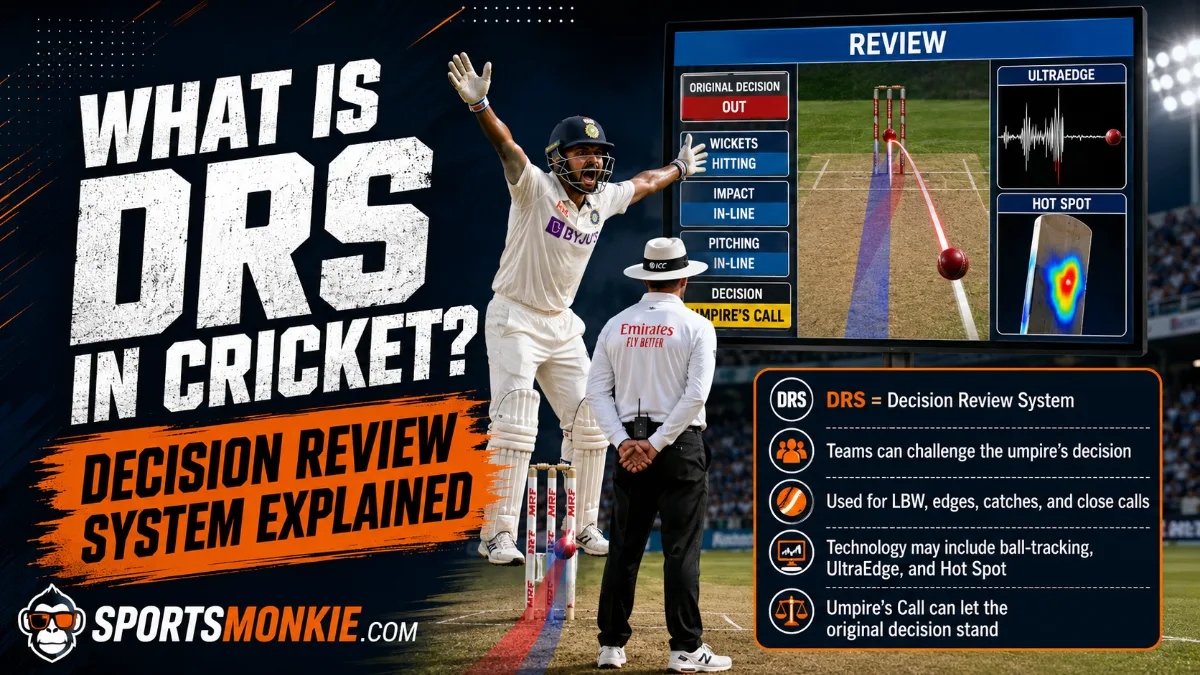
DRS is the Decision Review System: a mechanism that lets the batting or bowling side challenge an on-field umpire’s decision, with a third umpire ruling on it using ball-tracking, edge detection, and heat imaging. Teams get three unsuccessful reviews per innings in Tests and two in white-ball cricket, as of 2026, and must signal a “T” within 15 seconds.
Umpires get most decisions right, but cricket is fast and the margins are tiny. DRS gives teams a way to challenge the calls they believe are wrong, backed by technology that sees what the human eye cannot.
What DRS is
DRS stands for Decision Review System. When a team disagrees with an on-field umpire’s decision, a player can signal for a review, usually by making a “T” shape with their arms, within a few seconds. A third umpire then studies replays and technology to decide whether the original call should stand or be overturned.
Either side can use it: the bowling team can challenge a not-out, and the batting team can challenge an out.
The technology behind it
DRS is not one gadget but a set of tools, each answering a different question:
| Tool | What it checks |
|---|---|
| Ball-tracking (Hawk-Eye) | Predicts the ball’s path for LBW decisions |
| UltraEdge / Snicko | Detects fine edges off the bat via sound and vision |
| Hot Spot | Uses heat imaging to show where the ball made contact |
Together they can reveal a faint edge, confirm whether a catch carried, or show whether an LBW ball was hitting the stumps.
How many reviews teams get
As of 2026, each side gets three unsuccessful reviews per innings in Tests and two in ODIs and T20Is. The Test allowance rose from two to three during the COVID-era shift to neutral-umpire-free cricket and was retained; the old rule that reset reviews after 80 overs has been scrapped.
Reviews are kept or lost on a simple rule:
- Challenge succeeds (decision overturned): the team keeps its review.
- Result is umpire’s call: the team keeps its review.
- Challenge clearly fails: the team loses one review.
That is why teams guard their reviews carefully and try to use them only when a fielder or batter is genuinely confident.
Umpire’s call
The most debated part of DRS is umpire’s call. On marginal LBW decisions, where ball-tracking shows the ball only just clipping the stumps, the on-field umpire’s original decision is upheld. So the same borderline ball can be given out or not out depending on what the umpire decided first.
The threshold is specific: at least 50% of the ball must be predicted to hit the stumps for the on-field call to be overturned. Since 2021 the wicket zone has covered the full stumps, from the base to the top of the bails, which slightly widened the range of deliveries that produce a conclusive verdict.
The rationale is that Hawk-Eye is a prediction, not a measurement. It extrapolates the ball’s path after impact from the frames before it, and that extrapolation carries a margin of error of a few millimetres. Umpire’s call is the ICC conceding that where the margin swallows the answer, a human judgement is no worse than a computed guess. Fans hate it, and the logic is sound.
The review request itself
A review must be signalled within 15 seconds of the umpire’s decision, by the batter at the crease or the fielding captain making a “T” shape with their arms. The time limit is doing more work than it seems: it exists to stop players stalling while a teammate checks the dressing-room television. Umpires are told to reject late requests, and captains have lost reviews to hesitation.
The third umpire follows a fixed order for LBW reviews: check the delivery was legal, check for a bat edge, then run ball-tracking. Each step can end the review on its own.
Why it matters
DRS has not removed controversy, but it has cut down the clear howlers that used to swing matches. It gives players a fair chance to correct an obvious mistake while the limited reviews stop the game from becoming an endless series of challenges. For close LBWs and faint edges especially, it has become part of the fabric of the modern game.
Frequently asked questions
What is DRS in cricket?+
DRS stands for Decision Review System. It lets the batting or bowling side challenge an on-field umpire's decision, using technology such as ball-tracking, edge detection, and heat imaging to check whether the original call was correct. A third umpire makes the final ruling.
How many reviews does each team get?+
As of 2026, teams get three unsuccessful reviews per innings in Tests and two in ODIs and T20Is. A team keeps its review if the challenge succeeds or if the result is umpire's call, and loses one only when the review clearly fails. Test reviews no longer reset at 80 overs.
What technology does DRS use?+
DRS combines several tools: ball-tracking (often called Hawk-Eye) to predict the ball's path for LBW, an edge detector like UltraEdge or Snicko to catch fine edges via synchronised audio, and Hot Spot infrared imaging on some broadcasts to show contact points on bat or pad.
How long do you have to review a decision in cricket?+
Fifteen seconds from the umpire's decision. A player signals by making a 'T' shape with their arms, and the request must come from the batter at the crease or the fielding captain. Umpires are instructed to refuse late requests, which stops teams consulting the dressing room.
Why does umpire's call exist in DRS?+
Because ball-tracking has its own margin of error. When less than 50% of the ball is predicted to hit the stumps, the system cannot claim certainty, so the on-field umpire's judgement stands. It preserves the umpire's authority precisely where technology is least reliable.
Is DRS used in every cricket match?+
No. DRS requires expensive broadcast infrastructure, so it appears in international cricket and major franchise leagues but rarely in domestic or club cricket. Even at international level, coverage varies: some series run without Hot Spot, relying on ball-tracking and edge detection alone.
Sources
Play & tools
Free browser games and tools — no account, no download.
- Play today's Sports Connections — Today's Sports Connections — daily hints, answers, and play the grid.
- Play Guess the NFL Player — A new mystery NFL player every day. Eight guesses, with a clue on each — plus free unlimited mode.
- Explore all our games →
Related cricket guides
View all →
What Is DRS in F1? Drag Reduction System Explained
DRS opened a flap in an F1 rear wing to cut drag and aid overtakes. It was dropped for 2026, replaced by active aero and Override Mode. See how it works.
What Is LBW in Cricket? Leg Before Wicket Explained
LBW means the ball would have hit the stumps but struck the pad first. Here are the exact conditions umpires check and how DRS decides close calls.

What Is a DRS Train in F1? Why a Queue Cancels the Advantage
A DRS train is a line of F1 cars each within one second of the next, so every car opens DRS at once and nobody gains — the passing aid neutralises itself.
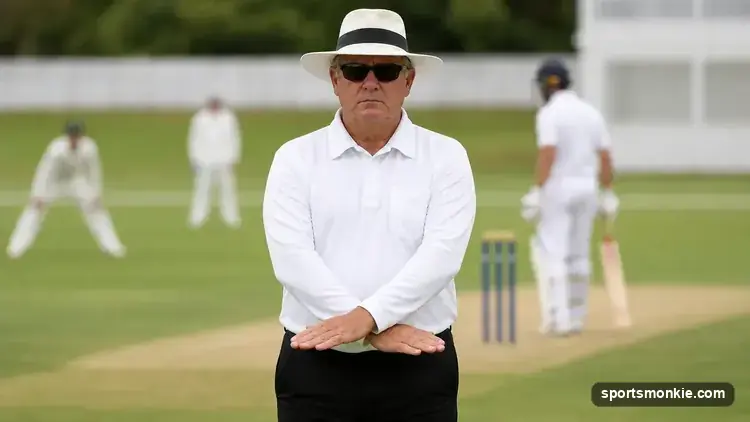
What Is a Dead Ball in Cricket? Rule and Common Situations
A dead ball is a delivery from which no runs score and no batter is out. Learn when the ball goes dead, who decides, and why it matters in a tight finish.
DLS Method in Cricket Explained: How Rain Targets Are Set
The Duckworth-Lewis-Stern (DLS) method resets targets in rain-hit limited-overs cricket using overs and wickets left. Here's the logic, with examples.
The Impact Player Rule in Cricket, Explained
The Impact Player rule lets a T20 team swap in one substitute mid-match to bat or bowl. Popularised by the IPL, here is how it works and when subs enter.