
The Impact Player Rule in Cricket, Explained
On this page5
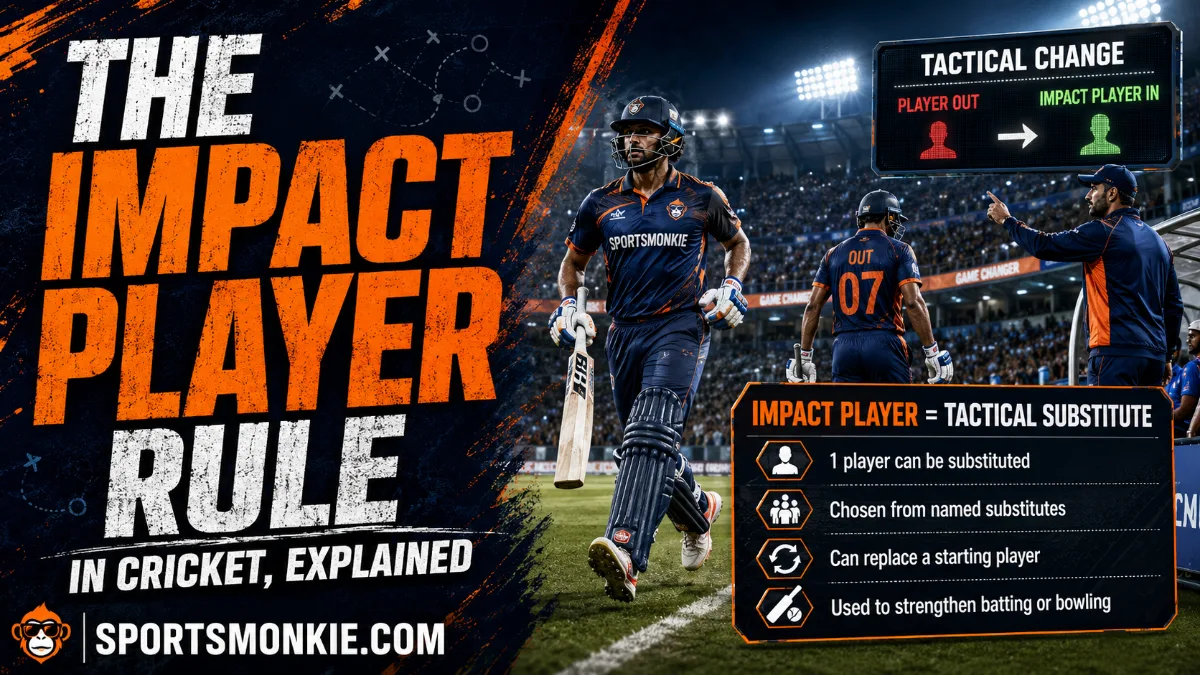
The Impact Player rule lets a T20 team substitute one player mid-match for a replacement who can bat, bowl, and field a full role. Teams name four candidates at the toss and must make the swap by the end of the 14th over of an innings. The IPL introduced it in 2023, and it is not used in international cricket.
For most of cricket’s history, the eleven who started a match were the eleven who finished it, and a substitute could only field. This broke that convention, and it has reshaped how sides pick and use their squads.
What the rule allows
The Impact Player is a substitute who can play a full role. Before the toss, each team names its eleven plus up to four possible substitutes. During the match, a team can bring one of those substitutes on as the Impact Player, and the player they replace takes no further part in the game.
The crucial difference from a normal substitute is that the Impact Player can bat, bowl, and field, not just field. That turns the swap into a genuine tactical weapon rather than a like-for-like cover.
When a team can bring one on
The Impact Player can be introduced at set moments in an innings:
- At the fall of a wicket
- At the end of an over
- When a batter retires
The deadline is the end of the 14th over of an innings, so it cannot be saved indefinitely. Once used, that is the team’s one change for the match, and the replaced player takes no further part.
Where the rule applies
The Impact Player is an IPL rule, not a cricket law. It sits in the BCCI’s playing conditions rather than the ICC’s, which means:
| Competition | Impact Player in use? |
|---|---|
| IPL | Yes, since 2023 |
| Syed Mushtaq Ali Trophy (India domestic) | Yes, trialled from 2022-23 |
| T20 World Cup and international T20Is | No |
| Big Bash League | No (uses its own X-Factor concept previously) |
That split matters. A player can spend an IPL season in a system built around twelve-man cricket, then walk into a World Cup where the rule does not exist and the balance of the eleven suddenly means everything again.
How teams use it
The rule effectively lets a side play a batter and a bowler in the same slot across the two innings:
| Scenario | Common use |
|---|---|
| Batting first | Bring on an extra batter to boost the total |
| Bowling second | Swap in an extra bowler to defend it |
| Chasing | Add batting depth to go after a big target |
Because a team can bat deep and still field a full bowling attack, totals in leagues using the rule have tended to climb, and the batting order carries less risk.
The debate
The criticism is sharper than a general grumble about tradition, and it comes from inside the game. Rohit Sharma and Ravichandran Ashwin have both argued publicly that the rule is killing the Indian all-rounder. The logic holds up: if you can substitute a specialist bowler in after your innings, you never need the player who bats at seven and bowls four overs. That player is exactly who India has historically struggled to produce and now has less reason to develop, and the national team feels it at World Cups where the rule does not exist.
Supporters point to the entertainment and the extra strategic layer, and to young specialists getting game time they would not otherwise get. The scoring evidence backs the entertainment claim: totals have climbed since 2023, and 250 has stopped being a shock.
As of 2026 the rule remains in place for the IPL, with the BCCI retaining it despite the criticism. The unresolved question is whether a domestic league should be allowed to shape player development in a direction the international game does not reward.
Frequently asked questions
What is the Impact Player rule in cricket?+
The Impact Player rule lets a T20 team bring on one substitute during a match to replace a player, who then takes no further part. Unlike a normal substitute, the Impact Player can bat, bowl, and field a full role. The IPL introduced it from the 2023 season.
When can a team use its Impact Player?+
A team names up to four substitutes at the toss and can introduce one at the fall of a wicket, at the end of an over, or when a batter retires. The substitution must be made by the end of the 14th over of an innings, so it cannot be held back indefinitely.
Can the Impact Player bat and bowl?+
Yes, and that is the whole point. An ordinary substitute may only field. An Impact Player takes a full playing role, so a team can effectively field twelve players across a match: an extra batter when batting, an extra bowler when defending.
Is the Impact Player rule used outside the IPL?+
Rarely. It is not part of the ICC's playing conditions, so it does not apply in international T20 cricket including World Cups. The IPL is its main home, and the BCCI trialled it in the domestic Syed Mushtaq Ali Trophy first, in 2022-23.
Why do critics dislike the Impact Player rule?+
Because it devalues the all-rounder. If a team can substitute in a specialist bowler after batting, it no longer needs a player who does both, which narrows the pathway for genuine all-rounders into international cricket. Rohit Sharma and Ravichandran Ashwin have both criticised it publicly.
Has the Impact Player rule increased T20 scores?+
Yes. Batting sides can attack from the start knowing a specialist replacement adds depth behind them, and IPL totals have climbed noticeably since 2023, with 250-plus scores becoming routine rather than remarkable. The rule shifted the risk calculation for top-order batters.
Sources
Play & tools
Free browser games and tools — no account, no download.
- Play today's Sports Connections — Today's Sports Connections — daily hints, answers, and play the grid.
- Play Guess the NFL Player — A new mystery NFL player every day. Eight guesses, with a clue on each — plus free unlimited mode.
- Explore all our games →
Related cricket guides
View all →
What Is a Dead Ball in Cricket? Rule and Common Situations
A dead ball is a delivery from which no runs score and no batter is out. Learn when the ball goes dead, who decides, and why it matters in a tight finish.
DLS Method in Cricket Explained: How Rain Targets Are Set
The Duckworth-Lewis-Stern (DLS) method resets targets in rain-hit limited-overs cricket using overs and wickets left. Here's the logic, with examples.
What Is a Nightwatchman in Cricket?
A nightwatchman is a lower-order batter sent in late to shield a specialist from tricky conditions. See why teams use one and when the tactic pays off.

Most Popular Cricket Tournaments in the World (2026 Rankings)
The IPL is cricket's most popular tournament in 2026, valued at $18.5 billion with 1B+ combined viewers. See how the ICC World Cup, T20 World Cup, BBL, PSL, and 6 more rank.

Richest Cricketers in the World: Who Tops the List?
The richest cricketers ranked by 2026 net worth, with the endorsement deals, IPL salaries, and business stakes that put Tendulkar, Dhoni, and Kohli on top.
Is PSL Bigger Than IPL? Comparing the Two T20 Leagues
The IPL is far larger than the PSL in viewership, revenue, and player salaries, though the Pakistan Super League has grown fast since its 2016 launch.