
What Is a Nightwatchman in Cricket?
On this page5
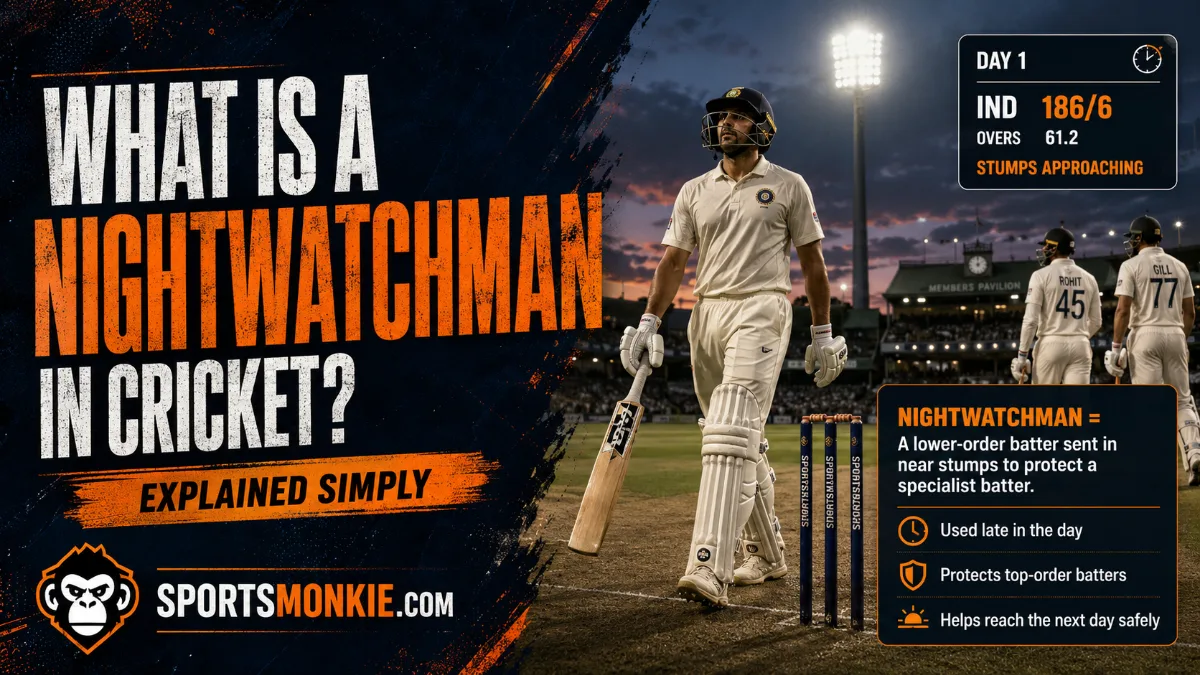
A nightwatchman is a lower-order batter, usually a bowler, promoted out of turn to bat in the closing overs of a day’s Test cricket. The point is to shield a specialist batter from the hardest conditions of the day and let them start fresh the next morning. It exists only in red-ball cricket, and it is falling out of fashion.
The last half hour of a day’s play is a nasty time to bat. The light is going, the bowlers are pushing for one more wicket before stumps, and a batter’s concentration has been stretched for hours.
The basic idea
A nightwatchman is a lower-order batter sent in out of turn, usually a bowler, to bat in the closing overs of a day. If a wicket falls late, instead of sending in the next specialist batter, the captain promotes a tail-ender to see out the remaining time.
The reasoning is basic economics. A frontline batter is worth a lot of runs, so you would rather not expose them to the toughest conditions of the day when there is little to gain. A tail-ender is worth fewer runs, so it hurts less if they get out.
Why late in the day is so hard
Several things make the end of a day’s play the worst time to arrive at the crease:
- Fading light makes the ball harder to pick up.
- Tired eyes and feet slow a fresh batter’s reactions.
- Bowlers are motivated to grab a wicket before the break.
Send your best batter in there and they might fall cheaply after all that effort. Send a nightwatchman and your star can walk out fresh the next morning, when batting is easier.
When it works, and when it backfires
| Outcome | What happens |
|---|---|
| Nightwatchman survives to stumps | Top batter is protected — tactic succeeds |
| Nightwatchman gets out quickly | You may lose two wickets in a session instead of one |
| Nightwatchman digs in next day | A bonus: some go on to score valuable runs |
The tactic is not universally loved. Critics argue that a nightwatchman can simply hand the bowling side an extra wicket, and that a set specialist might have survived anyway.
When it went spectacularly right
Jason Gillespie holds the answer to the trivia question. Sent in as nightwatchman against Bangladesh at Chattogram in April 2006, the Australian fast bowler batted through the next day and the one after, finishing on 201 not out. It remains the only double hundred by a nightwatchman in Test history, and Australia declared with him still there.
The detail that makes it better: it was the last Test innings Gillespie ever played. He was dropped afterwards and never picked again, retiring with a Test batting average boosted permanently by one absurd week.
Other nightwatchmen have made the tactic pay without going that far. Alex Tudor was left stranded on 99 not out for England against New Zealand at Edgbaston in 1999 when the winning runs came, denied a century by his own team’s victory. Tony Mann made 105 for Australia against India in 1977, the first nightwatchman Test hundred.
Why teams are dropping it
The tactic has quietly declined. England under Brendon McCullum has largely stopped using it, and the reasoning is straightforward: a nightwatchman who fails costs you two wickets in the session instead of one, and a top-order batter has better technique to survive the same overs. The arithmetic that justified the tactic assumed the tail-ender’s wicket was nearly worthless, which is less true now that lower orders bat better than they did.
Australia has stuck with it more consistently, and the split is less about evidence than temperament. The nightwatchman is a red-ball gamble: risk a cheap wicket now to keep a valuable one safe for tomorrow. It belongs to Test and first-class cricket, where days end and begin again, not to the non-stop world of T20.
Frequently asked questions
What is a nightwatchman in cricket?+
A nightwatchman is a lower-order batter promoted up the order to bat in the final overs of a day's play in a Test match. The idea is to protect a more valuable top-order batter from facing bowling in fading light or tiring conditions late in the day.
Why send in a nightwatchman instead of a specialist batter?+
Batting is hardest at the end of a day, when the light is poor and batters are tired. By sending in a lower-order player who is worth fewer runs, the team risks losing a less important wicket and keeps a top batter fresh to start the next morning.
Is the nightwatchman tactic used in T20 or ODIs?+
No. The nightwatchman is a red-ball tactic, used almost only in Test cricket and first-class matches where play spans several days. Limited-overs formats have no overnight break, so there is no fading-light window to protect anyone from.
What is the highest score by a nightwatchman?+
Jason Gillespie's 201 not out for Australia against Bangladesh at Chattogram in April 2006 is the only double century by a nightwatchman in Test cricket. It was also the last Test innings of his career, which makes it one of the sport's strangest sign-offs.
When is a nightwatchman sent in?+
Usually when a wicket falls in roughly the last half hour to 45 minutes of a day's play. There is no law defining it, so the call is the captain's judgement, weighing the overs remaining, the light, and how well the bowlers are currently operating.
Do all teams use nightwatchmen?+
No, and it has fallen out of favour. England under Brendon McCullum has largely abandoned it, arguing a set batter is better equipped than a tail-ender and that the tactic can cost two wickets rather than one. Australia has historically used it more consistently.
Sources
Play & tools
Free browser games and tools — no account, no download.
- Play today's Sports Connections — Today's Sports Connections — daily hints, answers, and play the grid.
- Play Guess the NFL Player — A new mystery NFL player every day. Eight guesses, with a clue on each — plus free unlimited mode.
- Explore all our games →
Related cricket guides
View all →
Types of Cricket Formats: From Slowest to Fastest
Cricket formats run from multi-day Tests to the explosive 10-over Hundred. This guide ranks every format from slowest to fastest and how they differ.
C.K. Nayudu: India's First Test Cricket Captain
C.K. Nayudu captained India in its first Test in 1932 and became the first cricketer to win the Padma Bhushan. Meet the tiger of Indian cricket.
The Impact Player Rule in Cricket, Explained
The Impact Player rule lets a T20 team swap in one substitute mid-match to bat or bowl. Popularised by the IPL, here is how it works and when subs enter.

Best Spin Bowlers in Current Cricket: Top Active Spinners Ranked
The best active spin bowlers in cricket right now, ranked across Tests and white-ball — from Rashid Khan's two-format No. 1 to Nathan Lyon's 560-plus Test wickets.

Best Spin Bowlers in Cricket History: All-Time Greats
Test cricket's 13 greatest spin bowlers ranked, from Muralitharan and Warne to Lyon and Ashwin — with wickets, signature deliveries, and what sets each apart.

Most Successful Cricket Teams in History: The All-Time Rankings
Every major cricket nation ranked by ICC titles: Australia's 10 trophies, the West Indies dynasty, India's seven, and South Africa's 2025 WTC breakthrough.