
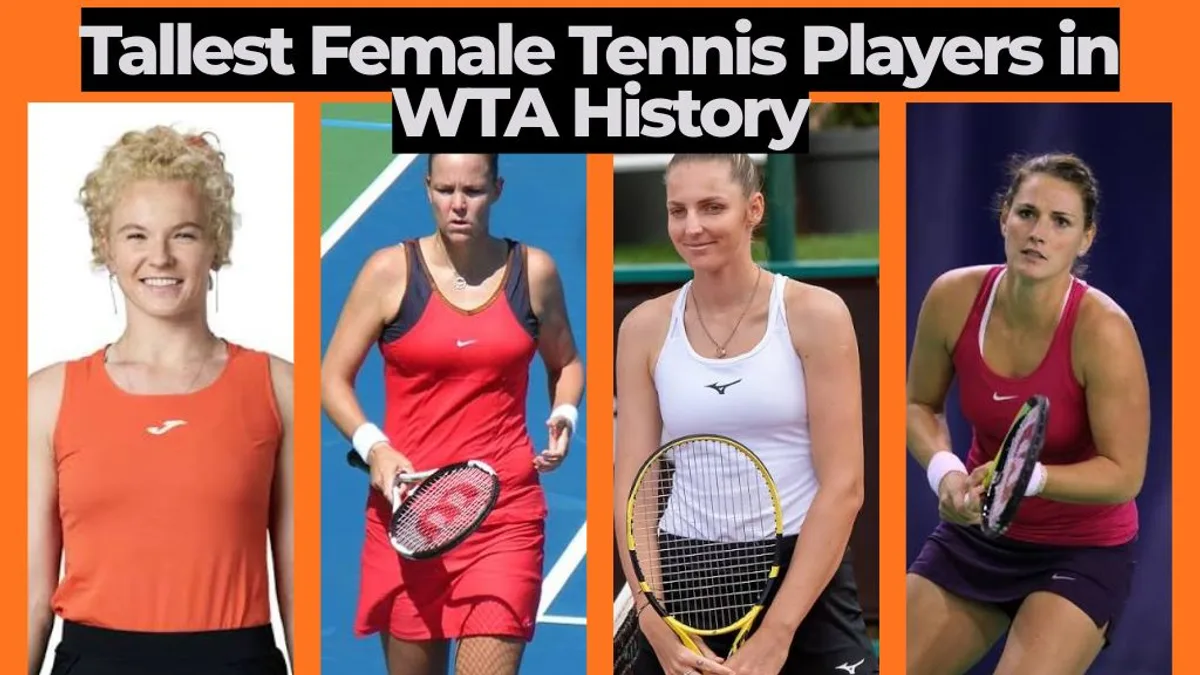
Tallest Female Tennis Players: WTA Heights in 2026
On this page14
- 01The tallest WTA players at a glance
- 02Akgul Amanmuradova
- 03Eva Hrdinova
- 04Lindsay Davenport
- 05Maria Sharapova
- 06Karolina Pliskova
- 07Venus Williams
- 08Elena Rybakina
- 09How we ranked this list
- 10Why height is a serving weapon
- 11Where height stops helping
- 12Shorter champions who beat the tall
- 13Current WTA player height lookup
- 14Tallest active players to watch
Placement here is set by one thing only: verified standing height from WTA and tour profiles, tallest first. Titles and rankings don't move a player up or down the order; they're context for what each player did with the extra reach. Where two players share a height, the one with the higher singles peak is listed first.
The tallest WTA players at a glance
| Rank | Player | Height | Career peak |
|---|---|---|---|
| 1 | Akgul Amanmuradova | 6'3" (1.91 m) | No. 50 singles |
| 2 | Eva Hrdinova | 6'3" (1.91 m) | No. 168 singles |
| 3 | Lindsay Davenport | 6'2½" (189 cm) | World No. 1; three majors |
| 4 | Maria Sharapova | 6'2" (188 cm) | World No. 1; five majors |
| 5 | Karolina Pliskova | 6'1" (186 cm) | World No. 1 |
| 6 | Venus Williams | 6'1" (185 cm) | World No. 1; seven majors |
| 7 | Elena Rybakina | 6'0" (184 cm) | World No. 2; two majors |
- Joint record-holder
Akgul Amanmuradova
At 6'3" (1.91 m), Amanmuradova of Uzbekistan is the tallest woman ever to compete on the WTA Tour, tied with Eva Hrdinova. She ranks first over Hrdinova because she went deeper into the pro game: a career-high singles ranking of No. 50 in May 2008 and No. 36 in doubles, where her reach at the net paid off with two WTA doubles titles.
Her serve was the obvious weapon, but the same frame that generated free points made low, wide balls a chore to chase. That trade-off, big serve against slower direction changes, defines almost every player on this list.
Height: 6'3" (1.91 m) · Country: Uzbekistan · Peak: No. 50 singles, No. 36 doubles · Note: 2 WTA doubles titles
- Joint record-holder
Eva Hrdinova
Hrdinova of the Czech Republic matches Amanmuradova at exactly 6'3" (1.91 m), making the two of them the tallest players in WTA history. She sits just behind because her career lived mostly on the ITF Women's Circuit, where she collected 19 doubles titles; her WTA-level singles ranking peaked around No. 168.
She's the clearest case on this list of height alone not translating to tour results. Leverage handed her a heavy serve, but without the movement and shot tolerance the top tier demands, the extra inches never carried her into the WTA's main draws with any regularity.
Height: 6'3" (1.91 m) · Country: Czech Republic · Peak: ~No. 168 singles · Note: 19 ITF doubles titles
- Tallest world No. 1
Lindsay Davenport
Davenport, at 6'2½" (189 cm), is the tallest player ever to reach world No. 1 and the tallest woman on this list to win majors. She took the 1998 US Open, 1999 Wimbledon, and 2000 Australian Open, and logged 55 tour titles across 98 weeks at No. 1.
Unlike the record-holders above her, she turned height into a full game: a flat, heavy ball struck early that rushed opponents off the baseline. She overpowered rivals rather than out-ran them, and it worked for the better part of a decade. See more of her peers on our list of the greatest female tennis players of all time.
Height: 6'2½" (189 cm) · Country: USA · Peak: World No. 1 · Defining feat: 3 Grand Slam singles titles
- Five-time major champion
Maria Sharapova
Sharapova, listed at 6'2" (188 cm), sits one notch below Davenport on height and matched her as a former No. 1. Her five Grand Slam singles titles span all four majors, a career Grand Slam completed at the 2012 French Open on the clay her height supposedly made hardest.
That range is what separates her from the taller Davenport, whose majors all came on faster surfaces. Sharapova paired a high-kicking serve with relentless baseline aggression and competed at the top until her 2020 retirement.
Height: 6'2" (188 cm) · Country: Russia · Peak: World No. 1 · Defining feat: Career Grand Slam, 5 majors
- Former No. 1, serve specialist
Karolina Pliskova
Pliskova, 6'1" (186 cm), is the third-tallest woman to reach world No. 1, which she did in July 2017. Her game is built around one of the biggest serves in the modern women's game, the shot that carried her to the 2016 US Open and 2021 Wimbledon finals.
She ranks above the equally-listed Venus Williams here on the strength of that No. 1 ranking. After ankle surgery cost her most of 2025, Pliskova returned to competition in 2026 and remains the tallest former No. 1 still active.
Height: 6'1" (186 cm) · Country: Czech Republic · Peak: World No. 1 · Defining feat: 2 Grand Slam finals
- Seven-time major champion
Venus Williams
Venus Williams stands 6'1" (185 cm) and is the most decorated tall player in the sport's history, with seven Grand Slam singles titles and 49 weeks at No. 1. Five of those majors came at Wimbledon, where her serve and reach translated best on grass.
Listed a centimeter under Pliskova, she's ranked just behind on height alone; by results she's clearly ahead. Her career also outlasted nearly everyone on this list, still competing into her mid-40s.
Height: 6'1" (185 cm) · Country: USA · Peak: World No. 1 · Defining feat: 7 Grand Slam singles titles
- Two-time major champion
Elena Rybakina
Rybakina, 6'0" (184 cm), is the tallest of the current front-runners and the clearest proof that height and movement now travel together. She won 2022 Wimbledon, added the 2025 WTA Finals, and beat world No. 1 Aryna Sabalenka to take the 2026 Australian Open, rising to a career-high No. 2.
She rounds out the list because she's an inch shorter than the 6'1" players above her, not because she's done less recently. Her serve reaches speeds few can return, yet she defends the baseline well enough to hold No. 2 behind Sabalenka through mid-2026.
Height: 6'0" (184 cm) · Country: Kazakhstan · Peak: World No. 2 · Defining feat: 2 majors + 2025 WTA Finals
Reader interaction
Build your ranking
Drag the names into the order you think is right — or use the arrows — then submit to see how your list compares with everyone else's.
- Akgul Amanmuradova
- Eva Hrdinova
- Lindsay Davenport
- Maria Sharapova
- Karolina Pliskova
- Venus Williams
- Elena Rybakina
Audience ranking
How everyone ranked them
Built from reader rankings using position-based points.
The ranked cards above list the tallest women in WTA history by verified height. This section explains how the order was set and, just as importantly, where the height advantage stops paying off.
How we ranked this list
Every placement comes from standing height as reported on WTA and tour player profiles, tallest to shortest. We did not weight titles, prize money, or peak ranking into the order itself, a 6’3” player who never cracked the top 100 still outranks a 6’0” major champion here, because the list answers “who is tallest,” not “who is best.”
Two caveats worth knowing. First, tennis heights are self-reported and drift a centimeter or two between sources, so near-ties (Pliskova at 186 cm, Venus at 185 cm) are close enough that different databases occasionally flip them. Second, when heights are identical we break the tie by singles career-high ranking, which is why Amanmuradova edges Hrdinova despite the same 6’3” listing.
Why height is a serving weapon
On serve, a taller player contacts the ball higher and steeper. Given the dimensions of a tennis court, that raised contact point opens up service-box targets a shorter server physically can’t reach at the same angle. The returner gets less reaction time, and the server generates pace from leverage instead of a bigger swing, which is easier to repeat under pressure.
That is why the biggest serves in the women’s game cluster among its tallest players. Reach also helps at the net, on overheads, and when stretching up to a high-kicking second serve. The advantage is easiest to see alongside the fastest serves recorded in tennis, although technique and placement still matter more than height alone.
Where height stops helping
The same long levers slow a player down on the shots that decide baseline rallies: low balls, wide balls, and sudden changes of direction. A taller frame has a higher center of gravity and more limb to reorganize, so getting down to a skidding ball and recovering costs more time.
That is the recurring trade in these cards. Amanmuradova and Hrdinova served big but couldn’t convert reach into deep tour runs; Davenport, Sharapova, and Rybakina succeeded because they moved well enough to protect the baseline while keeping the serve. Height is a tool, not a verdict.
Shorter champions who beat the tall
The counter-evidence is overwhelming. Justine Henin (5’5”) and Arantxa Sanchez Vicario (5’6”) reached No. 1 and won multiple majors on footwork and tactics. Much of that edge traces to shot-making fundamentals, including how players grip the racket, which let smaller players redirect pace and defend the wide ball.
Serena Williams, a tour-average 5’9”, won 23 Grand Slam singles titles, more than any single player on this height list. Monica Seles (5’10”) showed groundstroke power alone can dismantle taller, harder-serving opponents. Raw height correlates with a big serve, not with trophies.
Current WTA player height lookup
Current WTA profiles answer many of the individual height searches that lead readers to this page. The measurements below use the tour’s own listings rather than fan databases.
| Player | WTA-listed height | Why readers search her |
|---|---|---|
| Elena Rybakina | 6’0” (1.84 m) | One of the tallest current major champions |
| Aryna Sabalenka | 5’11” (1.82 m) | Current No. 1 and powerful server |
| Amanda Anisimova | 5’11” (1.80 m) | Tall top-10 baseline player |
| Alexandra Eala | 5’9” (1.75 m) | Rising 2026 top-20 player from the Philippines |
The centimetre figures explain why two players may both appear as 5’11” in a profile while still differing by two centimetres. Rounded imperial conversions are useful for quick comparisons, but the metric listing is the better tie-breaker.
Tallest active players to watch
Beyond the ranked names still competing (Pliskova and Rybakina), the current tour is full of tall power players. Aryna Sabalenka anchors the top spot with a serve-first game despite being just under the 6’0” cutoff for this list.
| Active player | Height | Country | Best result |
|---|---|---|---|
| Elena Rybakina | 6’0” (184 cm) | Kazakhstan | 2 majors, No. 2 |
| Aryna Sabalenka | 5’11” (182 cm) | Belarus | World No. 1, 4 majors |
| Karolina Pliskova | 6’1” (186 cm) | Czech Republic | Former No. 1 |
| Alycia Parks | 6’1” (185 cm) | USA | WTA titlist |
| Ashlyn Krueger | 6’1” (185 cm) | USA | WTA titlist |
| Beatriz Haddad Maia | 6’1” (185 cm) | Brazil | Major semifinalist |
| Rebeka Masarova | ~6’1” (186 cm) | Switzerland | Top-100 |
Each leans on serve speed and reach, the classic tall-player advantages, but every one of them still has to move and construct points to turn size into results.
Frequently asked questions
Who is the tallest female tennis player in WTA history?+
Akgul Amanmuradova of Uzbekistan and Eva Hrdinova of the Czech Republic tie as the tallest women ever to play the WTA Tour, both listed at 6'3" (1.91 m). Amanmuradova went the furthest of the two, reaching No. 50 in singles and No. 36 in doubles. Hrdinova played mostly on the lower-tier ITF circuit. Neither won a Grand Slam singles title.
Who is the tallest WTA world No. 1 ever?+
Lindsay Davenport is the tallest player to reach world No. 1, standing 6'2½" (189 cm). She held the top ranking for 98 weeks across eight spells between 1998 and 2006. Maria Sharapova (6'2"/188 cm) and Karolina Pliskova (6'1"/186 cm) are the next-tallest players to top the rankings. All three leaned on a dominant serve, the shot height helps most.
Who is the tallest active female tennis player in 2026?+
Karolina Pliskova (6'1"/186 cm) is the tallest former No. 1 still competing after her 2026 return from ankle surgery. Rebeka Masarova is around 1.86 m, and the 6'1" trio of Alycia Parks, Ashlyn Krueger, and Beatriz Haddad Maia are among the tallest on tour. Elena Rybakina (6'0") is the tallest player currently ranked in the top five.
Does height help female tennis players?+
Height helps most on serve. A taller player contacts the ball higher and creates a steeper angle into the box, giving the returner less time and reducing the need to swing harder for pace. It also extends reach at the net and on overheads. The trade-off shows on low, wide balls that reward quicker footwork and a lower center of gravity, where shorter players often have the edge.
What is the average height of a professional female tennis player?+
The average height on the WTA Tour is roughly 5'8" to 5'9" (173–175 cm). The spread is wide, from compact baseliners under 5'6" to servers above 6'0". The tour has trended slightly taller over the past two decades as the baseline power game has grown more dominant, though several recent major champions sit right around the tour average.
How tall are Serena and Venus Williams?+
Venus Williams stands 6'1" (185 cm) and won seven Grand Slam singles titles, using her reach and serve to great effect. Serena Williams is 5'9" (175 cm), about tour-average, yet won 23 Grand Slam singles titles, the most in the Open Era. Only Venus makes this height ranking, a reminder that the taller sister was not the more decorated one.
Can shorter players still win Grand Slams?+
Yes, and regularly. Justine Henin (5'5") and Arantxa Sanchez Vicario (5'6") both reached world No. 1 and won multiple majors through footwork, court craft, and shot variety. Serena Williams won 23 majors at 5'9". Height is a genuine edge on serve and reach, but timing, movement, and competitive temperament decide most matches at the elite level.
Sources
Play & tools
Free browser games and tools — no account, no download.
- Play today's Sports Connections — Today's Sports Connections — daily hints, answers, and play the grid.
- Play Guess the NFL Player — A new mystery NFL player every day. Eight guesses, with a clue on each — plus free unlimited mode.
- Explore all our games →
Related tennis guides
View all →
Greatest Female Tennis Players of All Time: The Definitive List
Serena Williams, Steffi Graf, Martina Navratilova and Margaret Court ranked by majors, weeks at No. 1, and dominance — the women's tennis GOAT case settled.
Highest-Paid Female Tennis Players: Pay Explained
Highest-paid female tennis players: prize money vs endorsements, the Grand Slam equal-pay history, where pay is still not equal, and the career money leaders.
Greatest Tennis Players of All Time (Men's)
A ranked look at the greatest men's tennis players ever, from the Big Three of Djokovic, Nadal and Federer to Laver, Sampras and Borg, updated for 2026.
Why Do Tennis Players Change Ends?
Tennis players change ends to keep conditions fair when sun, wind, court wear and other environmental factors affect play.
10 Best Tennis Drills for Beginners to Learn Fast
The best tennis drills for beginners start with mini-tennis inside the service boxes, then add drop-feed rallies, target cones, and wall drills. Here are 10 drills ranked by what they build.
9 Best Tennis Footwork Drills to Move Faster and Hit Cleaner (Ranked)
Nine tennis footwork drills ranked by what they fix: split-step reaction, lateral coverage, explosive change of direction, and recovery. Move faster, hit cleaner.