
Plyometric Exercises for Volleyball: 8 Court-Specific Drills That Transfer

On this page6
The best plyometric exercises for volleyball mirror the sport’s actual jumps — a running approach for hitting, a quick standing jump for blocking, and lateral cuts for digging and defense — not a generic vertical-jump program borrowed from basketball. Training the right pattern, not just any jump, is what makes power show up on the court.
This guide covers 8 volleyball-specific plyometric exercises with the cues coaches use, a twice-weekly programming plan, and the mistakes that quietly cap most players’ progress. For the approach mechanics, strength base, and full 8-week plan these drills fit into, see how to jump higher for volleyball, plus the pillar guide on how to jump higher and the broader plyometric exercises for vertical jump.
Why volleyball needs sport-specific plyometrics
A vertical jump test is a single, flat-footed effort — volleyball almost never asks for that. An attacker builds momentum through a 3- or 4-step approach and converts horizontal speed into lift. A blocker jumps from a near-standstill, often twice in a row to reset at the net. A defender explodes sideways before jumping to dig or cover. Each is a different force-production pattern, and training only one leaves real gains on the table.
Plyometrics work by training the stretch-shortening cycle — the rapid stretch-then-contract action in the legs when you dip and immediately explode upward. Volleyball-specific plyometrics train that cycle under the conditions the sport actually creates: approach momentum, repeated standing efforts, and lateral loading.
8 volleyball-specific plyometric exercises
1. Approach-jump reps
The single highest-transfer drill for attackers, since it trains the exact movement used to hit.
- Start 3-4 steps back, using your normal hitting footwork (right-left-right for a right-handed hitter).
- Drive through the last two steps to convert speed into lift — plant hard and swing both arms up together.
- Jump for max height as if attacking, and land balanced on both feet with soft knees.
- Rest 30-45 seconds. Do 5-6 reps, 2-3 sets.
Cue: the last two steps should feel fast, not a slow walk-up — approach speed is what converts to height.
2. Standing block jumps (double effort)
Trains the no-approach, repeated-jump pattern blockers need.
- Stand at the net, feet shoulder-width, knees slightly bent.
- Dip quickly (shallow, not a deep squat) and explode up, hands reaching over the net line.
- Land and immediately reset for a second jump within 1-2 seconds, simulating a block-and-reblock.
- Do 4-6 double-jump reps per set, 2-3 sets.
Cue: keep the dip shallow — blockers don’t have time to load deep, so a quick, small dip mirrors game speed.
3. Depth jumps (box drop jumps)
A reactive-power drill: step off a box and minimize ground contact before jumping again.
- Stand on a stable 12-18 inch box (lower if new to this drill).
- Step off — don’t jump off — and land on both feet.
- The instant your feet touch down, explode upward into a max-height jump.
- Do 4-5 reps per set, 2-3 sets, with full rest between sets.
Cue: ground contact should be as short as possible — think “hot pavement.”
4. Lateral bound to vertical jump
Builds the sideways-explode-then-jump pattern used in defense and transition.
- From standing, bound sideways off one leg, landing on the opposite leg with a stable, athletic bend.
- Immediately explode into a max-height vertical jump from that landing leg.
- Alternate direction each rep. Do 6-8 total reps (3-4 per side), 2-3 sets.
Cue: stick the lateral landing before jumping — a wobbly landing bleeds power and adds injury risk.
5. Tuck jumps
A high-rep rhythm builder. Jump straight up driving both knees toward your chest, and land softly, absorbing through the ankles, knees, and hips. Do 8-10 reps, 2-3 sets. Cue: land quietly — a loud landing caps the next rep’s output.
6. Squat jumps
A foundational, lower-intensity plyometric for the base under the drills above. Explode up from a quarter- to half-squat, arms swinging overhead, and land softly back into the same squat position. Do 6-8 reps, 2-3 sets. Cue: land into the same depth, not locked-out knees.
7. Single-leg bounds
Trains unilateral power and stability, addressing imbalances a two-legged program can hide. Push off one leg, land on the same leg, and immediately rebound into the next bound. Do 5-6 bounds per leg, 2 sets. Cue: advanced — build a base with double-leg jumps first.
8. Broad jump to vertical jump
Trains converting horizontal power into vertical lift, similar to an approach. Jump forward for max distance, land on both feet, and instantly explode into a max vertical jump. Do 4-5 reps, 2-3 sets. Cue: minimize the pause — the transfer comes from that quick transition.
Common mistakes and how to fix them
- Skipping the approach pattern. Training only standing jumps misses the sport’s most common jump. Fix: include an approach-based drill every session.
- Landing loud and stiff-legged. A hard, flat landing signals poor force absorption and raises injury risk. Fix: cue a soft landing through bent ankles, knees, and hips every rep.
- Training on fatigued legs. Jumping after a full practice produces sloppy mechanics and blunts the power benefit. Fix: place plyometric work early, right after the warm-up.
- Too much volume, too soon. Jumping is high-impact; daily depth jumps or high rep counts invite overuse injury. Fix: cap it at 2 sessions a week, 48 hours apart.
- Ignoring lateral and reactive patterns. Straight-up jumps alone miss the sideways loading defense demands. Fix: rotate in lateral bounds and depth jumps alongside vertical drills.
Simple 2-day-a-week programming plan
Run this alongside regular practice, not as a replacement for skill work:
- Day 1 (early week): Squat jumps (2×8), approach-jump reps (3×5), standing block jumps (3×4 doubles), tuck jumps (2×10).
- Day 2 (later week, 48+ hours later): Depth jumps (3×4), lateral bound to vertical jump (2×4/side), broad jump to vertical jump (3×4), single-leg bounds (2×5/side, once a solid base is built).
Hold volume steady for 2 weeks before adding a set or rep, and track a standing vertical or approach-jump reach test every 3-4 weeks to see whether it’s working. This pairs well with the strength and technique work in how to jump higher and plyometric exercises for vertical jump.
Safety notes before you start
Warm up with 5-10 minutes of dynamic movement (leg swings, lunges, light skipping) before any session, and prioritize clean landing mechanics over jump height. Add volume and intensity gradually — a sudden spike in jump-training load is a leading cause of overuse injury in volleyball players. This article is educational, not individualized coaching; beginners, younger athletes, and anyone managing an injury or medical condition should check with a qualified coach, athletic trainer, or physician before starting.
The bottom line
Volleyball-specific plyometrics — approach jumps, block jumps, depth jumps, and lateral bounds — build the exact power patterns the sport uses, which is why they out-transfer a generic vertical-jump program. Layer 2 focused sessions a week onto your regular practice, prioritize clean landings over raw volume, and give it 6-8 weeks before judging results.
Frequently asked questions
What plyometric exercises are best for volleyball players?+
Approach-jump drills, standing block jumps, depth jumps, and lateral bounds are the highest-transfer plyometrics for volleyball because they mimic the sport's actual jump patterns — a running approach for attacking and a quick, repeated standing jump for blocking. General vertical-jump moves like box jumps and squat jumps still help but should be paired with these court-specific drills.
How often should volleyball players do plyometric training?+
Two sessions per week is the standard prescription during in-season and pre-season training, with at least 48 hours between sessions for the nervous system and connective tissue to recover. Doing jump-specific plyometrics on back-to-back days, especially alongside full practices and matches, raises injury risk without adding extra benefit.
Do plyometrics actually increase volleyball vertical jump?+
Yes — plyometrics train the stretch-shortening cycle, the rapid load-and-release action in the legs that produces explosive force, which is the main limiting factor in jump height once an athlete already has a reasonable strength base. Studies on youth and collegiate volleyball players consistently show measurable vertical-jump gains after 6 to 8 weeks of structured plyometric programs.
What is the best plyometric exercise for a block jump?+
Standing repeated tuck jumps and lateral bound-to-block-jump drills transfer best, since a block is a standing, no-approach jump often performed twice in quick succession to reset for a second attempt. Training the quick double-jump pattern directly builds the specific power blockers need more than a single-effort exercise does.
Can beginners do volleyball plyometrics?+
Beginners can do plyometrics but should start with lower-intensity, double-leg options like squat jumps and step-off approach jumps before progressing to depth jumps or single-leg work. Building a base of basic strength and landing mechanics first reduces injury risk and makes the higher-intensity drills more productive later.
How long before volleyball plyometrics improve my jump?+
Most athletes see measurable vertical-jump gains within 6 to 8 weeks of consistent, twice-weekly plyometric training, with some technique-driven improvement showing up even sooner. Progress depends on training age, consistency, and how well plyometrics are paired with a strength-training base.
What's the difference between plyometrics for volleyball and for other jumping sports?+
Volleyball plyometrics emphasize a running approach jump (like an attack) and rapid, repeated standing jumps (like blocking), plus lateral movement, because those are the sport's actual jump patterns. A basketball or track athlete trains more single-effort, straight-vertical jumps, so a volleyball program borrows the same base exercises but weights approach and reactive drills more heavily.
Should I do plyometrics before or after volleyball practice?+
Plyometrics are best done early in a session, right after a dynamic warm-up and before hitting or scrimmage drills, while the legs are fresh and fast-twitch output is highest. Doing high-intensity jump training on already-fatigued legs at the end of practice increases injury risk and produces sloppier, lower-quality reps.
Sources
Play & tools
Free browser games and tools — no account, no download.
- Play today's Sports Connections — Today's Sports Connections — daily hints, answers, and play the grid.
- Play Guess the NFL Player — A new mystery NFL player every day. Eight guesses, with a clue on each — plus free unlimited mode.
- Explore all our games →
Related guides

How to Jump Higher for Volleyball: Approach, Plyo & Strength
To jump higher for volleyball, fix your approach mechanics first, then add twice-weekly plyometrics and heavy lower-body strength. Here is the exact approach-jump technique, drills, and 8-week plan.

10 Best Plyometric Exercises for Tennis (Court-Speed Power)
The best plyometric exercises for tennis train the explosive, side-to-side power you actually use on court: lateral bounds, split-step reactions, and rotational med-ball throws. Here are 10 tennis-specific plyos, ranked by court payoff.
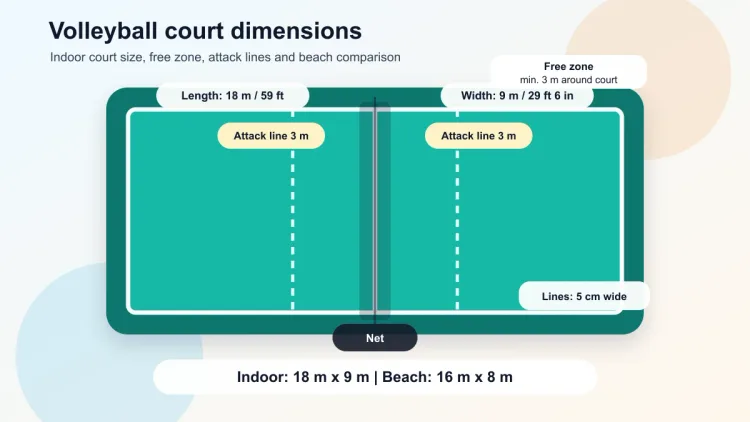
Volleyball Court Dimensions and Space Needed
Official volleyball court dimensions: indoor court size, beach court size, attack line, service zone, free zone, net height and backyard setup.
Breaststroke Kick Technique: Whip Kick, Faults & Drills
Master the breaststroke kick with a step-by-step whip kick sequence, ankle flexion cues, whip vs frog kick differences, and fixes for the most common faults.

9 Plyometric Exercises for Baseball (Power + Arm Health)
The best plyometric exercises for baseball train rotational power and elastic arm strength: med-ball rotational throws, lateral bounds, and depth drops that build bat speed and protect the throwing arm.

9 Plyometric Exercises for Explosive Power (Ranked by Payoff)
The best plyometric exercises for explosive power are ground-contact moves like the depth jump, broad jump, and medicine-ball slam that train your muscles to fire fast. Here are 9, ranked by how much power they build.