
Passer Rating vs QBR: What's the Difference?

On this page5
Passer rating and QBR both try to grade quarterbacks in one number, but they are built on completely different philosophies. Passer rating is the traditional, passing-only formula that runs from 0 to a perfect 158.3 — you can compute it from any box score. ESPN’s Total QBR is a proprietary metric on a 0-to-100 scale that folds in rushing and sacks, adjusts for the opponent, and weights each play by how much it actually mattered to the game. One is a transparent formula; the other is a fuller, context-aware estimate you have to look up.
Knowing which is which keeps you from comparing them as if they were the same thing. A 110 passer rating and a 70 QBR are both good — they just sit on different scales measuring different things.
The core difference at a glance
| Passer rating | Total QBR | |
|---|---|---|
| Scale | 0 to 158.3 | 0 to 100 (50 = average) |
| Source | Public NFL formula | Proprietary to ESPN |
| Inputs | Completions, yards, TDs, INTs, attempts | All of that plus rushing, sacks, penalties |
| Situation-adjusted? | No — every attempt equal | Yes — weighted by leverage |
| Opponent-adjusted? | No | Yes |
| Can you compute it? | Yes, from a box score | No |
How passer rating works
Passer rating takes four components — completion percentage, yards per attempt, touchdown rate, and interception rate — caps each between 0 and 2.375, adds them, divides by six, and multiplies by 100. That is the whole thing. Its virtues are transparency and simplicity: anyone with a stat line can reproduce it, and it has decades of history behind it.
Its weaknesses follow from what it ignores. Rushing does not count, so a quarterback who gains 60 yards on the ground gets nothing for it. Sacks do not count. Game situation does not count, so a 40-yard completion when trailing by 30 helps the rating exactly as much as a game-tying score. For the full breakdown of the math, see how passer rating is calculated.
How QBR works
Total QBR was ESPN’s attempt to fix those blind spots. Rather than a fixed box-score formula, it is built on play-by-play data and expected points added — the value each play created relative to expectation. From there it does three things passer rating never does:
- Includes rushing and sacks. Scrambles, designed runs, rushing touchdowns, and sacks taken all count toward the quarterback’s number.
- Adjusts for opponent. Production against a top defense is worth more than the same line against a weak one.
- Weights by leverage (“clutch” weighting). A third-down conversion in a one-score game counts more than a completion in a blowout. Low-leverage stat-padding is discounted.
QBR also tries to split credit — a receiver breaking a short pass for 70 yards does not fully accrue to the quarterback. The trade-off is transparency: because the inputs are proprietary and the model is complex, you cannot reproduce QBR yourself, and reasonable people can argue with how it assigns credit.
When they disagree — and why that is useful
The interesting cases are when the two numbers split. A pocket passer who racks up yards in garbage time can post a gaudy passer rating while QBR shrugs, because that production barely moved the win probability. A mobile quarterback who runs for three first downs and takes no sacks can grade far higher in QBR than his passing-only rating suggests. The gap is not a bug — it tells you how a quarterback produced, not just how much.
The practical rule: use passer rating when you want a quick, transparent, historically comparable read on the passing line. Use QBR when you want a fuller estimate of total contribution that accounts for legs, sacks, and situation.
Which should you trust?
For most fan conversations, read them together. If both are high, the case is settled. If they diverge, dig into why — it usually reveals something real about the quarterback’s game, like heavy garbage-time volume or rushing value the old formula misses.
For the wider analytics that power QBR under the hood, see our explainer on EPA in football, and for the team-level efficiency metric built on similar ideas, DVOA in football. To see which quarterbacks turn these numbers into contracts, the highest-paid NFL players is a who’s-who of the position.
And if you want quarterback value working in your fantasy roster rather than just on a leaderboard, our fantasy football trade calculator weighs total production so a trade holds up on output.
Bottom line: passer rating is the transparent, passing-only 0–158.3 formula; QBR is the proprietary, situation-adjusted 0–100 metric that adds rushing and sacks. Read both, and pay attention when they disagree.
Frequently asked questions
Which is better, passer rating or QBR?+
Neither is strictly better; they answer different questions. Passer rating is a transparent, passing-only formula anyone can compute. QBR is a broader, opponent- and situation-adjusted estimate of a quarterback's total contribution, including rushing and sacks. QBR captures more but is proprietary and less transparent.
Why do passer rating and QBR sometimes disagree sharply?+
Because they weight things differently. A quarterback who piles up yards in a blowout can post a huge passer rating while QBR discounts that low-leverage production. A mobile quarterback who runs for key first downs can rate higher in QBR than in passing-only passer rating.
What scale does each use?+
Passer rating runs from 0 to a perfect 158.3, set by the formula's four capped components. QBR runs from 0 to 100, where 50 is meant to represent an average NFL quarterback. The different ceilings are one reason the two numbers are not directly comparable.
Does QBR include rushing and sacks?+
Yes. That is one of its central differences from passer rating. QBR credits rushing yards and rushing touchdowns and charges the quarterback for sacks, since ESPN treats those as part of the quarterback's job. Passer rating ignores all three.
What is 'clutch weighting' in QBR?+
QBR weights plays by their leverage — how much they affected the outcome. A third-down conversion in a tight game counts more than a meaningless completion in garbage time. Passer rating has no such weighting; every attempt counts equally regardless of score or situation.
Can I calculate QBR myself?+
Not fully. ESPN's Total QBR uses proprietary play-by-play inputs, including expected points added and a division of credit among the quarterback, receivers, and blockers. You can compute passer rating from a box score in a minute; QBR you have to look up.
Sources
Play & tools
Free browser games and tools — no account, no download.
- Play 17-0 — Draft nine and chase a flawless NFL regular season — the perfect 17-0 run, no playoffs.
- Play 20-0 — Draft nine and chase a perfect NFL season — regular season and playoffs, undefeated.
- Play 16-0 — Draft nine and chase a perfect 16-0 — the classic 16-game NFL regular season, no playoffs.
- Play Flawless Six — Draft five players and a head coach, then chase a perfect NFL season with the right chemistry.
- Play Guess the NFL Player — A new mystery NFL player every day. Eight guesses, with a clue on each — plus free unlimited mode.
- Play NFL Wordle — A Wordle for football — guess the daily NFL player in eight tries, with green-amber-grey feedback on every clue.
- Play NFL Connections — Sort sixteen football tiles into four hidden groups of four. A new daily puzzle, four mistakes allowed, plus unlimited mode.
- Explore all our games →
- Open the schedule simulator — Pick every 2026 NFL game and watch the standings and playoff seeds update live.
- Open the squares generator — Generate a randomized, printable Super Bowl squares grid for your party — free, no sign-up.
- Open the trade calculator — Weigh any fantasy football trade instantly — clear winner and value gap.
- Run the NFL predictor — Simulate the NFL bracket and see who your picks send to the Super Bowl.
- Open the passer rating calculator — Calculate the official NFL passer rating (0–158.3) from any passing line, with the formula shown.
- Explore all our free sports tools →
Related nfl guides
View all →
How Is Passer Rating Calculated? The NFL Formula
NFL passer rating comes from four capped components — completion %, yards, TDs, and INTs per attempt. Here is the full formula and a worked example.
What Is DVOA in Football? Defense-Adjusted Value Explained
DVOA measures a team's success per play against a league baseline, adjusted for opponent, where 0% is average. Here is what it means and how to read it.

Cam Ward Laughs Off Viral 'Three Minutes' Video From Titans Press Conference
Cam Ward was caught on the Titans' own livestream giving reporters three minutes to arrive, then laughed it off Wednesday and said the talk beats talk of an 0-4 start.

Michigan's Zack Marshall Apologizes for Leaked Texts Criticizing Coordinator Jason Beck
Michigan tight end Zack Marshall apologized after group-chat texts criticizing offensive coordinator Jason Beck and the Wolverines' scheme leaked online.
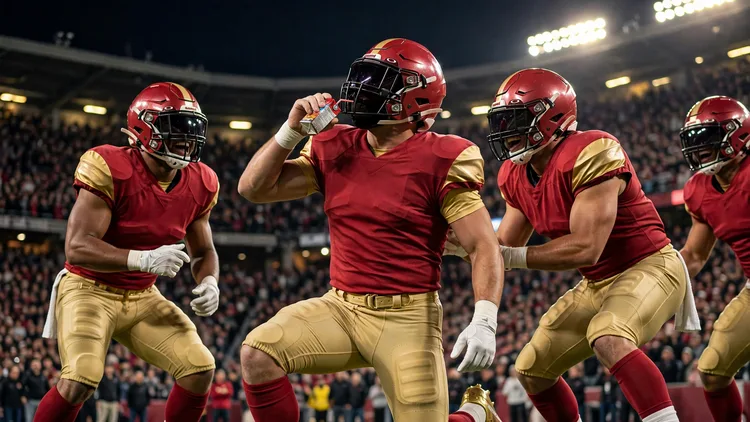
NFL Rescinds Juszczyk's $14,926 Juice-Box Fine and Allows Drinking Celebrations
The NFL has rescinded Kyle Juszczyk's $14,926 fine, accepted his juice-box explanation, and said drinking celebrations will no longer be disciplined.

Stephen A. Smith Walks Back Lane Johnson Comments After First Take Mental-Health Row
Stephen A. Smith mocked Lane Johnson's mid-season retirement on First Take, was challenged on his own panel, and spent Wednesday clarifying he was attacking the Eagles' chaos, not mental health.