
How Is Passer Rating Calculated? The NFL Formula
On this page5
NFL passer rating is calculated from four separate components, each based on a quarterback’s passing per attempt, then blended into a single number that runs from 0 to a perfect 158.3. The four pieces are completion percentage, yards per attempt, touchdown rate, and interception rate. Each is capped so no single category can run away with the score, and the caps are exactly why the maximum lands on the strange-looking figure of 158.3 rather than a tidy 100.
It is a passing-only stat — no rushing, no sacks — which keeps the formula simple but leaves real blind spots. Here is the full calculation, step by step.
The four components
Each component is computed, then forced to stay between 0 and 2.375. If a raw value comes out above 2.375, it is set to 2.375; if it comes out below 0, it is set to 0.
- a (completion percentage): ((COMP ÷ ATT) − 0.3) × 5
- b (yards per attempt): ((YDS ÷ ATT) − 3) × 0.25
- c (touchdown rate): (TD ÷ ATT) × 20
- d (interception rate): 2.375 − ((INT ÷ ATT) × 25)
Then combine them:
Passer rating = ((a + b + c + d) ÷ 6) × 100
The interception component runs backward — it starts at 2.375 and subtracts — because fewer interceptions should score higher. When all four components hit their 2.375 cap, the sum is 9.5, and 9.5 ÷ 6 × 100 = 158.33, the perfect rating.
A worked example
Take a quarterback with a strong season: 350 completions on 500 attempts, 4,000 yards, 35 touchdowns, 10 interceptions.
- a: ((350 ÷ 500) − 0.3) × 5 = (0.70 − 0.3) × 5 = 2.000
- b: ((4000 ÷ 500) − 3) × 0.25 = (8.0 − 3) × 0.25 = 1.250
- c: (35 ÷ 500) × 20 = 0.07 × 20 = 1.400
- d: 2.375 − ((10 ÷ 500) × 25) = 2.375 − 0.50 = 1.875
Sum: 2.000 + 1.250 + 1.400 + 1.875 = 6.525 Rating: (6.525 ÷ 6) × 100 = 108.8
None of the four components maxed out, yet the rating is still excellent. That shows how demanding the caps are — a perfect 158.3 requires elite marks in all four at once, not just one gaudy category.
What each component demands at the cap
| Component | Value needed to hit the 2.375 cap |
|---|---|
| Completion percentage | 77.5% or higher |
| Yards per attempt | 12.5 or higher |
| Touchdown rate | 11.875% of attempts |
| Interception rate | 0.0% (no interceptions) |
Those thresholds are why perfect games are rare and perfect seasons essentially impossible. Averaging 12.5 yards per attempt across a year has never been done; the ceiling is built to stay just out of reach over a full sample.
What counts as a good passer rating
Rule changes protecting receivers and passers have inflated ratings over the decades, so the bar has moved.
| Passer rating | Rating |
|---|---|
| 110 and up | Excellent, MVP-level season |
| 100 to 109 | Very good |
| 90 to 99 | Roughly league average |
| 80 to 89 | Below average |
| Below 80 | Poor for a modern starter |
A single-game 158.3 happens a handful of times most seasons. Over a full year, ratings above 120 sit at the outer edge of what the game has produced.
Why passer rating matters, and where it falls short
Passer rating endures because it is easy to compute from a box score and it rewards the right things — accuracy, yardage, touchdowns, and avoiding turnovers. But its blind spots are real. It ignores rushing entirely, so a mobile quarterback who gains 500 yards on the ground gets no credit. It ignores sacks, ignores game situation, and treats a garbage-time touchdown the same as a game-winner.
Those gaps are exactly what ESPN’s Total QBR was designed to close. For the full comparison, read passer rating vs QBR, and for the broader play-value approach, our explainer on EPA in football. To see quarterback production translated into money, the highest-paid NFL players is dominated by the passers who post these numbers.
If you want to put quarterback value to work in a lineup, our fantasy football trade calculator folds passing production into its valuations so a trade is judged on output, not name recognition.
In short: passer rating averages four capped components — completion, yards, touchdowns, and interceptions per attempt — times 100 over six, topping out at 158.3, with roughly 90 as today’s average and 110-plus excellent.
Frequently asked questions
What is a perfect passer rating?+
A perfect NFL passer rating is 158.3. To reach it a quarterback must complete at least 77.5 percent of passes, average at least 12.5 yards per attempt, throw a touchdown on at least 11.875 percent of attempts, and throw zero interceptions. All four components max out at their 2.375 cap.
Why is the maximum 158.3 instead of 100?+
Because of the math. Each of the four components is capped at 2.375, so the best possible sum is 9.5. Divide by six and multiply by 100 and you get 158.33. The odd ceiling is a byproduct of the formula's scaling, not a round number anyone chose.
Can passer rating be zero?+
Yes. If all four components hit their floor of 0 — a very low completion rate, negative or tiny yardage, no touchdowns, and a high interception rate — the rating bottoms out at 0.0. It happens in games with multiple picks and almost no production.
Does passer rating include rushing or sacks?+
No. Passer rating is built only from passing attempts, completions, yards, touchdowns, and interceptions. A quarterback's rushing yards, rushing touchdowns, and sacks taken have no effect on it, which is one of the stat's main blind spots.
What is a good passer rating in the modern NFL?+
Rules favoring the passing game have pushed averages up. A rating around 90 is now roughly league average for a starter, 100-plus is good, and 110 or higher over a season is excellent. The best single seasons have topped 120, near the outer edge of what is sustainable.
Is passer rating the same as QBR?+
No. Passer rating is the traditional box-score formula that runs 0 to 158.3. ESPN's Total QBR is a separate metric on a 0 to 100 scale that adds rushing, sacks, and situational context. They measure related things but are not interchangeable.
Sources
Play & tools
Free browser games and tools — no account, no download.
- Play 17-0 — Draft nine and chase a flawless NFL regular season — the perfect 17-0 run, no playoffs.
- Play 20-0 — Draft nine and chase a perfect NFL season — regular season and playoffs, undefeated.
- Play 16-0 — Draft nine and chase a perfect 16-0 — the classic 16-game NFL regular season, no playoffs.
- Play Flawless Six — Draft five players and a head coach, then chase a perfect NFL season with the right chemistry.
- Play Guess the NFL Player — A new mystery NFL player every day. Eight guesses, with a clue on each — plus free unlimited mode.
- Play NFL Wordle — A Wordle for football — guess the daily NFL player in eight tries, with green-amber-grey feedback on every clue.
- Play NFL Connections — Sort sixteen football tiles into four hidden groups of four. A new daily puzzle, four mistakes allowed, plus unlimited mode.
- Explore all our games →
- Open the schedule simulator — Pick every 2026 NFL game and watch the standings and playoff seeds update live.
- Open the squares generator — Generate a randomized, printable Super Bowl squares grid for your party — free, no sign-up.
- Open the trade calculator — Weigh any fantasy football trade instantly — clear winner and value gap.
- Run the NFL predictor — Simulate the NFL bracket and see who your picks send to the Super Bowl.
- Open the passer rating calculator — Calculate the official NFL passer rating (0–158.3) from any passing line, with the formula shown.
- Explore all our free sports tools →
Related nfl guides
View all →
Passer Rating vs QBR: What's the Difference?
Passer rating is the traditional 0–158.3 box-score formula; ESPN's QBR is a 0–100 situation-adjusted metric that adds rushing. Here is how they differ.
What Is DVOA in Football? Defense-Adjusted Value Explained
DVOA measures a team's success per play against a league baseline, adjusted for opponent, where 0% is average. Here is what it means and how to read it.

Cam Ward Laughs Off Viral 'Three Minutes' Video From Titans Press Conference
Cam Ward was caught on the Titans' own livestream giving reporters three minutes to arrive, then laughed it off Wednesday and said the talk beats talk of an 0-4 start.

Michigan's Zack Marshall Apologizes for Leaked Texts Criticizing Coordinator Jason Beck
Michigan tight end Zack Marshall apologized after group-chat texts criticizing offensive coordinator Jason Beck and the Wolverines' scheme leaked online.
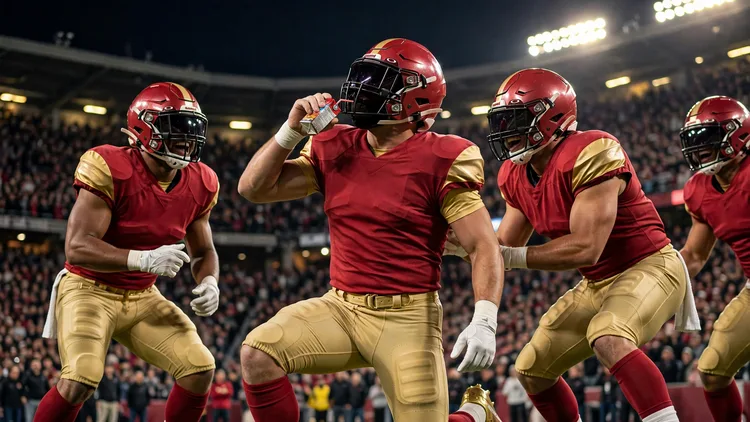
NFL Rescinds Juszczyk's $14,926 Juice-Box Fine and Allows Drinking Celebrations
The NFL has rescinded Kyle Juszczyk's $14,926 fine, accepted his juice-box explanation, and said drinking celebrations will no longer be disciplined.

Stephen A. Smith Walks Back Lane Johnson Comments After First Take Mental-Health Row
Stephen A. Smith mocked Lane Johnson's mid-season retirement on First Take, was challenged on his own panel, and spent Wednesday clarifying he was attacking the Eagles' chaos, not mental health.