
Overhead & Ceiling-Mounted Golf Launch Monitors: Worth It?

On this page6
An overhead golf launch monitor mounts to the ceiling above or behind the hitting area and tracks your ball and club from directly overhead, instead of sitting on a tripod in front of or beside you. That single change removes the risk of a shanked iron cracking a $6,000 unit, frees up your entire floor, and is why most permanent home simulator builds now spec a ceiling mount over a portable one. The tradeoff is cost, a fixed install, and a real ceiling-height requirement most buyers underestimate.
What makes an overhead unit different from a floor or tripod launch monitor
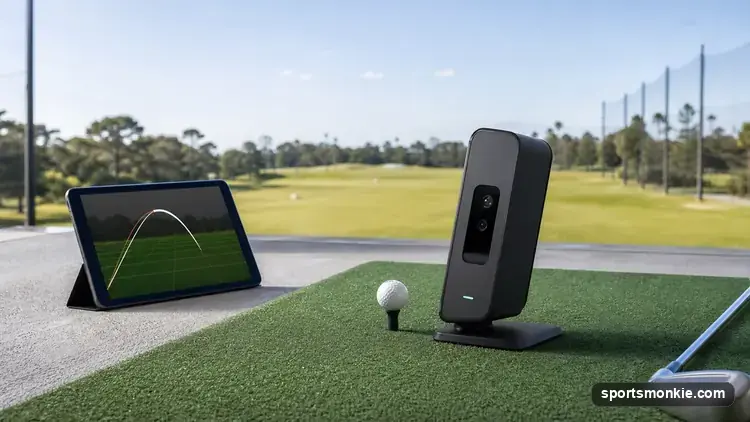
A floor or tripod launch monitor, like a SkyTrak, a Garmin R10, or a TrackMan 4, sits somewhere near your feet or just off to the side and reads the ball as it launches. It travels with you, sets up in minutes, and works outdoors. It also sits in a spot a mis-hit can reach, and it eats floor space you’d otherwise use for stance and follow-through.
A ceiling-mounted unit solves both problems by getting out of the swing path entirely. Cameras look straight down (or down and back, depending on the model) at the ball and clubhead through impact. Because nothing is bolted to the floor, both left- and right-handed golfers can hit from the same mat without moving anything, and there’s no unit to trip over walking to the tee. The cost is that once it’s up, it’s up. Relocating means tools, a ladder, and usually a repatch of drywall.
What overhead launch monitors are actually available right now
| Model | Mount type | Price tier | Ceiling height needed |
|---|---|---|---|
| Vistrak SCX IR | DIY ceiling mount | Budget (~$3,499) | 8-10 ft |
| Uneekor EYE MINI (ceiling package) | Retractable overhead | Budget/mid (~$3,000+) | 9-10 ft |
| Uneekor EYE XR | Rear-mounted ceiling | Mid (~$7,000) | 9-10 ft |
| Uneekor EYE XO | Front-mounted ceiling | Upper-mid ($8,000-$10,000) | 9-10 ft |
| TrackMan iO | Ceiling only | Premium (~$13,995) | 9’4”-10’ (9’8” ideal) |
| Uneekor EYE XO2 | Front-mounted ceiling | Premium (~$11,000) | 9-10 ft |
| Foresight Falcon | Ceiling, four-camera | Ultra-premium ($15,999) | 9.5 ft minimum |
| Foresight GCHawk | Ceiling, commercial-grade | Ultra-premium ($19,999) | 9.5-10 ft (same footprint as Falcon) |
Uneekor’s EYE XR is the odd one out worth knowing about: it mounts behind the player instead of over the front of the hitting area, which some builders prefer because it clears the swing plane of a driver on a lower ceiling more comfortably than a front-mounted unit. Foresight’s Falcon and GCHawk sit at the top of the market and are built for commercial bays and high-end residential studios as much as single-user rooms.
How much ceiling height do you actually need
This is where most buyers get caught out after the sale, not before it. Every current ceiling-mounted model needs somewhere in the 8- to 10-foot range above the hitting mat, and the number matters more than any spec sheet feature:
- TrackMan iO wants 9’4” to 10’, with 9’8” as the manufacturer’s stated ideal, and mounts 3’3” to 3’5” in front of the tee.
- Foresight Falcon needs a 9.5-foot minimum; below that, Foresight steers buyers toward a different model entirely.
- Uneekor’s EYE XO and EYE XR both need a 9-10 foot window; golfers on forums report the XO struggling below roughly 8’11” without a drop mount.
- Vistrak SCX IR is the most forgiving at 8-10 feet, per Simply Golf Simulators’ budget overhead guide, which is why it’s the default recommendation for garages and basements with standard 8-foot ceilings.
If your ceiling is under 8 feet, no current overhead unit is a clean fit. A floor or radar launch monitor is your only real option. Between 8 and 9 feet, you’re shopping the budget tier only. Above 9.5 feet, every model on the list above is on the table.
One correction worth making here, because a lot of overhead-launch-monitor pages get it wrong: TrackMan 4 is not an overhead-mountable unit. It’s a floor/tripod dual-radar system, full stop. TrackMan’s overhead product is a separate device, the TrackMan iO, built from the ground up for ceiling installs. If you see “TrackMan 4 overhead mount” mentioned anywhere, that’s not a supported configuration.
What installation actually involves
None of these units bolt straight into drywall. You’re mounting into a joist, a beam, or a purpose-built bracket, and getting that wrong with a $10,000 camera hanging over your head isn’t the place to improvise. The two approaches builders on the Golf Simulator Forum actually use:
- Drop pole or NPT ceiling plate: one plate screwed into a ceiling joist, a length of pipe or a projector drop extension, and a second plate or a 2x6 crossbar to hold the unit. This is the standard approach for finished ceilings with visible joists.
- Custom bracket or beam: for open-joist garages, unfinished basements, or converted spaces with unusually high ceilings, builders run a beam between the walls or fabricate a slotted-iron bracket, similar in concept to a garage door opener mount.
Budget $500-$1,000 for a professional installer if you’re not comfortable finding joists, working at height, or running the low-voltage cabling most units need. DIY is common and well documented for anyone handling their own studio build, but it’s not a weekend-one job. Plan the mount position before you frame the room, not after.
Who should actually buy overhead vs. a portable unit
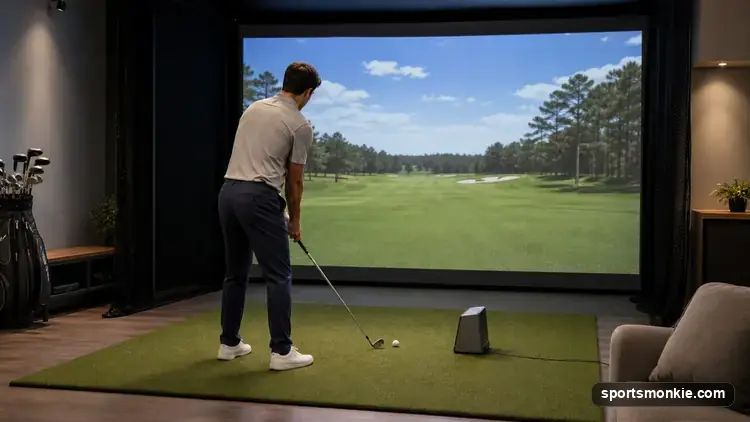
Buy overhead if you’re building a permanent, dedicated simulator room and you know that room isn’t moving. The clear floor, the fixed left/right setup, and the fact that you’ll never again reposition a tripod after a bad shot are real, daily conveniences once the room is finished. If you’ve already checked your handicap trajectory and know you’re hitting the bay four or more times a week, tracking your handicap alongside consistent swing data is exactly the use case these units are built for.
Skip it and buy portable if any of the following is true: you’re renting, you’re still deciding whether a home simulator is worth the space at all, your ceiling is under 8 feet, or you want a unit that can also come outside or to the range. A SkyTrak, Garmin R10, or Bushnell Launch Pro will get you real numbers for a fraction of the price and none of the installation risk. Plenty of golfers who eventually go overhead start on a floor unit for a year first. It’s a reasonable way to confirm the space gets used before you commit $7,000-plus to something bolted to your ceiling.
If you’re weighing this purchase against everything else in the bag, our golf hub covers the rest of the gear, handicap, and scoring questions worth sorting out before you spend simulator-studio money, including how the pros you’re chasing, like the greatest golfers of the modern era, actually use this same tracking data in their own practice.
The bottom line
Overhead and ceiling-mounted launch monitors solve two real problems that portable units simply don’t have: getting hit by your own equipment and losing floor space. That’s worth $3,000 to $20,000 depending on how serious the room is, provided you’ve measured your ceiling first and you’re not planning to move the setup in a year. If either of those isn’t true yet, a portable unit does the job for less money and zero drywall repair.
Frequently asked questions
What is an overhead golf launch monitor?+
It's a launch monitor mounted to the ceiling behind or above the hitting area instead of sitting on the floor. Cameras or infrared sensors look down and track the ball and club through impact. Uneekor's EYE XR/XO line, TrackMan iO, and the Foresight Falcon are the main examples on the market.
Is a ceiling-mounted launch monitor more accurate than a floor unit?+
Not automatically. Overhead units read the swing from directly above, which many golfers find gives cleaner short-game and putting data, but top floor radar units like a Full Swing or a well-placed floor camera system are just as accurate for full-swing numbers. The real gain is safety and a clear floor, not raw precision.
How much ceiling height do I need for an overhead launch monitor?+
Plan on 9 to 10 feet of clearance above the hitting mat for most models; TrackMan iO wants 9'4" to 10' with 9'8" as its ideal, and Foresight's Falcon needs at least 9.5 feet. A few budget units, like the Vistrak SCX IR, will work as low as 8 feet.
Can I mount a TrackMan overhead?+
Not the TrackMan 4. It's a floor/tripod dual-radar unit only. TrackMan's overhead product is a separate model, the TrackMan iO, built specifically for ceiling installs. If a listing says "TrackMan 4 overhead," that's a setup error, not a supported configuration.
What is the cheapest ceiling-mounted launch monitor?+
The Vistrak SCX IR runs around $3,499 and is the standard budget pick for DIY overhead builds. Uneekor's EYE MINI can also be run in a retractable ceiling package near that price point, though its default configuration is a floor/tripod unit.
Do I need a professional installer for a ceiling mount?+
You can DIY it with a stud finder, a drop pole or NPT ceiling plate, and basic tools, and plenty of simulator builders do. Anything over 10-12 feet, drywall-only ceilings, or a finished room you don't want to damage twice is where paying $500-$1,000 for a professional install earns its keep.
Sources
Play & tools
Free browser games and tools — no account, no download.
- Play today's Sports Connections — Today's Sports Connections — daily hints, answers, and play the grid.
- Play Guess the NFL Player — A new mystery NFL player every day. Eight guesses, with a clue on each — plus free unlimited mode.
- Explore all our games →
Related golf guides
View all →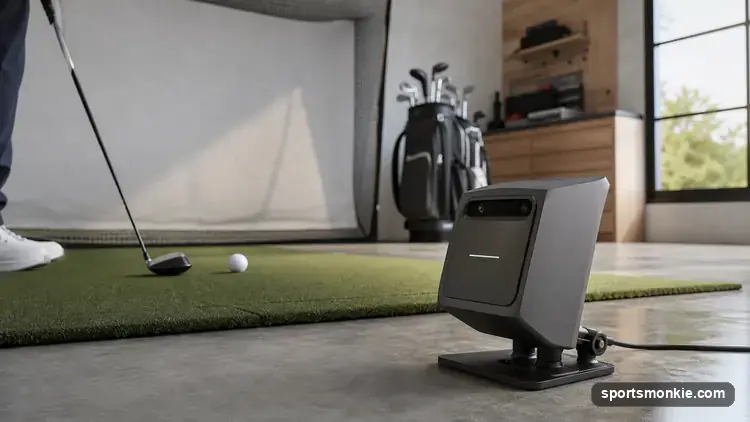
Shot Scope LM1 Review: Is It Worth It in 2026?
The Shot Scope LM1 golf launch monitor costs $199.99 and tracks 5 swing metrics with no subscription. Here's the accuracy, limits, and who should buy it.
Portable Golf Launch Monitors: What Actually Matters
What a portable golf launch monitor really measures, 2026 prices from $200 to $2,500, and which metrics are marketing fluff versus real data.

Garmin Approach R10: Is It Worth It in 2026?
The Garmin Approach R10 golf launch monitor lists at $599 and tracks 14 metrics off Doppler radar. Here's the accuracy, setup, and who should spend more.
Best Launch Monitor for a Golf Simulator (2026 Guide)
A launch monitor for a golf simulator lives or dies on software compatibility, not specs. What actually works with GSPro, E6 Connect, and your room size.
Rapsodo MLM2PRO Review: Is It Worth It in 2026?
Rapsodo MLM2PRO price, subscription cost, accuracy, and E6 Connect compatibility, tested against the Garmin R10 to answer whether it is worth buying in 2026.

Golf Ball Compression Chart by Swing Speed
A golf ball compression chart rating Pro V1, TP5, Chrome Soft, Supersoft and more from ~35 to 100, matched to the driver swing speed each ball suits.