
Shot Scope LM1 Review: Is It Worth It in 2026?

On this page6
The Shot Scope LM1 is worth it if you want honest ball speed, clubhead speed, and carry-distance numbers for $199.99 with no subscription. It is not worth it if you need spin rate, launch angle, or simulator golf, because the LM1 covers none of those. It is a radar-based unit, tracks five metrics, sets up in under a minute, and undercuts the Garmin Approach R10 and Rapsodo MLM2PRO by hundreds of dollars. Here is what it measures, how accurate it actually is, and who should spend their money elsewhere.
What does the Shot Scope LM1 actually measure?
Five things, according to Shot Scope’s own product listing: clubhead speed, ball speed, smash factor, carry distance, and total distance. That’s the entire dataset. There is no spin rate, no spin axis, no launch angle, and no shot dispersion, so the LM1 will not tell you why a shot curved, only how far it went and how fast it left the club.
Under the hood it runs a 24GHz K-band Doppler radar rather than a camera, which is why the specs sheet skips spin data entirely; radar-only units read speed and distance well but need cameras or a launch-angle sensor to calculate spin. The unit itself weighs about 300 grams, sits behind the ball roughly 4.5 feet, and shows results on a 3.5-inch color screen with no phone or app required to use it. Syncing to the free Shot Scope app is optional, and there is no subscription fee at any point, a real point of difference from both competitors below.
Setup is the other selling point. PlayBetter clocked it at under a minute from power-on to first swing, and the device stores up to 1,000 shots internally, so a full range session or two never needs a phone nearby to keep recording. Battery is rated around 5 hours per charge and refills over USB-C in about 2 hours, which comfortably covers a practice session but won’t survive a full day of lessons back to back without a top-up. Given the 300-gram weight and included carry case, it lives in a side pocket rather than needing a bag of its own, which is the tradeoff you’d expect from skipping cameras entirely.
How accurate is the Shot Scope LM1?
Good on full swings, shaky on mishits. Golf Monthly benchmarked the LM1 against a Foresight GCQuad, a tour-grade unit that costs tens of thousands of dollars, and found carry distance on 9-iron shots was never more than 3 to 4 yards off. That’s a tight tolerance for a $199.99 device.
PlayBetter’s testing backs that up with a capture rate above 90% on well-struck full shots, though clubhead speed consistently read 1 to 2 mph faster than expected, a small but consistent bias worth knowing before you compare LM1 numbers to a fitting-bay reading. Both reviewers found the same weak spot: accuracy drops on mishits, short chip shots, and anything with heavy curve, and Golf Monthly specifically noted it struggles more indoors. Trust the LM1 for driver and full-iron sessions where you’re chasing speed and carry gains. Trust it less for wedge work or diagnosing a slice.
Shot Scope LM1 vs Garmin Approach R10 vs Rapsodo MLM2PRO
The LM1 isn’t competing on features, it’s competing on price. Here’s how the three stack up on paper.
| Shot Scope LM1 | Garmin Approach R10 | Rapsodo MLM2PRO | |
|---|---|---|---|
| Price (2026) | $199.99 | $599.99 | $599.99–$699.99 |
| Sensor type | Doppler radar | Doppler radar | Dual camera + radar |
| Metrics tracked | 5 | 12+ | 15 (8 directly measured) |
| Spin rate / launch angle | No | Yes | Yes (needs RPT-marked balls) |
| Simulator play | No | Yes, via E6 Connect | Yes, via GSPro, E6 Connect, others |
| Subscription | None | Optional, $99.99/year | $199.99/year after 45-day trial |
| Weight | ~300g, pocket-sized | Under 1 lb | Tripod-mounted, less portable |
| Battery life | ~5 hours | ~10 hours | Not published |
The Garmin R10 roughly triples the LM1’s price but adds spin rate, launch angle, and access to Garmin’s E6 Connect virtual courses, which turns it into a real entry-level simulator rather than just a range tool. The Rapsodo MLM2PRO goes further still with dual cameras plus radar for 15 metrics, but it locks most of that behind a $199.99 annual membership once the 45-day trial ends, and you need Callaway or Titleist balls with Rapsodo’s RPT marking to get accurate spin readings at all.
Judged purely on cost per metric, the LM1 wins. Judged on what a serious student of their swing actually needs, spin rate and launch angle matter more than the extra $400 might suggest, which is why the R10 remains the better buy for anyone planning to use the data to actually change their swing plane or ball flight.
Who is the Shot Scope LM1 actually good for?
It fits a narrower group than the marketing suggests, but that group is real:
- Range regulars without a simulator budget who just want to know if a new driver or shaft actually adds ball speed.
- Golfers tracking distance gapping between clubs, since carry and total distance are exactly what club selection depends on.
- Beginners and mid-handicappers building basic swing-speed awareness before they’re ready to interpret spin data anyway.
- Existing Shot Scope users with one of the brand’s GPS watches, who get one connected app instead of juggling two ecosystems.
If you’re already working on a specific number, checking a handicap index after a run of practice sessions is the natural next step, since raw speed gains don’t mean anything until they show up in your actual scores.
What are the LM1’s biggest limitations?
Five things to know before buying:
- No spin, launch angle, or dispersion data. You will never see shot shape, only speed and distance.
- Accuracy drops on mishits and short shots. Chips, pitches, and heavily curved shots are the LM1’s weak spot per both Golf Monthly and PlayBetter’s testing.
- Clubhead speed reads slightly hot, roughly 1 to 2 mph above other measured devices in PlayBetter’s testing.
- No simulator or virtual-course play. It’s a data tool, not a golf game.
- One unit per customer at checkout on Shot Scope’s own site, which rules out bulk buying for a coaching studio or hitting bay.
None of that erases the value at $199.99. It just means the LM1 is a speed-and-distance tool, not a full swing analyzer, and buying it expecting the latter is where reviews turn sour. A player still working out why they keep carding a bogey instead of par has bigger fish to fry than spin axis anyway.
Is the Shot Scope LM1 worth $199 in 2026?
Yes, for the job it’s built for. The LM1 gives accurate speed and distance feedback, skips the subscription tax that both Garmin and Rapsodo charge for full features, and fits in a pocket. It’s the right buy for a golfer who wants honest numbers on the range and nothing else. It’s the wrong buy for anyone who needs spin rate, launch angle, or simulator golf at home, where the extra few hundred dollars for a Garmin R10 buys real functionality, not just a bigger screen.
Explore more gear breakdowns and the players shaping the sport in our full golf hub.
Frequently asked questions
Is the Shot Scope LM1 worth it?+
Yes, if you only want ball speed, clubhead speed, smash factor, and carry/total distance without a subscription. At $199.99 it undercuts the Garmin Approach R10 and Rapsodo MLM2PRO by hundreds of dollars. It is not worth it if you need spin rate, launch angle, dispersion, or simulator play, since the LM1 does not offer any of those.
How accurate is the Shot Scope LM1?+
Golf Monthly tested it against a Foresight GCQuad and found carry distance never more than 3 to 4 yards out on 9-iron shots. PlayBetter clocked a capture rate above 90% on full swings, though clubhead speed ran 1 to 2 mph hot and accuracy dropped on mishits, short chips, and shots with heavy curve.
Does the Shot Scope LM1 measure spin rate or launch angle?+
No. The LM1 tracks only five metrics: clubhead speed, ball speed, smash factor, carry distance, and total distance, confirmed on Shot Scope's own product listing. Spin rate, spin axis, launch angle, and shot dispersion are absent, which is the single biggest gap versus the Garmin R10 and Rapsodo MLM2PRO.
Shot Scope LM1 vs Garmin Approach R10: which should I buy?+
Buy the LM1 for pure speed and distance feedback at a third of the price. Buy the R10 if you want spin rate, launch angle, and simulator play through Garmin's E6 Connect software, since it tracks 12-plus metrics against the LM1's five for roughly $400 more.
Do I need a subscription for the Shot Scope LM1?+
No. The LM1 works standalone straight out of the box with no app, account, or fee required to see live numbers on its screen. Syncing sessions to the free Shot Scope app is optional and still carries no subscription cost, unlike the Rapsodo MLM2PRO's $199.99 annual membership.
Can the Shot Scope LM1 be used indoors?+
Yes, but with caveats. Shot Scope rates it IPX3 for weather resistance and it works in home setups and hitting bays, but reviewers at Golf Monthly and PlayBetter both flagged reduced accuracy indoors, especially on shots with significant curve, so treat indoor readings as a rough guide rather than a precise number.
Sources
Play & tools
Free browser games and tools — no account, no download.
- Play today's Sports Connections — Today's Sports Connections — daily hints, answers, and play the grid.
- Play Guess the NFL Player — A new mystery NFL player every day. Eight guesses, with a clue on each — plus free unlimited mode.
- Explore all our games →
Related golf guides
View all →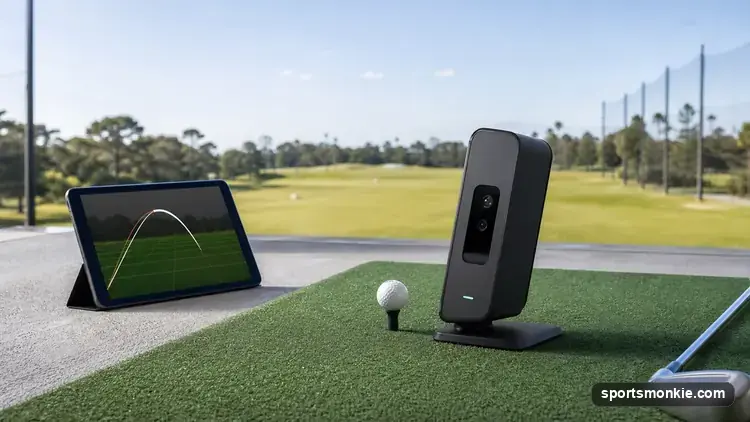
Portable Golf Launch Monitors: What Actually Matters
What a portable golf launch monitor really measures, 2026 prices from $200 to $2,500, and which metrics are marketing fluff versus real data.
Rapsodo MLM2PRO Review: Is It Worth It in 2026?
Rapsodo MLM2PRO price, subscription cost, accuracy, and E6 Connect compatibility, tested against the Garmin R10 to answer whether it is worth buying in 2026.

Garmin Approach R10: Is It Worth It in 2026?
The Garmin Approach R10 golf launch monitor lists at $599 and tracks 14 metrics off Doppler radar. Here's the accuracy, setup, and who should spend more.
Overhead & Ceiling-Mounted Golf Launch Monitors: Worth It?
Overhead golf launch monitors mount to the ceiling, safe from mis-hits. What they cost, the ceiling height needed, and who should skip it for a floor unit.
Best Launch Monitor for a Golf Simulator (2026 Guide)
A launch monitor for a golf simulator lives or dies on software compatibility, not specs. What actually works with GSPro, E6 Connect, and your room size.

Mario Lemieux's Son Austin Makes His PGA Tour Debut in Bermuda
Austin Lemieux, the 30-year-old son of Mario Lemieux, makes his PGA Tour debut in Bermuda after shooting 66, his father's famous number, in the qualifier.